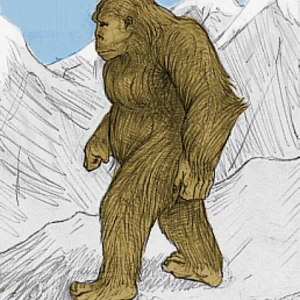

A legendary creature of the Himalayas, the Yeti is described as a large bipedal ape-like being living in the eternal snows. A central figure in Tibetan and Nepalese folklore, it has fascinated explorers and scientists since the 19th century.
Yeti
Yeti
8 min read
Frequently asked questions
Key Facts
- 1832: first written mention by B.H. Hodgson, British Resident in Nepal, describing a hairy bipedal creature
- 1921: the Everest expedition reports giant footprints in the snow, popularizing the term 'Abominable Snowman'
- 1951: photographer Eric Shipton brings back photos of mysterious tracks on Everest
- 1960: Sir Edmund Hillary leads a dedicated scientific expedition in search of the Yeti, with no conclusive results
- 2017: DNA analysis of samples presumed to be from the Yeti reveals they belong to Himalayan bears
Works & Achievements
One of the first Western works to seriously mention tracks and testimonies related to the Yeti. Waddell describes footprints found in the snow and the explanations given by local porters.
A series of photographs of footprints on the Menlung Glacier, published in the international press. Considered the most compelling visual evidence ever produced regarding the Yeti.
The report of a British expedition devoted entirely to the search for the Yeti. Though scientifically inconclusive, it helped establish the quest for the Yeti as a subject of serious investigation.
A scientific study published in Proceedings of the Royal Society B that genetically identified all biological samples attributed to the Yeti as belonging to known Himalayan bear species.
A graphic novel in which Tintin sets off to find a missing friend in the Himalayas and encounters the Yeti. This work has deeply embedded the image of the Yeti in European popular culture.
A British science-fiction horror film exploring the theme of the Yeti in the Himalayas. Reflecting the era's fascination with the creature, it helped bring the myth to a wider Western audience.
Anecdotes
In 1951, British mountaineer Eric Shipton photographed enormous footprints in the snow on Everest, measuring 33 centimetres across. The images spread around the world and reignited fascination with the Yeti. Never fully explained, these tracks remain one of the most frequently cited pieces of photographic evidence in the history of cryptozoology.
In 1954, the British newspaper the Daily Mail funded an entire expedition dedicated to searching for the Yeti in the Himalayas. The explorers brought back a purported scalp preserved in the Buddhist monastery of Khumjung, Nepal. Analysed decades later, it turned out to belong to a wild goat — but the expedition helped turn the Yeti into a global phenomenon.
The Tibetan word 'Yeti' comes from 'Yeh-Teh', literally meaning 'rocky animal'. In Sherpa and Tibetan folklore, there are actually several distinct creatures: the Meh-Teh (large snow ape), the Dzu-Teh (giant bear), and the Teh-Lma (small forest being). Westerners and the media merged these figures into a single mythical creature.
In 2017, a genetic study published in the scientific journal Proceedings of the Royal Society B analysed nine biological samples (hair, bones, teeth) attributed to the Yeti. The conclusion was unambiguous: all of them belonged to Himalayan bears (brown bear, Asian black bear). The study did not kill the myth, however, which remains deeply rooted in local cultures.
Sir Edmund Hillary, the first man to reach the summit of Everest in 1953, took part in a scientific expedition dedicated to the Yeti in 1960. After several months of investigation, he concluded that the 'evidence' put forward until then consisted of misidentifications or hoaxes. His declaration caused a stir, given that his Himalayan credentials were beyond question.
Primary Sources
Local guides reported the presence of a wild bipedal creature in the forested regions of northern Nepal, which they call 'Ban Manush' (wild man). They claim this creature is covered in long black hair and moves on two limbs.
We discovered in the snow large footprints which, according to our Tibetan porters, belonged to the 'Metoh-Kangmi', a term they translated for us as 'wild man of the snows'.
The footprints measured on the Menlung Glacier stretched over several hundred metres and displayed a morphology incompatible with that of any known bear or ape. The size and spacing of the steps suggest a large bipedal creature.
All samples attributed to anomalous primates in the Himalayas were found to correspond to known bear species. No evidence for the existence of an unknown primate species was found in our dataset.
Key Places
It was on this high-altitude glacier that Eric Shipton photographed the famous giant footprints in 1951. The site has become an essential reference point in any serious discussion about the Yeti.
This Sherpa monastery in the Everest region houses a scalp presented as belonging to a Yeti. Since the 1950s, it has become a place of pilgrimage for the curious and researchers alike.
The fifth highest mountain in the world, Makalu is one of the areas most frequently cited in accounts of Yeti encounters, owing to its remoteness and vast glaciers.
A vast high-altitude region where Yeti folklore has been deeply rooted in local culture for centuries. Tibetan nomadic communities have passed down accounts of encounters from generation to generation.
Home to the Sherpa people at the foot of Everest, this valley is the cultural heartland of the Yeti myth in Asia. Sherpa guides on Himalayan expeditions have long been the primary keepers of the legend.
Typical Objects

An iconic tool of 20th-century Himalayan expeditions, the ice axe accompanied explorers who, between ascents, searched for Yeti tracks in the snow.

A relic kept in the Buddhist monastery of Khumjung in Nepal, long presented as a Yeti scalp. Its temporary loan for scientific analysis in 1960 was a worldwide event.

Photographs of footprints — most notably those taken by Eric Shipton in 1951 — are the main documentary 'evidence' cited by researchers. The camera is the central instrument in the quest for the Yeti.

A technique used by cryptozoological expeditions to preserve casts of prints found in snow or mud. Several casts attributed to the Yeti are on display in Western museums.

A Tibetan religious painting on cloth, sometimes depicting supernatural creatures from Himalayan cosmology. Some ancient thangkas show hairy beings resembling the Yeti in a spiritual context.

Gradually produced over the 19th and 20th centuries, these maps outlined the still-unexplored regions where the Yeti was said to live, fueling the imagination of explorers and researchers alike.
School Curriculum
Vocabulary & Tags
Key Vocabulary
Daily Life
Morning
According to Tibetan and Nepali folklore, the Yeti moves across glaciers and snowy slopes at dawn, taking advantage of the early light to search for food. Sherpas claim that its tracks are often discovered in the morning by herders leading their yaks to high-altitude pastures.
Afternoon
The creature is said to retreat into caves or under rocky overhangs during the coldest or windiest hours of the day. Twentieth-century explorers frequently interpreted these natural shelters as potential Yeti lairs during their expeditions.
Evening
According to local accounts, the Yeti becomes more active after nightfall, moving silently through the transition zones between forest and snow. Nepali herders report unsettling nocturnal cries echoing through isolated valleys, traditionally attributed to the creature.
Food
Based on local testimonies compiled by explorers, the Yeti is said to be omnivorous — feeding on roots, berries, snow rodents, and occasionally small animals. Some accounts describe attacks on yak herds, which has fueled its reputation as a dangerous creature.
Clothing
As a legendary creature, the Yeti wears no clothing: it is said to be covered in thick fur, described variously as reddish, reddish-brown, or whitish, which allows it to survive the extreme temperatures of the Himalayas above 4,000 meters.
Housing
The Yeti is said to inhabit the most inaccessible areas of the Himalayas, primarily glacial caves or rocky crevices at elevations between 3,500 and 6,000 meters. These extreme-altitude zones, rarely visited before the rise of modern mountaineering expeditions, long fed the mystery surrounding its existence.
Historical Timeline
Period Vocabulary
Visual Style
Style illustration cryptozoologique mêlant esthétique des expéditions himalayennes des années 1920-1960 et iconographie bouddhiste tibétaine, dominé par des contrastes neige aveuglante et ombres profondes.
Sound Ambience
Ambiance sonore des hautes altitudes himalayennes : vents glaciaux, silence minéral des glaciers, grondements d'avalanches lointaines et échos de cloches de monastères bouddhistes.
Liens externes & ressources
Références
Œuvres
Among the Himalayas — L.A. Waddell
1899
Photographies de l'expédition Shipton — Eric Shipton
1951
Rapport de l'expédition du Daily Mail
1954
Genetic analysis of hair samples attributed to Yeti — Bryan Sykes et al.
2017
Tintin au Tibet — Hergé
1960