
A demonic half-man, half-goat creature from Germanic Alpine folklore, Krampus is the punishing companion of Saint Nicholas. While Saint Nicholas rewards well-behaved children, Krampus punishes the naughty ones by whipping them with birch branches or carrying them away in his basket.
Krampus
Krampus
8 min read
Frequently asked questions
Key Facts
- Pre-Christian origins in Germanic Alpine traditions, predating the 11th century
- Associated with the feast of Saint Nicholas (December 6) in Germanic regions
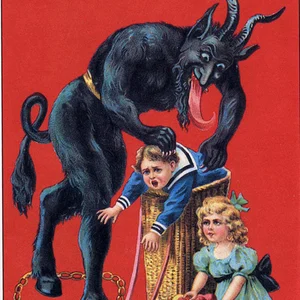
- 'Krampuskarten' (Krampus postcards) became popular in Austria and Germany in the 19th century
- The night of December 5 is known as 'Krampusnacht' in Austrian and Bavarian traditions
- The character has experienced an international cultural revival in the 21st century (films, festive events)
Works & Achievements
A series of thousands of illustrated postcards produced in Austria and Germany, depicting Krampus in humorous, frightening, or satirical scenes. These cards are now considered a valuable record of popular visual culture from the Belle Époque.
A foundational work of Germanic mythology in which Grimm catalogs the demonic winter figures from Germanic folk traditions, laying the groundwork for the scholarly study of Krampus and related beings.
A collection of carved wooden masks representing Krampus, bearing witness to Alpine artisan traditions. These masks, often painted and adorned with real animal horns, are considered major works of folk art.
An American feature film that transplants the Alpine folk figure into a contemporary American setting, illustrating the globalization of European traditions and their transformation through global popular culture.
An annual folk event in which costumed young men parade through the streets wearing carved masks and chains, keeping alive a living tradition recognized as intangible cultural heritage in Austria.
Anecdotes
Krampus has its origins in the pre-Christian traditions of Germanic and Alpine peoples, likely connected to chthonic deities or nature spirits. As Christianity spread through the Alps, the figure of Krampus became associated with the Advent calendar, emerging as the demonic companion of Saint Nicholas on the night of December 5th.
The night of December 5th to 6th is known as 'Krampusnacht' (Krampus Night) in Austrian, Bavarian, and Slovenian regions. According to tradition, Krampus would visit homes to punish disobedient children with birch switches, while Saint Nicholas rewarded well-behaved ones with sweets and gifts.
In the 19th century, illustrated postcards called 'Krampuskarten' spread throughout the Austro-Hungarian Empire. Often humorous or frightening in tone, these cards depicted Krampus carrying children away in his basket and were exchanged as seasonal greeting cards during the winter holidays.
The Catholic Church and civil authorities made several attempts to suppress Krampus-related festivities, which were seen as too closely tied to paganism. In Austria, the Austrofascist regime of the 1930s officially banned depictions of Krampus, declaring them a barbaric custom incompatible with Christian values.
Since the 2000s, Krampus has experienced a worldwide surge in popularity, particularly in the United States, where costumed parades known as 'Krampuslauf' are held in many cities. This cultural phenomenon illustrates how a regional folk tradition can spread and transform in the age of globalization.
Primary Sources
On the eve of Saint Nicholas Day, Krampus goes from house to house with birch rods and chains to frighten and punish naughty children, while Saint Nicholas gives good children nuts and apples.
Greetings from Krampus! Illustration of a horned Krampus carrying a basket filled with weeping children, accompanied by the caption: 'For the children who have not been good this year.'
Among the demons and wild spirits of winter there appear figures that are half animal, half human, who emerge in folk tradition as punishers of the wicked, accompanied by holy or divine figures.
The depiction of Krampus in public processions and printed materials is to be considered incompatible with Christian values and public order, and is hereby prohibited.
Key Places
An alpine city where the Krampus tradition is especially vibrant; Salzburg's 'Krampuslauf' draws thousands of spectators each year to watch processions of masked and chained participants.
A Styrian mountain village known for its traditional Krampusnacht celebrations, where groups of costumed young men roam the streets on the night of December 5th.
Bavaria shares the Krampus tradition with Austria; Munich hosts several 'Krampusläufe' and Christmas markets where the demonic figure appears alongside Saint Nicholas.
Slovenia has its own version of Krampus known as 'Parkelj'; Slovenian traditions have enriched the character's iconography throughout the alpine regions.
As the capital of the Austro-Hungarian Empire, Vienna was the main center for producing and distributing 'Krampuskarten' (Krampus postcards) at the turn of the 20th century, helping to popularize the figure across Central Europe.
Typical Objects

Krampus traditionally carries a bundle of birch or willow branches, a symbol of the punishment dealt to disobedient children. These switches were also painted gold and offered to Saint Nicholas as an emblem of his justice.

A large basket carried on Krampus's back, in which he takes away particularly naughty children to bring them to hell or into the forest. This object symbolizes the ultimate punishment — one that goes far beyond a simple spanking.

Krampus is often depicted in chains, symbolizing his submission to the authority of Saint Nicholas and the Christian order. The rattling of chains and jingling of bells announces his arrival in homes and streets.

Participants in 'Krampusläufe' wear traditional hand-carved wooden masks depicting a demonic face with long goat horns. These masks, often passed down from generation to generation, are true works of folk art.

In some regional traditions, Krampus carries a torch or lantern to light his way through the winter night. This supernatural light is a reminder of his infernal origins and his nature as a creature of the dark.

From the late 19th century onward, illustrated postcards depicting Krampus were exchanged during Advent in German-speaking countries. These cards, now sought-after collector's items, reflect the character's integration into modern popular culture.
School Curriculum
Vocabulary & Tags
Key Vocabulary
Tags
Daily Life
Morning
According to folk tradition, Krampus sleeps during the day in deep forests or caves in the Alpine mountains. He wakes slowly as the night of December 5th approaches, checking his basket and birch switches in preparation for his punishing rounds.
Afternoon
In popular accounts, Krampus roams the forests at dusk, watching over villages and drawing up his list of disobedient children as reported by Saint Nicholas. He sharpens his claws and rattles his chains, terrifying those who hear him from afar.
Evening
When night falls, Krampus walks the streets and knocks on the doors of homes where badly behaved children live. He shakes his chains, cracks his switches, and lets out terrifying growls before moving on — leaving behind birch twigs as a warning, or carrying the worst offenders away in his basket.
Food
Tradition does not assign him a human diet; according to some accounts he feeds on children's fear and the souls of the wicked. In lighter versions intended for children, he is sometimes depicted eating bitter foods or burning coals.
Clothing
Krampus is covered in thick dark fur, either naturally or in costume form. He wears heavy chains interlaced with bells, a horned mask carved from wood, and carries a bundle of birch switches. His feet are the hooves of a goat.
Housing
Krampus dwells in the wild, inhospitable regions of the Alps: icy caves, dense conifer forests, inaccessible cliffs. His habitat symbolizes the opposition between the civilized, Christian world of the villages and the untamed world of wild, undomesticated natural forces.
Historical Timeline
Period Vocabulary
Visual Style
Illustration dans l'esprit des chromolithographies autrichiennes de la fin du XIXe siècle, avec une créature mi-bouc mi-démon aux couleurs sombres et contrastées sur fond de paysage alpin enneigé.
Sound Ambience
Ambiance hivernale nocturne des Alpes germaniques, mêlant le bruit des chaînes et des clochettes du Krampus au vent dans les forêts de sapins et aux cris d'enfants effarouchés.
Liens externes & ressources
Références
Œuvres
Krampuskarten (cartes postales du Krampus)
1880-1920
Deutsche Mythologie de Jacob Grimm
1835
Masques de Krampus de la collection du Musée d'ethnographie de Vienne
XIXe siècle
Film 'Krampus' de Michael Dougherty
2015
Krampuslauf de Schladming — défilé annuel
depuis le XIXe siècle