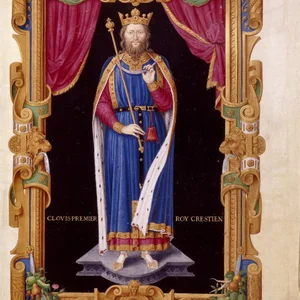

Clovis I (466-511) was the king of the Franks who unified the Frankish kingdoms and founded the Merovingian dynasty. His baptism in 496 sealed the alliance between the Franks and the Catholic Church. He laid the foundations of what would become the kingdom of France.
Frequently asked questions
Key Facts
- 481: Clovis becomes king of the Franks upon the death of his father Childeric
- 486: Victory over Syagrius, the last representative of Roman authority in Gaul
- 496: Baptism of Clovis and conversion to Catholicism, a major political decision
- 507: Victory at the Battle of Vouillé against the Visigoths, expanding the Frankish kingdom
- 511: Death of Clovis; the kingdom is divided among his four sons
Works & Achievements
Written codification in Latin of the legal customs of the Salic Franks. This foundational text organizes justice through a system of fines and would influence medieval law for centuries.
Church founded by Clovis and Clotilde on the Montagne Sainte-Geneviève in Paris. It would become the burial site of Clovis and the nucleus of the future Abbey of Saint Genevieve.
First great council of the Frankish kingdom, convened by Clovis. It organized the relationship between the Church and royal power, establishing a model of collaboration that would endure.
Through military conquests and the elimination of other Frankish kings, Clovis united the Salic, Rhenish, and Ripuarian Franks under a single crown, creating a unified kingdom of northern Gaul.
Following the victory at Vouillé, Clovis seized the entire southwest of Gaul, pushing the Visigoths beyond the Pyrenees and doubling the size of his kingdom.
Anecdotes
During the Battle of Tolbiac in 496 against the Alemanni, Clovis, seeing his troops faltering, reportedly implored the God of his wife Clotilde, promising to convert if he obtained victory. The Franks prevailed and Clovis kept his promise by being baptized in Reims.
After the Battle of Soissons in 486, a Frankish soldier broke a liturgical vase that Clovis wanted to return to the Bishop of Reims. A year later, during a military review, Clovis recognized the soldier, threw his weapons to the ground and split his skull, saying: "Remember the vase of Soissons!" This episode, reported by Gregory of Tours, illustrates royal authority in the face of Frankish warrior customs.
Clotilde, a Burgundian and Catholic princess, played a decisive role in the conversion of Clovis. Despite the death of their first son shortly after his baptism — which Clovis interpreted as a bad omen — Clotilde persisted in her efforts to bring her husband to the Christian faith.
Clovis received from the Byzantine emperor Anastasius I the insignia of honorary consul. He donned the purple tunic and diadem in the Basilica of Saint Martin of Tours, distributing gold coins to the crowd, which granted him Roman legitimacy in addition to his Frankish power.
To unify the Franks under his sole command, Clovis methodically eliminated the other Frankish kings, including members of his own family. Gregory of Tours reports that he then publicly lamented having no more relatives to help him, hoping thereby to flush out any potential survivors.
Primary Sources
Clovis said to his men: 'I find it hard to bear that these Arians hold a part of Gaul. Let us march with God's help and, having defeated them, bring the land under our dominion.'
Queen Clotilde never ceased to urge the king to acknowledge the true God and abandon his idols, but nothing could bring him to this belief, until at last a war broke out against the Alemanni.
Your faith is our victory. Every battle you fight is a triumph for us. Divine Providence has given our age an arbiter: the choice you make for yourself is a judgment rendered for all.
The Salic Law codifies the fines and compositions for various offences among the Franks, establishing a system of wergeld (man-price) that replaces private vengeance with financial compensation.
Key Places
Capital of the Salian Franks and birthplace of Clovis's political power. It was here that the tomb of his father Childeric I was discovered in 1653.
Site of Clovis's victory over Syagrius in 486 and of the episode of the vase. This conquest opened the gates of northern Gaul to him.
City where Clovis was baptized by Bishop Remigius around 498–499. This city would go on to become the coronation city of the kings of France.
Site of the decisive battle of 507 against the Visigoths of Alaric II. This victory allowed Clovis to conquer Aquitaine and push the Visigoths back into Spain.
Clovis made it his capital around 508, choosing the city for its central position. He had the Basilica of the Holy Apostles built there (the future Abbey of Saint Genevieve), where he would be buried.
Typical Objects

Throwing axe characteristic of Frankish warriors. A formidable weapon hurled before hand-to-hand combat, it became a symbol of Frankish military power.

Large single-edged knife worn at the belt. An everyday weapon of the Franks, used both in battle and in daily life.

Barbed-tip javelin inspired by the Roman pilum. Once lodged in an enemy's shield, it was nearly impossible to remove and weighed down the opponent's defense.

Gold brooch decorated with garnets used to fasten the royal cloak. Merovingian fibulae, crafted with refined goldsmithing, attested to the rank and wealth of their owner.

Silver or bronze liturgical vase claimed by the Bishop of Reims after the Battle of Soissons. Its famous episode illustrates the tension between the warriors' right to plunder and the emerging royal authority.

Ring bearing the inscription CHILDIRICI REGIS, found in the tomb of Clovis's father at Tournai in 1653. It attests to the continuity of Frankish royal power.

Byzantine gold coin imitated by Frankish kings. Clovis minted coins modelled on the imperial standard, thereby asserting his sovereignty over Gaul.
School Curriculum
Vocabulary & Tags
Key Vocabulary
Tags
Daily Life
Morning
Clovis began his day in his royal residence, often a repurposed Gallo-Roman villa. After a frugal breakfast of bread, cheese, and dried meat, he received his leudes and loyal followers to handle the kingdom's affairs. After his conversion, he sometimes attended an early morning religious service.
Afternoon
The afternoon was devoted to military activities: troop reviews, training in the use of the francisca and scramasax, or campaign planning. Clovis also administered justice, arbitrating disputes among his subjects according to the Salic law. He received ambassadors and bishops to consolidate his alliances.
Evening
In the evening, a grand banquet brought together the king and his warriors in the throne hall. Roasted meat, mead, and wine were served in abundance. Bards recited the deeds of the Frankish ancestors. These feasts were also political occasions where Clovis distributed gifts and rewards to secure the loyalty of his men.
Food
The diet of Clovis and the Frankish court centered on meat — pork, game, beef — often roasted on a spit. Spelt and barley bread accompanied meals. Mead, the traditional Germanic drink, sat alongside Gallo-Roman wine. Cheeses, legumes, and fruits rounded out an abundant royal table.
Clothing
Clovis wore a long tunic cinched at the waist by a belt adorned with gold and garnet plaques. Over it, a wool cloak dyed in purple, fastened at the shoulder by a cloisonné fibula, marked his royal rank. His long hair, a sacred symbol of Merovingian kingship, was never cut. He wore braies (trousers) and leather boots in the Frankish style.
Housing
Clovis resided in former Gallo-Roman villas or palaces of wood and stone, surrounded by palisades. After 508, he settled in the Palace of the Thermae in Paris, a former Roman building. The halls were heated by large central hearths, the walls decorated with tapestries and war trophies. The king moved frequently between his residences, ruling an itinerant kingdom.
Historical Timeline
Period Vocabulary
Visual Style
Style visuel mérovingien mêlant l'orfèvrerie cloisonnée, les entrelacs germaniques et les mosaïques de l'Antiquité tardive, dans une palette de pourpre royal, d'or et de grenats sombres évoquant la fusion entre héritage romain et traditions franques.
Sound Ambience
Ambiance d'une salle royale mérovingienne mêlant bruits de forge, conversations de guerriers, feu crépitant, chants liturgiques et cloches d'église, évoquant la rencontre entre le monde franc guerrier et la civilisation chrétienne gallo-romaine.
Liens externes & ressources
Références
Œuvres
Loi salique (Pactus Legis Salicae)
vers 507-511
Basilique des Saints-Apôtres de Paris
vers 502-511
Concile d'Orléans
511
Unification des royaumes francs
486-511
Conquête de l'Aquitaine
507-508