
A Romanian sculptor based in Paris, Constantin Brâncuși is one of the fathers of modern sculpture. By refining forms down to their essence, he paved the way for abstraction and revolutionized the art of the 20th century.
Constantin Brâncuși(1876 — 1957)
Constantin Brâncuși
France, Roumanie
5 min read
Frequently asked questions
Famous Quotes
« Simplicity is not an end in art, but one arrives at simplicity in spite of oneself, by drawing closer to the real meaning of things.»
« It is not things that are difficult to make, but getting ourselves into the state to make them.»
Key Facts
- Born in 1876 in Hobița, a rural farming region of Romania
- Arrived in Paris in 1904 after traveling partly on foot
- Refused in 1907 to work in Rodin's studio: “Nothing grows in the shade of great trees”
- Created several versions of The Kiss from 1907 onward and of Bird in Space from 1923 onward
- Died in 1957 in Paris; he bequeathed his studio to the French State (reconstructed near the Centre Pompidou)
Works & Achievements
Two figures reduced to an almost geometric block; a sharp break with Rodin's realism and a manifesto for direct carving.
A pared-down portrait with large eyes and an oval face, made in several versions, an emblem of Brâncuși's stylization.
An ovoid head laid horizontally, a search for the pure form of the egg, the matrix for many later works.
A streamlined form in polished bronze that suggests flight; at the heart of the customs trial that recognized abstract art.
A major element of the Târgu Jiu ensemble, a vertical monument to fallen soldiers that seems to soar without limit.
Together with the Endless Column, they form the monumental ensemble at Târgu Jiu, a symbolic journey of mourning and memory.
Anecdotes
When the sculptor Auguste Rodin offered Brâncuși a position working in his studio as a carver, the young Romanian refused, saying: “Nothing grows in the shade of great trees.” He preferred to find his own path rather than imitate the master.
In 1904, at the age of 28, Brâncuși left Romania for Paris, covering much of the journey on foot, crossing Europe with very little money. This formative voyage carried him all the way to the capital of modern art.
In 1926, one of his sculptures, “Bird in Space,” was held up at the American customs: the agents refused to see it as a work of art and wanted to tax it as an industrial metal object. The trial that followed, won by Brâncuși in 1928, led to the official recognition of abstract art in the United States.
Brâncuși lived and worked in his Paris studio as if it were a sanctuary: he constantly rearranged his sculptures, photographed his own works, and regarded the arrangement of the whole as a creation in its own right. Upon his death, he bequeathed his entire studio to the French state.
For the town of Târgu Jiu in Romania, Brâncuși designed a memorial to the soldiers who died during the First World War, including the famous “Endless Column,” nearly 30 metres tall, which seems to want to connect the earth to the sky.
Primary Sources
Nothing grows in the shade of great trees.
The work is judged original and decorative, recognized as a work of modern art and not as a mere manufactured object subject to customs duties.
Simplicity is not an end in art, but one arrives at simplicity in spite of oneself as one approaches the real meaning of things.
Key Places
Brâncuși's birthplace, in a rural region whose folk art and woodworking would leave a lasting mark on his work.
Where he received his artistic training in Romania before leaving for the West.
His studio in the Montparnasse district, where he lived and worked for decades; today reconstructed near the Centre Pompidou.
The town where Brâncuși created his monumental ensemble commemorating the Romanian soldiers of the First World War.
Where Brâncuși is buried following his death in 1957.
Typical Objects

Tools of direct carving, a method dear to Brâncuși, who carved the stone and wood himself without an intermediate plaster model.

A favourite material that Brâncuși polished to a shine to make light play across pure forms.

For Brâncuși, the base is not a mere support but a work in its own right, often carved into stacked geometric forms.

Brâncuși photographed his own sculptures in his studio, considering these shots the proper way to present his works.

An elongated, tapering form evoking flight rather than the bird itself, which became one of the symbols of abstract sculpture.

A stack of rhomboid metal modules that seems to rise endlessly toward the sky, at once a sculpture and a commemorative monument.
School Curriculum
Vocabulary & Tags
Key Vocabulary
Daily Life
Morning
Brâncuși often started his day early in his studio, lighting the fire in his forge and preparing his tools. He liked order and quiet before settling down to carve stone or wood.
Afternoon
The afternoon was devoted to manual work: he carved the material directly, tirelessly polished marble or bronze, and moved his sculptures around to observe the light. He sometimes welcomed visitors, artists or collectors.
Evening
In the evening, he cooked for himself in his studio, hosting friends such as the composer Erik Satie or poets. Music and conversation held an important place in his evenings.
Food
Brâncuși cooked simple, rustic dishes inspired by his native Romania, and insisted on preparing his own meals. He had built a real oven in his studio and loved offering food to his guests.
Clothing
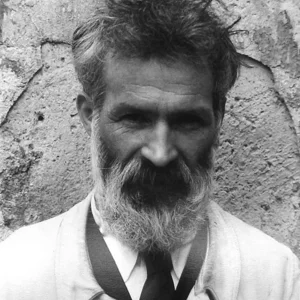
He readily wore white work clothes, clogs and a sculptor's apron, and sported a long beard that gave him the air of a patriarch or a wise peasant.
Housing
He lived in his Parisian studio, a space that was both a place to live and to create, which he arranged as a coherent whole. This studio, filled with his sculptures and their bases, was for him a single global work that he refused to break up.
Historical Timeline
Period Vocabulary
Liens externes & ressources
Références
Œuvres
Le Baiser
1907-1908
Mademoiselle Pogany
1912
La Muse endormie
1910
Oiseau dans l'espace
1923 et versions suivantes
Colonne sans fin
1938
La Table du silence et la Porte du baiser
1938