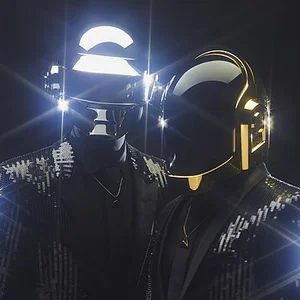

Daft Punk was a French electronic music duo formed in 1993 by Thomas Bangalter and Guy-Manuel de Homem-Christo. A major figure of the French touch movement, the group—famous for its robot helmets—left a profound mark on electronic music worldwide before disbanding in 2021.
Daft Punk
Daft Punk
5 min read
Frequently asked questions
Key Facts
- The duo was formed in Paris in 1993 by Thomas Bangalter and Guy-Manuel de Homem-Christo
- The album Homework (1997), a cornerstone of the French touch, featuring the track Around the World
- The album Discovery (2001), including One More Time, a worldwide hit
- The album Random Access Memories (2013) and its single Get Lucky, which won several Grammy Awards in 2014
- The announcement of the group's break-up in 2021 after 28 years together
Works & Achievements
Debut album that established Daft Punk and the French touch on the global electronic scene, featuring the hits “Da Funk” and “Around the World.”
Iconic album blending house music and pop nostalgia, including “One More Time” and “Harder, Better, Faster, Stronger.”
Japanese animated feature film that illustrates the entire Discovery album, without dialogue.
A rawer and more repetitive album, reflecting a critique of consumer society and the media.
Live album from the world tour, awarded a Grammy; a benchmark for electronic music performed in concert.
Orchestral and electronic film score composed for Disney, broadening the duo's audience.
Album recorded with live musicians, featuring “Get Lucky”; crowned Album of the Year at the 2014 Grammys.
Anecdotes
Thomas Bangalter and Guy-Manuel de Homem-Christo met in high school in Paris and first formed an indie rock band called Darlin'. A dismissive English review described their music as “daft punky thrash”: amused, they kept the insult “Daft Punk” as their name.
The duo almost always refused to show their faces. From 2001 onward, they appeared only in robot helmets, jokingly explaining that a studio accident on 9 September 1999 had turned them into machines.
For the track “Harder, Better, Faster, Stronger”, they cut up and reassembled hundreds of tiny sound fragments. Their album Discovery (2001) was then illustrated in full by a Japanese animated feature film, Interstella 5555, supervised by their idol Leiji Matsumoto.
In 2014, Daft Punk won five Grammy Awards, including Album of the Year for Random Access Memories, a record made largely with real studio musicians rather than computers.
On 22 February 2021, the duo announced their split with an eight-minute video titled “Epilogue”, in which one of the robots self-destructs in the desert: 28 years of career came to an end without a farewell concert.
Primary Sources
The silent video shows the two robots walking through the desert; one removes the other's jacket to activate a countdown, then explodes, followed by the caption "1993–2021."
"We don't see ourselves as stars or superheroes, but we love the idea of becoming robots and creating a piece of staging."
Daft Punk receive the Grammy for Album of the Year, one of five awards they won that night.
Key Places
City where Bangalter and de Homem-Christo met in high school and where the French touch was born. Birthplace of the duo and their label.
Site of the 2006 concert that marked a turning point for electronic shows thanks to its pyramid stage design.
City of the studios where Random Access Memories was recorded with session musicians, and where the 2014 Grammy Awards ceremony took place.
Hub of Japanese animation where the film Interstella 5555 was produced under the supervision of Leiji Matsumoto, an idol of the duo.
Typical Objects

Full gold and silver helmets, decorated with LEDs, worn to conceal their faces and embody two androids. They have become the band's worldwide emblem.

Electronic machines producing rhythms and sound textures, at the heart of house and techno. Daft Punk repurposed them to create hypnotic loops.

A device transforming the human voice into a robotic timbre, recognizable on tracks like “Harder, Better, Faster, Stronger.” It extends the duo's android aesthetic.

A machine that records fragments of existing tracks to replay and reassemble them. Daft Punk made virtuoso use of it to build their hits.

A giant pyramid-shaped structure covered in LED screens, used during the Alive 2007 tour. It revolutionized the staging of electronic concerts.

Costumes and accessories embedding lights to reinforce the android appearance on stage. They completed the helmets to form a total visual spectacle.
School Curriculum
Vocabulary & Tags
Key Vocabulary
Tags
Daily Life
Morning
Far from the image of stars, the two musicians led a discreet life and protected their anonymity. A morning might begin by listening to old funk, disco, and rock records that inspired them.
Afternoon
Afternoons were often spent in the studio, programming machines, sampling excerpts, and stacking sound loops for hours to achieve the sound they were after.
Evening
In the evening, the work of mixing and fine-tuning continued late into the night; when on tour, by contrast, they prepared highly visual shows, helmets and lights included.
Food
Their diet was that of contemporary urban artists, with no particular known regimen; on tour, quick meals and irregular schedules set the rhythm of group life.
Clothing
In public, they almost always wore their robot helmets, gloves, and dark or luminous outfits. Off stage, they dressed in an ordinary way to go unnoticed.
Housing
They lived partly in Paris, the city of their beginnings, while frequently traveling to studios and international festivals, notably in the United States.