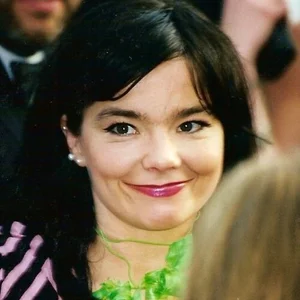

Icelandic singer, composer, and artist born in 1965 in Reykjavík, pioneer of experimental electronic music and avant-garde pop. She is also an actress, awarded at Cannes in 2000 for Dancer in the Dark.
Frequently asked questions
Famous Quotes
« Music is like a huge reservoir and you've just got to find what's your tone, your note.»
« I'm a fountain of blood in the shape of a girl.»
Key Facts
- 1977: releases her first solo album at age 11 in Iceland
- 1986–1992: member of post-punk band The Sugarcubes, achieving international success
- 1993: launches her international solo career with the album Debut
- 2000: Best Actress award at the Cannes Film Festival for Lars von Trier's Dancer in the Dark
- 2011: Biophilia, the first album in history to be released as an interactive app
Works & Achievements
Her first solo album, which introduced the world to an unclassifiable artist blending house, jazz, and electronic pop, produced by Nellee Hooper. It is still regarded as one of the defining albums of the 1990s.
An album of radical stylistic ruptures featuring collaborations with Tricky and Howie B, exploring industrial electronics and orchestral music in a single breath.
Conceived entirely in Iceland with producer Mark Bell, this album — built on sharp strings and massive electronic beats — is regularly ranked among the greatest albums of all time by the international music press.
Lars von Trier's film awarded the Palme d'Or at Cannes; Björk plays an immigrant mother and composed the entire score, winning the Best Actress award.
An intimate album of delicate micro-sounds — music boxes, harp, choir — exploring private life and domestic love, widely regarded as a founding work of electronic chamber music.
A groundbreaking multimedia project distributed as interactive iPad apps, integrated into Icelandic school curricula and praised by UNESCO for its educational approach to music and science.
An autobiographical album about heartbreak, recorded in secret with producer Arca, acclaimed by international critics as one of her most sincere and fully realized works.
Anecdotes
At just 11 years old, Björk recorded her self-titled debut album in Iceland in 1977, a collection of covers of Icelandic songs and pop standards. This homemade album, sold only in her home country, revealed an already astonishing voice and a musical maturity far beyond what you would expect from a child her age.
Before becoming a global star, Björk was part of the Icelandic punk band KUKL in the 1980s, then co-founded The Sugarcubes in 1986. This avant-garde post-punk group became the first Icelandic band to achieve international success, paving the way for an entire generation of Nordic musicians.
In 2000, Björk won the Best Actress award at the Cannes Film Festival for her role in Lars von Trier's Dancer in the Dark, a deeply moving musical film in which she plays a blind Czech immigrant sentenced to death. She also composed the entire film score — a remarkably rare achievement collectively honored with the Palme d'Or.
At the 2001 Academy Awards, Björk appeared in a swan-shaped dress created by Macedonian fashion designer Marjan Pejoski. Initially mocked by the press, this outfit is now considered one of the most iconic looks in the history of Hollywood award ceremonies, a symbol of artistic independence in the face of show-business conventions.
In 2011, Björk revolutionized music distribution with Biophilia, the first album in history to be conceived and released as an interactive iPad app. Each song corresponds to a separate application exploring the connections between music, nature, and science — an educational and artistic approach that earned her recognition in both educational and technology circles.
Primary Sources
I want my music to sound like what people feel, not what they think they should feel. Iceland taught me to listen to silence, to nature, to volcanoes — those are my first instruments.
I never wanted to be an actress, but Lars von Trier convinced me that the character's pain and the music were one and the same. It is the hardest thing I have ever done.
Biophilia is an invitation to explore the connections between music, nature, and the universe. I hope this project can be used in schools around the world to teach music in a different way.
Growing up in Iceland means growing up with volcanoes, geysers, and the northern lights. These natural phenomena are in my musical DNA. I cannot separate them from my creativity.
Key Places
The capital where Björk was born and raised, whose volcanic landscapes, geysers, and Nordic light deeply permeate her sonic and visual world.
The city where Björk settled in the early 1990s after the Sugarcubes disbanded, and where she recorded her first solo albums at the heart of the British electronic music scene.
The venue where she received the Best Actress Award in 2000 for Dancer in the Dark, marking her transition from the music world to the seventh art.
The Museum of Modern Art dedicated a retrospective to her in 2015, officially recognizing her work as belonging as much to the visual and performing arts as to music.
The wild interior region of Iceland, a constant source of inspiration for Björk, whose geothermal landscapes and glaciers have fueled her imagination since childhood.
Typical Objects

Björk uses analog modular synthesizers to create unprecedented sound textures, a hallmark of her experimental electronic music since the 1990s.

An electronic instrument played without physical contact, the theremin appears in several of her compositions and embodies her fascination with the boundaries between technology and the human body.

For the Biophilia project (2011), Björk designed an ecosystem of interactive iPad apps, transforming each song into a unique educational and sensory experience.

Her outfits created by avant-garde designers such as Alexander McQueen and Hussein Chalayan are inseparable from her stage performances, turning each concert into a total work of art.

During the Biophilia tour, giant Tesla coils produced electric lightning bolts in time with the music, illustrating her ambition to fuse science and live performance.

Björk favors vintage ribbon microphones for their warm sonic characteristics, which she paradoxically pairs with cutting-edge digital processing.

Designed by artists such as James Merry, these headdresses and masks transform her public appearances into fully realized artistic performances, blurring the line between music and visual art.
School Curriculum
Vocabulary & Tags
Key Vocabulary
Daily Life
Morning
Björk begins her days in Iceland to the rhythm of Nordic nature, often at dawn during the summers of endless daylight. She devotes her mornings to composition, working both on computer and with acoustic instruments in a studio she has set up at her home in Reykjavík.
Afternoon
Her afternoons are often dedicated to artistic collaborations — with designers, music video directors, or programmers developing her musical applications. She is known for long walks through the Icelandic landscapes that serve as a direct source of her sonic inspiration.
Evening
When not on tour, Björk spends her evenings with family or experimenting with new sounds in her studio. During periods of intense creativity, she may work late into the night — she is renowned for her perfectionism and absolute standards in music production.
Food
Björk follows a primarily vegetarian and locally sourced diet, rooted in Icelandic culinary tradition built around seafood, vegetables, and Nordic dairy products. She is deeply attuned to environmental issues and sustainable food practices.
Clothing
Her wardrobe is one of the most singular and recognizable in contemporary culture — she collaborates with avant-garde designers such as Alexander McQueen, Hussein Chalayan, and Iris van Herpen. Her outfits blend Nordic references, organic forms, and experimental materials, always in keeping with her artistic vision.
Housing
She lives primarily in Reykjavík, in a home whose interior reflects her taste for natural forms and Icelandic craftsmanship. She has also resided in London and New York depending on her projects, but Iceland remains her fundamental anchor and the wellspring of her artistic identity.