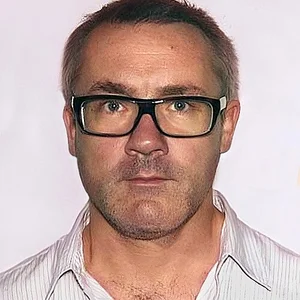

Damien Hirst is a British visual artist born in 1965, a leading figure of the Young British Artists (YBA) movement. He is famous for his provocative works exploring death, science and the value of art, including animals preserved in formaldehyde.
Damien Hirst(1965 — ?)
Damien Hirst
Royaume-Uni
6 min read
Frequently asked questions
Famous Quotes
« I can't wait to get into a position to make really bad art and get away with it.»
Key Facts
- Born on 7 June 1965 in Bristol, United Kingdom
- Organised the Freeze exhibition in 1988, launching the Young British Artists movement
- Created The Physical Impossibility of Death in the Mind of Someone Living in 1991, a tiger shark preserved in formaldehyde
- Won the Turner Prize in 1995
- Created For the Love of God in 2007, a platinum skull set with 8,601 diamonds
Works & Achievements
A shark preserved in formaldehyde, Hirst's most famous work and a symbol of the Young British Artists.
A cow and her calf cut in half and displayed in formaldehyde tanks, shown at the Venice Biennale.
An installation showing the life cycle of flies around a cow's head, a raw staging of death.
A platinum human skull covered with 8,601 diamonds, one of the most expensive works ever made.
Thousands of canvases of coloured dots that question mass production and the role of assistants.
A project of 10,000 works paired with NFTs, inviting buyers to choose between the physical object and its digital version.
Anecdotes
In 1991, Damien Hirst submerged a tiger shark over four metres long in a tank of formaldehyde and titled the work “The Physical Impossibility of Death in the Mind of Someone Living.” The collector Charles Saatchi funded the piece, which became the emblematic image of the Young British Artists.
While still a student at Goldsmiths College, Hirst organised an exhibition himself in 1988 called “Freeze” in a disused warehouse in London's docklands. This show of young artists launched an entire generation and drew the attention of the major art dealers.
In 2007, Hirst covered a real human skull with 8,601 diamonds to create “For the Love of God.” The cost of the materials alone came to several million pounds, making it one of the most expensive works ever made by a living artist.
In September 2008, in the midst of the financial crisis, Hirst bypassed the galleries and sold his works directly at auction at Sotheby's during the sale “Beautiful Inside My Head Forever.” The operation brought in around 111 million pounds, a record for a sale devoted to a single artist.
The first shark from 1991, having been poorly preserved, began to decompose; Hirst had to replace it in 2006 with a new specimen, reigniting the debate over what a work of art truly is when its material is changed.
Primary Sources
The title Hirst chose expresses the idea that a living being cannot truly conceive of its own death, even when looking it straight in the face.
Auction of 223 new works by Damien Hirst, offered directly by the artist without going through his galleries.
Hirst explains that he wanted to set the dazzling luxury of the diamonds against the raw reality of death embodied by the human skull.
Key Places
City in southwest England where Damien Hirst was born in 1965. He then grew up in Leeds.
London art school where Hirst studied from 1986 to 1989. There he met the future Young British Artists.
Former harbour docks where Hirst staged the “Freeze” exhibition in 1988 in a disused warehouse.
Major museum of modern and contemporary art that devoted a major retrospective to Hirst in 2012.
City where Hirst presented his ambitious exhibition “Treasures from the Wreck of the Unbelievable” in 2017 across two palaces.
Coastal region of southwest England where Hirst set up his studios and where he lives and works.
Liens externes & ressources
Références
Œuvres
The Physical Impossibility of Death in the Mind of Someone Living
1991
Mother and Child (Divided)
1993
A Thousand Years
1990
For the Love of God
2007
Série des Spot Paintings
1986-aujourd'hui
The Currency
2021