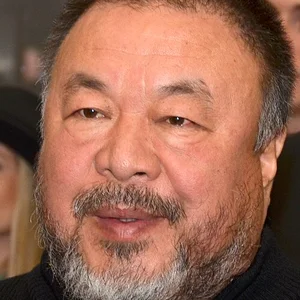

Ai Weiwei is a Chinese visual artist and activist, a leading figure in contemporary art. Known for his monumental installations and politically engaged works, he denounces human rights abuses and censorship by the Chinese regime, which earned him surveillance, imprisonment, and exile.
Ai Weiwei(1957 — ?)
Ai Weiwei
République populaire de Chine
6 min read
Frequently asked questions
Famous Quotes
« Everything is art. Everything is politics.»
« Freedom of expression has no borders.»
Key Facts
- Born on August 28, 1957, in Beijing, son of the poet Ai Qing, who was persecuted under Mao
- Helped design Beijing's National Stadium (the “Bird's Nest”) for the 2008 Olympic Games
- Investigated the children who died when schools collapsed during the 2008 Sichuan earthquake
- Held in secret detention for 81 days by the Chinese authorities in 2011
- Left China in 2015 after his passport was returned, living in exile in Europe
Works & Achievements
Photographic triptych in which the artist drops and shatters an ancient urn. A foundational work about breaking with tradition and authority.
Artistic design of the Olympic stadium with architects Herzog & de Meuron. Ai Weiwei distanced himself from the project to denounce the regime's propaganda.
Facade of the Munich museum covered with 9,000 children's backpacks, in tribute to the schoolchildren who died in the Sichuan earthquake.
Installation of 100 million hand-painted porcelain sunflower seeds at the Tate Modern. A reflection on the individual and mass production.
Six dioramas that reconstruct in detail his 81-day detention. A testimonial work about confinement and surveillance.
Documentary filmed in 23 countries about the global refugee crisis. He extends his art into engaged cinema.
Monumental sculpture made of thousands of assembled Chinese bicycles. A symbol of mass-scale China and collective movement.
Anecdotes
In 2010, Ai Weiwei covered the floor of the Turbine Hall at the Tate Modern museum in London with 100 million sunflower seeds… all made of porcelain! Each seed was hand-painted by craftspeople from the city of Jingdezhen. The work questions the place of the individual within the masses in China.
In 2011, the Chinese authorities arrested Ai Weiwei at Beijing airport and secretly detained him for 81 days. His disappearance sparked an international outcry and the “Where is Ai Weiwei?” campaign. Upon his release, his passport was confiscated for four years.
After the 2008 Sichuan earthquake, in which thousands of children died in the collapse of poorly built schools, Ai Weiwei led a citizen investigation to recover the names of the victims that the government had kept hidden. He documented more than 5,000 students' names.
Ai Weiwei is a pioneer in using social media as an artistic and activist tool. He has posted thousands of messages and photos on Twitter and on his blog (shut down by censorship in 2009) to circumvent the control of information in China.
As a child, Ai Weiwei grew up in internal exile: his father, the famous poet Ai Qing, was sent to a re-education camp in the Xinjiang desert where he was forced to clean public toilets. The family lived for years in a hole dug into the ground.
Primary Sources
“Everything is art. Everything is politics.” An emblematic phrase shared by the artist, summing up his approach.
“If you cannot act, you are not truly free. Freedom is about the possibility of asking questions.”
“Detention taught me the fragility of life and the necessity of defending human dignity.”
An autobiographical account connecting the story of his father, exiled under Mao, to his own struggle for freedom of expression in contemporary China.
Key Places
Ai Weiwei's birthplace and the center of his artistic and activist work. He set up his studio there in the Caochangdi district.
Where he lived from 1981 to 1993, discovering conceptual art and photography. This period shaped his Western vision of freedom of expression.
Desert region where his family was exiled during the Cultural Revolution, his father being sentenced to forced labor.
City where Ai Weiwei settled in exile from 2015, after his passport was returned, teaching and working there.
Island where he stayed to document the arrival of refugees in the Mediterranean, the source of several of his humanitarian works.
Museum where in 2010 he presented his monumental installation “Sunflower Seeds” in the Turbine Hall.
Typical Objects

A small hand-painted seed, produced by the millions for the installation *Sunflower Seeds*. It symbolizes the individual lost within the mass of the Chinese people.

An ancient Han dynasty vase dipped in industrial paint or emblazoned with the Coca-Cola logo. The object questions the value of heritage in the face of modernity.

A bicycle from the popular Chinese brand “Forever,” assembled into monumental sculptures. It evokes mass-produced China and mobility.

A tool for documentation and dissemination that Ai Weiwei uses to film his daily life and his arrests, and to post on social media.

Orange life jackets recovered from the island of Lesbos, Greece, and installed on museum façades. They denounce the migrant crisis and the deaths at sea.

Ordinary Chinese objects repurposed into installations. Ai Weiwei plays on the everyday to critique society and power.
School Curriculum
Vocabulary & Tags
Key Vocabulary
Tags
Daily Life
Morning
Ai Weiwei often begins his day in his studio surrounded by his cats and his assistants. He checks the news and social media, which remain essential tools of his activism.
Afternoon
His afternoons are devoted to designing artworks, exchanging ideas with his craftsmen, and overseeing international projects. He constantly documents his surroundings with his camera.
Evening
In the evening, he writes, prepares his interviews, and crafts his public statements. Cooking and sharing meals with those close to him hold an important place in his social life.
Food
Ai Weiwei enjoys traditional Chinese cuisine and likes to cook himself for his guests. Convivial meals around a large table are a family and friendly ritual.
Clothing
Recognizable by his long beard and casual demeanor, he wears simple, often dark clothing. His appearance reinforces his image as an approachable artist who stands outside official codes.
Housing
For a long time he lived and worked in a large studio he designed himself in Caochangdi, near Beijing. In exile, he divided his life between Berlin, Cambridge, and then Portugal, setting up vast creative spaces.
Historical Timeline
Period Vocabulary
Liens externes & ressources
Références
Œuvres
Dropping a Han Dynasty Urn
1995
Stade national de Pékin (« Nid d'oiseau »)
2008
Remembering
2009
Sunflower Seeds
2010
S.A.C.R.E.D.
2013