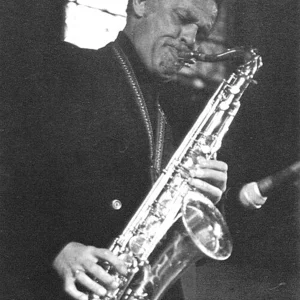

Dexter Gordon (1923-1990) was an African American jazz tenor saxophonist and a major figure of bebop. A pioneer of his instrument in this style, he enjoyed a long career between the United States and Europe, and was nominated for the Academy Award for Best Actor in 1987.
Dexter Gordon(1923 — 1990)
Dexter Gordon
États-Unis
6 min read
Frequently asked questions
Key Facts
- Born on February 27, 1923 in Los Angeles, he got his start in the big bands of Lionel Hampton (1940-1943) and then Billy Eckstine
- Became one of the pioneers of bebop on the tenor saxophone in the 1940s
- Recorded a series of landmark albums for the Blue Note label in the early 1960s (including 'Go!' in 1962)
- Moved to Europe (Copenhagen, Paris) from 1962 to 1976 before a triumphant return to the United States, celebrated by the album 'Homecoming' (1976)
- Nominated for the Academy Award for Best Actor for his role in Bertrand Tavernier's 'Round Midnight' (1986); died on April 25, 1990 in Philadelphia
Works & Achievements
Among the very first bebop recordings on tenor saxophone; they establish Gordon as a pioneer of the style on this instrument.
Famous “duel” between two tenor saxophones, which became a classic and a model for the musical jousts of bebop.
Album marking his powerful return to recording in the early 1960s.
Often cited as his masterpiece, the summit of his art in a quartet setting.
Recorded in Paris during his exile, with pianist Bud Powell: a symbol of the community of jazz musicians who had expatriated to Europe.
Concert marking his return to the United States after fourteen years in Europe, welcomed as a major event by the jazz world.
Film in which he plays the lead role of an exiled saxophonist; his performance earned him a nomination for the Academy Award for Best Actor.
Anecdotes
Dexter Gordon was nicknamed “Long Tall Dexter” because of his striking height, nearly six foot five. On stage, his silhouette was as recognizable as his playing: a slow, relaxed phrasing deliberately placed “behind the beat,” as if he were taking all the time in the world to tell a story.
Before playing a ballad, Gordon would often recite the song's lyrics to the audience in his deep, sonorous voice. He explained that a musician must know the words of a tune in order to “tell the story” with the saxophone, even without singing.
In 1947, he recorded “The Chase” with saxophonist Wardell Gray: a kind of musical duel in which the two tenors answer each other and compete in virtuosity. These “saxophone battles” were hugely popular with audiences and turned a concert into a real show.
His father, Frank Gordon, was one of the first African American doctors in Los Angeles, and his patients included musicians such as Duke Ellington and Lionel Hampton. It was partly thanks to him that young Dexter grew up surrounded by jazz.
In his sixties, Gordon became a film actor: he played the lead in the French film “Round Midnight” (1986) and was nominated for the Academy Award for Best Actor in 1987. Remarkably, he was not a professional actor but a real jazzman playing a musician.
Primary Sources
Dexter Gordon plays Dale Turner, an aging African American saxophonist living in exile in Paris. The character and the film are inspired by the real lives of expatriate musicians such as Lester Young and the pianist Bud Powell, to whom the work is dedicated.
A record made in Paris at the heart of his European exile, bringing together other African American musicians who had settled in Europe, notably the pianist Bud Powell and the drummer Kenny Clarke.
A quartet recording often regarded as Gordon's masterpiece, a direct sonic testament to his bebop tenor saxophone artistry in the early 1960s.
A live recording of his triumphant return to New York after fourteen years spent in Europe; it also captures his voice introducing the tunes to the audience.
Key Places
Gordon's hometown, where he grew up in a cultured environment and discovered jazz in early childhood.
The jazz capital where bebop was born; Gordon played its clubs and recorded most of his albums for Blue Note.
The city where Gordon settled during his European exile and played regularly at the Jazzhus Montmartre club.
Another major hub of his exile: here he recorded “Our Man in Paris” and later filmed the movie “Round Midnight.”
Site of the prison where Gordon was incarcerated in the 1950s because of his addiction problems, a dark period in his career.
The city where Dexter Gordon died in 1990.
Typical Objects

The instrument of his entire life, on which he was one of the great masters of the bebop style. His big, warm sound and relaxed phrasing made his an immediately recognizable voice.

The part the saxophonist places in his mouth; the choice of mouthpiece largely shapes Gordon's broad, round tone.

A small blade of cane that vibrates to produce the sound; a musician like Gordon would try out many to find the right one.

The 33 rpm vinyl on which his great albums of the 1960s were pressed. It was through these records that his playing spread around the world.

Like many bebop musicians, Gordon took care of his appearance with sharp suits. Sartorial elegance was part of the image of the modern jazzman.

The case he carried everywhere during his tours between the United States and Europe, holding the instrument he worked with.
School Curriculum
Vocabulary & Tags
Key Vocabulary
Tags
Daily Life
Morning
A musician of the night, Gordon woke up late, often around midday, after playing until the early hours of the morning. The morning was more of a time for rest, over a cup of coffee, before building his strength back up.
Afternoon
The afternoon was for work: practicing the saxophone, learning new tunes and their lyrics, or meeting up with other musicians at a café to chat and prepare for the evening's concerts.
Evening
The real day began in the evening, on the stage of a jazz club like the Montmartre in Copenhagen. The concerts stretched late into the night, sometimes followed by improvised “jam sessions” among musicians.
Food
Life on tour and the late-night schedule meant irregular meals, often eaten very late after the concerts. Having settled in Denmark, Gordon also adapted to local European habits.
Clothing
Elegant, he gladly wore sharp suits, true to the stylish image that bebop musicians wanted to project of themselves, far from the cliché of the scruffy musician.
Housing
Between tours, he lived mostly in apartments and hotels. During his exile, he settled for the long term in an apartment in Copenhagen, which became his home base in Europe.