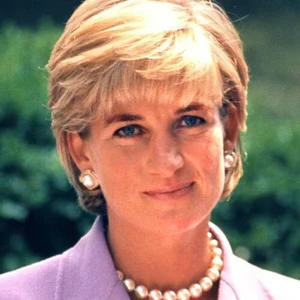

Princess of Wales (1981–1996), Diana Spencer became a global humanitarian figure through her commitment to banning landmines and supporting people living with AIDS. Her informal diplomatic influence and tragic death in 1997 made her an icon of the 20th century.
Diana Spencer(1961 — 1997)
Diana Spencer
Royaume-Uni
8 min read
Frequently asked questions
Famous Quotes
« I want to be a queen in people's hearts.»
« Landmines are a weapon of mass destruction in slow motion.»
Key Facts
- 1981: Marriage to Prince Charles, heir to the British throne, watched by 750 million viewers worldwide
- 1987: First public contact with AIDS patients, helping to combat the stigma surrounding the disease
- 1997: Global campaign against landmines in Angola and Mozambique, providing decisive support for the Ottawa Treaty
- December 1997: Signing of the Ottawa Treaty banning landmines, just months after her death
- 31 August 1997: Death in a car crash in Paris, triggering a national period of mourning in the United Kingdom
Works & Achievements
Diana worked alongside the Red Cross to raise awareness of the humanitarian tragedy caused by landmines in Angola and Bosnia. Her media presence directly contributed to the adoption of the Ottawa Treaty in December 1997.
From 1987, Diana made repeated visits to specialist hospital wards and broke taboos surrounding the disease, helping to bring about a major shift in how people in Britain and around the world viewed those living with AIDS.
Established after her death, this fund honours her humanitarian legacy by supporting projects in the areas of human rights, health, and aid to vulnerable populations.
A landmark television interview in which Diana spoke publicly about her marriage and her mental health, redefining the relationship between the British monarchy and the media.
Diana auctioned off 79 of her evening gowns in aid of four charities working on cancer and AIDS, raising nearly $3.26 million.
Diana regularly joined Centrepoint's outreach teams to meet homeless young people on the streets of London, drawing attention to a social reality that was often invisible.
Anecdotes
In 1987, Diana Spencer visited the first British hospital ward dedicated to AIDS patients in London. She shook hands with an AIDS patient without wearing gloves — a deliberate gesture that shocked public opinion but helped dismantle the myth that the disease could be spread through casual contact. The image circulated worldwide and transformed how the public understood the epidemic.
In January 1997, just months before her death, Diana walked through a partially cleared minefield in Angola, wearing a flak jacket and protective visor. The photographs from that visit, broadcast around the world, gave decisive momentum to the international campaign to ban landmines, ultimately leading to the Ottawa Treaty signed in December 1997.
During an official visit to India in 1992, Diana found herself alone in front of the Taj Mahal — a monument built as a tribute to eternal love — at a time when her relationship with Prince Charles was on the verge of collapse. The photograph of that carefully staged solitude became one of the most talked-about images of the decade, a symbol of a marriage in crisis.
In 1993, Diana announced at a press conference that she was stepping back from public life, exhausted by the relentless media pressure. She said: 'I am going to take a break... for a while.' The speech, delivered in a composed voice despite her visible emotion, illustrated the permanent tension between private life and royal duty in modern media-driven democracies.
In the BBC interview broadcast in November 1995 to an audience of 23 million British viewers, Diana publicly acknowledged her infidelity and questioned Charles's suitability to be king. The interview, secretly arranged without the royal family's knowledge, redefined the relationship between the monarchy and the media in the United Kingdom.
Primary Sources
"There were three of us in this marriage, so it was a bit crowded." Diana openly discusses the difficulties in her marriage and her relationship with James Hewitt, challenging the official image of the royal family.
"I am not a political figure. But I am someone with a concern for the human dimension of the problems that politicians try to resolve." Diana explains her humanitarian commitment outside official diplomatic channels.
Diana expresses her fears for her safety and mentions pressures endured within the royal family — a document cited in subsequent judicial inquiries.
The treaty, signed by 122 states in December 1997, implicitly acknowledges the influence of the humanitarian campaign to which Diana actively contributed in the final months of her life.
Key Places
Diana's official residence from her marriage onwards, Kensington Palace became the centre of her humanitarian work and the symbolic site of public mourning at her death.
It was in this Parisian tunnel that Diana lost her life on 31 August 1997 in a car crash. The site quickly became a spontaneous memorial visited every year.
Diana travelled to Angola in January 1997 to support the International Red Cross's landmine clearance campaign, walking through mined areas to raise global awareness.
The ancestral Spencer family estate where Diana was born and has been buried since her death in 1997. The site is home to a museum dedicated to her memory.
The site of her wedding in July 1981 and her state funeral on 6 September 1997, watched by 2.5 billion people around the world.
Typical Objects

Worn by Diana during her visit to Angola in January 1997, this equipment became the defining visual symbol of her campaign against landmines. The photographs taken that day had a worldwide impact.

This black sheath dress worn by Diana on the evening of her 1995 Panorama interview entered fashion history as a political and symbolic act of emancipation.

Diana was among the first public figures to use a mobile phone to maintain direct contact with journalists and charitable organisations, bypassing the Crown's official channels.

Worn at her wedding in 1981, this Spencer family heirloom became a symbol of Diana's aristocratic identity, distinct from that of the Windsor royal family.

Diana maintained a personal network of contacts across NGOs, hospitals, and charitable organisations worldwide, allowing her to act outside official diplomatic structures.

At her death, millions of flowers were laid outside Kensington Palace — an unprecedented outpouring of collective grief in Britain that forced the royal family to rethink its communication protocols.
School Curriculum
Vocabulary & Tags
Key Vocabulary
Tags
Daily Life
Morning
Diana rises early and starts her day with a physical workout — swimming or gym — at Kensington Palace, a habit she maintained even through difficult periods. She then spends time reading the British and international press, keeping close tabs on coverage of her humanitarian causes.
Afternoon
Her afternoons are often taken up with official visits to hospitals, shelters, and charitable organisations. Diana stood out for her way of making direct physical contact with the sick and the marginalised, kneeling down to speak with them at eye level.
Evening
Her evenings alternated between charity galas in formal attire and quiet time with her sons William and Harry, whom she was determined to give as normal a life as possible. She took them to amusement parks and ordinary restaurants, breaking with traditional royal protocol.
Food
Diana suffered from bulimia — an illness she spoke about publicly in her 1995 BBC interview — for much of the 1980s and 1990s. Outside these episodes, she favoured a light diet centred on fruit, salads, and fish, in keeping with the dietary trends of British high society at the time.
Clothing
Dressed by the greatest British and international designers — Catherine Walker, Versace, Chanel — Diana turned every outfit into a political or symbolic statement. She consciously adapted her wardrobe to context: sumptuous gowns for galas, simple and understated looks for humanitarian visits.
Housing
Diana lived primarily in Apartments 8-9 of Kensington Palace, which she decorated in a personal, warm, and less formal style than the usual state apartments. She welcomed friends, journalists, and charitable organisations there, turning her home into a sphere of influence parallel to the royal Court.
Historical Timeline
Period Vocabulary
Visual Style
Un contraste visuel saisissant entre l'éclat des palais royaux britanniques et la crudité documentaire des terrains humanitaires, unis par la présence lumineuse et empathique de Diana.
Sound Ambience
Un mélange de solennité royale et d'urgence humanitaire : le fracas discret de Londres, les salles d'hôpital et les terrains minés d'Angola composent le paysage sonore de Diana.
Liens externes & ressources
Références
Œuvres
Campagne internationale contre les mines antipersonnel (Croix-Rouge)
1997
Engagement contre le sida (National AIDS Trust)
1987-1997
Fondation du Diana, Princess of Wales Memorial Fund
1997
Interview BBC Panorama avec Martin Bashir
1995
Vente aux enchères des robes de Diana (Christie's New York)
1997
Parrainage de Centrepoint (association pour les sans-abri)
1992-1997