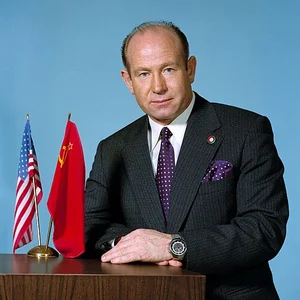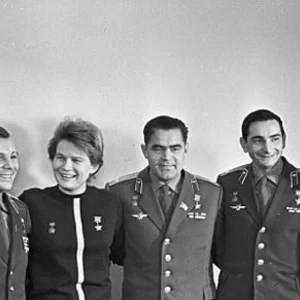

A Soviet cosmonaut, he completed the Vostok 3 mission in 1962, making 64 orbits around Earth. In 1970, aboard Soyuz 9, he set an endurance record of 18 days in space. The husband of Valentina Tereshkova, he stands as a symbol of Soviet space exploration.
Andriyan Nikolayev
Andriyan Grigoryevich Nikolayev
9 min read
Frequently asked questions
Key Facts
- Born on September 5, 1929, in Chuvashia (USSR)
- Vostok 3 mission: August 11–15, 1962, 64 orbits around Earth
- First formation flight alongside Vostok 4 (Pavel Popovich) at a distance of just a few kilometers
- Soyuz 9 mission: June 1–19, 1970, record of 17 days 16 hours in space
- Husband of Valentina Tereshkova (1963–1982); their daughter Elena is the first child born to two cosmonauts
Works & Achievements
Nikolayev's first spaceflight, lasting 3 days, 22 hours, and 22 minutes, setting a longevity record for the era. For the first time in history, two Soviet spacecraft (Vostok 3 and 4) flew simultaneously in orbit, demonstrating mastery of joint spaceflights.
Nikolayev's second and final spaceflight, carried out with Vitali Sevastyanov, which set a world endurance record (17 days, 16 hours, 58 minutes) that stood unbroken for two years. The mission yielded vital medical data on the physiological effects of prolonged weightlessness.
Nikolayev's autobiographical account of his training, his flights, and his thoughts on the conquest of space, widely distributed in Soviet schools. The book helped popularize the image of the cosmonaut among Soviet youth and became a classic of space popularization literature.
Following the medical difficulties observed after the Soyuz 9 return, Nikolayev worked with physicians in the space program to develop the first mandatory in-orbit physical exercise protocols. His recommendations are the foundation of practices still in use today aboard the International Space Station.
Nikolayev took on major leadership responsibilities at Star City, overseeing the selection and training of a new generation of Soviet and later Russian cosmonauts. His institutional role thus extended well beyond his career as a pilot, becoming part of the transmission of spaceflight knowledge.
Anecdotes
In August 1962, Nikolayev aboard Vostok 3 and Pavel Popovich aboard Vostok 4 flew simultaneously, coming within less than 6 kilometers of each other. It was the first time in history that two crewed spacecraft operated in space at the same time, demonstrating Soviet mastery of joint flights.
During his Vostok 3 flight, Nikolayev unstrapped himself and floated freely in his cabin for several hours — he was the first human being to move about in weightlessness inside a spacecraft. This experience, broadcast live on Soviet television, astonished the entire world.
Nicknamed “the Iron Man” (Железный человек) by his fellow cosmonauts for his unshakeable calm during the most grueling training sessions, Nikolayev never lost his composure, even in simulators reproducing critical failures. This reputation earned him selection for the longest and most dangerous missions.
Upon returning from Soyuz 9 in June 1970, after 18 days in space, Nikolayev and his crewmate Sevastyanov were so weakened by prolonged weightlessness that they could barely walk. Alarmed Soviet doctors dubbed this phenomenon the “Nikolayev effect”; the incident led the USSR to mandate compulsory physical exercise for all future long-duration flights.
In November 1963, Nikolayev’s marriage to Valentina Tereshkova — the first woman to have traveled in space — was celebrated in Moscow in the presence of Nikita Khrushchev himself. The event received widespread media coverage as a symbol of Soviet superiority, and their daughter Elena, born in 1964, was the first child born to two parents who had both been to space.
Primary Sources
On August 11, 1962, cosmonaut and citizen of the Soviet Union Andriyan Grigoryevich Nikolayev was launched into space aboard the Vostok 3 spacecraft. The spacecraft is orbiting the Earth at an altitude of between 166 and 218 kilometers.
Following a flight of 17 days, 16 hours, and 58 minutes, crew members exhibited significant muscle atrophy and marked cardiovascular deconditioning, requiring extended rehabilitation. It is recommended that a mandatory daily physical exercise programme be introduced for long-duration flights.
Yesterday in Moscow, cosmonaut Andriyan Nikolayev and cosmonaut Valentina Tereshkova were married, in the presence of Comrade Nikita Sergeyevich Khrushchev and members of the Central Committee Presidium. This union symbolizes the strength and youth of our Soviet nation.
Weightlessness is not the sensation of falling, but a total freedom of the body. I unstrapped myself and let myself float: it was as though gravity had never existed. I understood then that human beings were made for space just as much as for the Earth.
The conquest of space is the collective achievement of the Soviet people — its engineers, its scientists, its workers. Every orbit around the Earth is a victory of socialism over obscurantism and the fear of the unknown.
Key Places
A rural village in the Chuvash Republic where Nikolayev was born on September 5, 1929, into a peasant family. This place symbolizes the humble origins of many Soviet space pioneers, recruited from among workers and the sons of collective farm laborers.
The Soviet launch facility from which Nikolayev lifted off for his two space missions, Vostok 3 in 1962 and Soyuz 9 in 1970. Kept secret for decades, Baikonur was the heart of the Soviet space program and the departure point for all major crewed flights.
The Soviet cosmonaut training center where Nikolayev spent most of his career, preparing for flights and living there with his family. It was here that he met Valentina Tereshkova, and where much of the selection and training of cosmonauts was organized.
A desolate area of the Kazakh steppe where Nikolayev and Sevastyanov landed on June 19, 1970, after 18 days in space. Their state of exhaustion upon landing alarmed the medical teams and revealed to the world the physiological dangers of prolonged spaceflight.
The venue where the state wedding between Nikolayev and Tereshkova was celebrated in November 1963, in the presence of Khrushchev and the highest Soviet authorities. The event was broadcast on national television and presented as a symbol of the USSR's glory.
Typical Objects

A metal sphere 2.3 meters in diameter in which Nikolayev completed his 64 orbits in 1962. The cosmonaut was strapped into an ejection seat — the only planned return method at the time — as the spacecraft could not land softly with a passenger on board.

An orange pressurized suit worn during Vostok flights, designed to protect the cosmonaut in the event of cabin depressurization. Nikolayev wore it during his first flight, though he removed it in orbit to conduct his weightlessness experiments.

A Soviet Soyuz-series spacecraft aboard which Nikolayev and Sevastyanov set their endurance record in 1970. Larger and more advanced than Vostok, it allowed orbital maneuvers and a controlled return by parachute and retrorockets.

Freeze-dried food packaged in tubes or sealed pouches, the only food available to cosmonauts during early flights. Nikolayev was among the first to experience, over extended durations, the physiological effects of an entirely artificial diet in weightlessness.

A standard logbook that each cosmonaut kept by hand during their missions, recording scientific observations, physical sensations, and technical data. Nikolayev's logbook from Vostok 3 is preserved in the archives of the Russian space program.

A physical training device installed in Soyuz 9 that Nikolayev and Sevastyanov used to try to counteract the effects of prolonged weightlessness. Despite these efforts, their condition upon landing revealed that the exercise protocols were still insufficient.
School Curriculum
Vocabulary & Tags
Key Vocabulary
Tags
Daily Life
Morning
Before each mission, a cosmonaut's training day began at 6 a.m. with a series of intense physical exercises — running, swimming, gymnastics — designed to keep the heart and muscles at the level required by the program's doctors. Nikolayev would then move on to centrifuge sessions simulating the 8 to 10 g of acceleration at launch, followed by technical briefings with Korolev's engineers on the spacecraft's systems.
Afternoon
Afternoons were devoted to flight simulations in full-scale mock-ups of the Vostok or Soyuz, where Nikolayev rehearsed every emergency procedure until he could perform them with his eyes closed. Theoretical courses in astronomy, orbital mechanics, and space medicine rounded out the training, taught by engineers and academics who came specially to Star City.
Evening
Evenings at Star City were relatively quiet: cosmonauts had dinner with their families in their apartments in the residential complex, went to bed early, and avoided late nights as required by the program's strict rules. Nikolayev enjoyed playing chess — a popular pastime among Soviet engineers and pilots — and corresponded with his family in Chuvashia.
Food
In orbit, Nikolayev ate exclusively from freeze-dried preparations contained in metal tubes or sealed pouches — meat purées, fruit juices, concentrated soups — which he squeezed directly into his mouth to prevent crumbs from floating and damaging the instruments. At Star City, cosmonauts received a diet specially designed by nutritionists, rich in proteins and vitamins, far superior to ordinary Soviet fare.
Clothing
On missions, Nikolayev wore the pressurized SK-1 spacesuit during critical phases (launch, atmospheric re-entry) and a lightweight flight suit while in orbit. On Earth, cosmonauts wore military uniform at official ceremonies — Nikolayev held the rank of colonel in the Soviet Air Force — and wore plain civilian clothing for everyday activities at Star City.
Housing
Nikolayev lived with his family in a functional apartment in the residential complex of Star City, a closed and monitored settlement some thirty kilometers from Moscow. Comfortable by Soviet standards of the time — a spacious apartment, access to a communal canteen and sports facilities — this community dedicated entirely to cosmonauts was cut off from the outside world for reasons of security and military secrecy.
Historical Timeline
Period Vocabulary
Liens externes & ressources
Références
Œuvres
Vol Vostok 3 — 64 orbites autour de la Terre
11-15 août 1962
Vol Soyouz 9 — Record de durée de 18 jours dans l'espace
1-19 juin 1970
'Les Étoiles attendent la patience' (Звёзды ждут терпеливых)
1967
Contribution au protocole médical des vols de longue durée
1970-1974
Commandement du Centre d'entraînement des cosmonautes
1974-1992