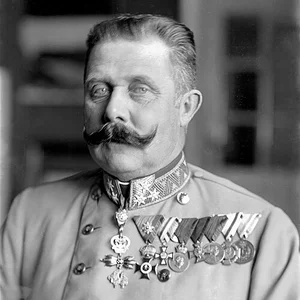

Archduke and heir to the Austro-Hungarian Empire, his assassination in Sarajevo on June 28, 1914, by Gavrilo Princip triggered the First World War. A central figure in the nationalism and European tensions of the early twentieth century.
Franz Ferdinand of Austria(1863 — 1914)
Franz Ferdinand of Austria
empire d'Autriche, Cisleithanie
8 min read
Frequently asked questions
Key Facts
- Born on July 18, 1863, in Graz; Archduke and heir to the Austro-Hungarian Empire
- Morganatic marriage to Sophie Chotek in 1900, against the wishes of the imperial court
- Assassinated on June 28, 1914, in Sarajevo by Bosnian nationalist Gavrilo Princip
- His assassination triggered the July Crisis of 1914 and drew the great powers into war
- His death is considered the spark that ignited the First World War
Works & Achievements
An account of his grand journey through British India, Australia, and Japan, published in two volumes. This document reveals the archduke's intellectual curiosity and his perspective on the colonial empires of his era.
Over the years, Franz Ferdinand assembled an exceptional collection of more than 300,000 pieces: paintings, medieval armor, hunting trophies, and Japanese art objects. It bears witness to the encyclopedic culture of the great European aristocratic houses.
Franz Ferdinand developed the idea of a Triple Monarchy that would include an autonomous South Slavic state alongside Austria and Hungary. This plan, never officially formalized, aimed to stabilize the empire in the face of rising nationalist tensions.
As Inspector General of the Armed Forces, Franz Ferdinand pushed for the professionalization and modernization of the imperial army. He sought to make it an instrument of deterrence rather than a tool of aggression.
Anecdotes
Franz Ferdinand was an obsessive hunter: he kept a meticulous record of every kill and is said to have shot more than 270,000 animals over the course of his life, from deer to elephants on his travels abroad. This passion was so excessive that it shocked parts of the European aristocracy.
In 1900, he married Countess Sophie Chotek against the wishes of Emperor Franz Joseph. This so-called "morganatic" marriage subjected him to a public humiliation: at official ceremonies, Sophie was not permitted to sit beside him or be treated as an archduchess, and their children were excluded from the line of succession to the throne.
On June 28, 1914, in Sarajevo, a first bomb thrown by Nedeljko Čabrinović exploded beneath the archduke's car but left him unharmed. Franz Ferdinand insisted on visiting the injured at the hospital — it was during this detour that his driver took a wrong turn and stopped by chance directly in front of Gavrilo Princip, who fired the fatal shots.
Contrary to the image his opponents projected onto him, Franz Ferdinand advocated for a sweeping reform of the empire: he envisioned transforming Austria-Hungary into a federal "trialism" that would include the South Slavic peoples. This idea earned him the hatred of Serbian nationalists, who feared that such a reform would undermine the appeal of their own national ambitions.
The automobile in which he was assassinated — a 1911 Graf & Stift Double Phaeton — outlasted its owner. It is preserved at the Military History Museum in Vienna and remains one of the most iconic relics associated with the outbreak of the First World War.
Primary Sources
The Royal Serbian Government will furthermore pledge to the following: [...] to proceed without delay to the arrest of Major Voja Tankosić and a certain Milan Ciganović, a Serbian subject, both of whom have been implicated by the Sarajevo investigation.
Since the Royal Serbian Government has not replied in a satisfactory manner to the note delivered to it by the Austro-Hungarian Minister in Belgrade on July 23, 1914, the Imperial and Royal Government finds itself compelled to safeguard its own rights and interests.
At 10:50 a.m., as the motorcade was crossing the Appel Quay bridge, a bomb was thrown at His Imperial Highness's car. The device bounced off the folded-down hood and exploded beneath the following vehicle, wounding several people.
I am a Yugoslav nationalist, and I aim to unite all South Slavs, regardless of their beliefs. I am not a criminal, for I eliminated one who was doing evil. I believe I have done a service by ridding the world of a scourge, and I feel that I conducted myself rightly.
The policy of persecuting Slavs within our empire is a grave mistake. We cannot durably govern millions of subjects who regard us as oppressors. A federal reform is inevitable if we wish to preserve the unity of the monarchy.
Key Places
Administrative capital of Bosnia, annexed by Austria-Hungary in 1908, Sarajevo was the scene of the assassination of Franz Ferdinand on June 28, 1914. The street corner where Princip fired the fatal shots is today a site of global remembrance.
The imperial capital and main residence of the Habsburg court, Vienna was the political and cultural heart of the Austro-Hungarian Empire. It was here that Franz Ferdinand lived at the Belvedere Palace and carried out his duties as heir to the throne.
Franz Ferdinand's favorite country retreat, where he housed his extensive art and hunting collections. It was at this castle that the Archduke had withdrawn with his family shortly before his departure for Sarajevo.
Capital of the Kingdom of Serbia, Belgrade was the center of South Slavic nationalist movements that claimed the Austro-Hungarian territories inhabited by South Slavs. Tensions between Belgrade and Vienna were at the heart of the 1914 crisis.
Castle and burial place of Franz Ferdinand and his wife Sophie Chotek. Because their marriage was morganatic, they could not be interred in the Habsburg imperial crypt in Vienna.
Typical Objects

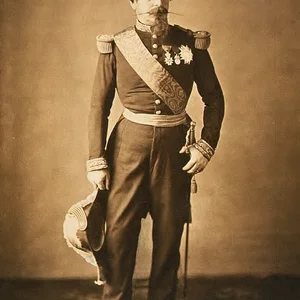
Franz Ferdinand wore the imperial army's ceremonial uniform at official appearances, complete with his decorations and plumed cap. He was dressed in this uniform when he was assassinated in Sarajevo on June 28, 1914.

A prestigious Austro-Hungarian touring car in which Franz Ferdinand and Sophie were traveling during their official visit to Sarajevo. It was in this open-top vehicle that they were struck by Gavrilo Princip's bullets.

A passionate hunter, Franz Ferdinand owned an impressive collection of firearms and devoted many hours to hunting on his estates. He kept a meticulous hunting journal recording every one of his kills.

The empire ruled by Franz Joseph, which Franz Ferdinand was set to inherit, spanned more than 680,000 km² and encompassed a dozen nationalities. Understanding this map was essential to grasping the tensions the archduke sought to manage through reform.

Franz Ferdinand meticulously recorded every animal he killed, from his earliest hunts right up until his death. This personal document reflects both his methodical nature and the aristocratic culture of the era.

As Inspector General of the Armed Forces and future sovereign, Franz Ferdinand maintained an extensive diplomatic correspondence with European chancelleries. These exchanges bear witness to his efforts to prevent a war he considered catastrophic.
School Curriculum
Vocabulary & Tags
Key Vocabulary
Daily Life
Morning
Franz Ferdinand rose early and devoted his mornings to official correspondence and military reports. As Inspector General of the Imperial Armed Forces, he regularly received officers and studied files on the modernization of imperial troops. He lunched with his family whenever his duties allowed.
Afternoon
Afternoons were often given over to meetings with political advisers or diplomatic audiences. At his country residences such as Konopiště, Franz Ferdinand indulged his passion for hunting, roaming the Bohemian forests rifle in hand, accompanied by gamekeepers and bodyguards.
Evening
Evenings at the Vienna court involved official dinners, receptions, and opera performances, where protocol and etiquette were strictly observed. In private, Franz Ferdinand cherished family life with Sophie and their three children, far from the imperial formalism that forced his wife to hold a lower rank in public.
Food
Franz Ferdinand's table reflected the Viennese cuisine of the high aristocracy: roasted meats from game he hunted himself, cured meats, pastries, and Moravian wines. Formal meals followed an elaborate multi-course protocol, while family meals were simpler and more relaxed.
Clothing
Franz Ferdinand wore Austro-Hungarian military dress uniforms for his public appearances: a dark navy tunic with gold frogging, red-striped trousers, and a white-plumed shako. For hunting, he wore a dark green loden Tyrolean outfit with a chamois-feather hat — the characteristic dress of the Austrian aristocracy.
Housing
His main residence in Vienna was the Upper Belvedere, a vast Baroque palace with formal French gardens, befitting his rank as heir apparent. He preferred, however, Konopiště Castle in Bohemia, where he had arranged his collections and could lead a freer life, away from the constraints of imperial court protocol.
Historical Timeline
Period Vocabulary
Visual Style
Style portraitiste de la cour impériale austro-hongroise : uniformes chamarrés, intérieurs baroques dorés et premières photographies en sépia, entre faste viennois et châteaux de Bohême.
Sound Ambience
Ambiance sonore de Vienne impériale au tournant du XXe siècle : fanfares militaires, carillons, bruits de sabots et premiers moteurs d'automobiles se mêlent dans la capitale des Habsbourg.
Liens externes & ressources
Références
Œuvres
Journal de voyage autour du monde
1896
Projet de réforme fédérale de l'empire (« trialisme »)
Vers 1906-1914
Modernisation des forces armées austro-hongroises
1913-1914