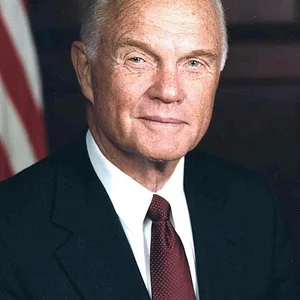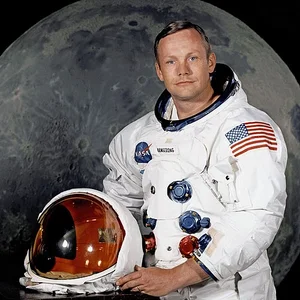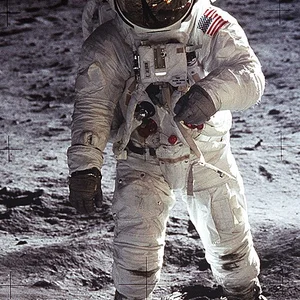

An American astronaut, he was the second man to walk on the Moon during the Apollo 11 mission on July 20, 1969. A former combat pilot in Korea and holder of a doctorate in orbital mechanics, he contributed to the development of space rendezvous techniques.
Buzz Aldrin(1930 — ?)
Buzz Aldrin
États-Unis
8 min read
Frequently asked questions
Famous Quotes
« Magnificent desolation.»
« Exploration is not a choice, really; it's an imperative.»
Key Facts
- Born on January 20, 1930, in Glen Ridge, New Jersey
- Fighter pilot during the Korean War (1950–1953), he flew 66 combat missions
- Earned a doctorate in orbital mechanics from MIT in 1963
- On July 20, 1969, he set foot on the Moon during Apollo 11, 19 minutes after Neil Armstrong
- Developed the space rendezvous techniques used during the Gemini and Apollo missions
Works & Achievements
A foundational theoretical work completed at MIT describing the orbital rendezvous techniques used in all subsequent crewed missions. Aldrin formalized the maneuvers that have since become standard in astronautics.
The final mission of the Gemini program, during which Aldrin successfully completed three productive spacewalks totaling 5 hours 30 minutes, demonstrating the EVA mastery essential to the Apollo program.
Alongside Neil Armstrong, Aldrin was part of the first pair to walk on the Moon. The mission stands as one of the most significant technological and scientific achievements of the 20th century.
A candid and deeply personal account in which Aldrin describes his struggle with depression and alcoholism following Apollo 11. It was the first public testimony by an astronaut about psychological hardship.
An autobiographical sequel chronicling the decades after Apollo 11 and his advocacy for Mars exploration. A bestseller that reignited public debate about the future of American space exploration.
A forward-looking work in which Aldrin makes the case for permanent colonization of Mars through a cycling transit program based on an orbital trajectory he named the "Aldrin Cycler."
Anecdotes
During the moon landing on July 20, 1969, Buzz Aldrin became the first human being to perform a religious ritual on the Moon. A few minutes after the Eagle touched down, and before stepping outside, he quietly produced a miniature communion kit provided by his Presbyterian church in Webster, Texas, and took communion in silence. NASA had asked him not to broadcast the act live, following a controversy sparked by the biblical reading during Apollo 8.
Buzz Aldrin held a doctorate in orbital mechanics from MIT, with a thesis titled “Line-of-sight guidance techniques for manned orbital rendezvous” (1963). He was one of the first astronauts to hold a scientific doctorate, earning him the nickname “Dr. Rendezvous” among his colleagues. His theoretical work allowed him to design the maneuvers used during the Gemini and Apollo missions.
During the Gemini 12 mission in November 1966, Aldrin demonstrated that extravehicular activities could be productive and fully controlled. His predecessors had exhausted themselves during EVAs, but Aldrin had prepared with underwater training exercises and specially designed handholds. He spent 5 hours and 30 minutes in space performing complex tasks, proving the feasibility of future lunar missions.
The nickname “Buzz” traces back to Aldrin’s childhood: his younger sister, who couldn’t pronounce “brother,” called him “Buzzer.” The name stuck for life. In 1988, Buzz Aldrin made it official by legally changing his first name from Edwin Eugene to Buzz. Curiously, his mother’s maiden name before marriage was Marion Moon.
After returning from Apollo 11, Aldrin, Armstrong, and Collins were placed in quarantine for 21 days — first aboard a Navy vessel, then in an isolated trailer in Houston. Scientists feared extraterrestrial biological contamination. The three astronauts later said they felt like “fish in a bowl” under the gaze of the entire world, having just accomplished one of humanity’s greatest feats.
Primary Sources
The lunar surface was described as 'magnificent desolation.' The fine-grained surface material was cohesive; footprints were retained with sharp edges. Visibility was excellent in all directions.
The problem of rendezvous in space requires precise knowledge of orbital mechanics and the ability to execute maneuvers with accuracy. The guidance techniques developed herein provide a systematic approach to orbital rendezvous applicable to manned spaceflight.
Walking on the moon was not an exotic experience. The sky was black, the sun was blazing, and there was no wind. The silence was absolute. I felt no great sense of space or distance. The horizon seemed close — too close.
I had been the second human being to walk on the moon, yet I returned home to find myself virtually anonymous, unable to navigate the celebrity I had earned, battling depression and alcoholism.
Astronaut Aldrin's extravehicular activity was an unqualified success. The use of underwater neutral buoyancy training, combined with special handholds and work constraints, proved essential to productive EVA operations.
Key Places
Buzz Aldrin's hometown, where he was born on January 20, 1930. His father, an Air Force colonel, profoundly influenced his calling toward aviation.
Aldrin completed his higher military education there and graduated in 1951 with honors, finishing third in his class in mechanical engineering.
Aldrin prepared and defended his doctoral dissertation there in 1963 on guidance techniques for manned orbital rendezvous — work that became fundamental to the Apollo program.
Launch site of Apollo 11 on July 16, 1969. Aldrin, Armstrong, and Collins lifted off aboard the Saturn V rocket from Launch Complex 39A.
NASA's operational headquarters where Aldrin was based as an astronaut. He underwent years of intensive training there for the Gemini and Apollo missions.
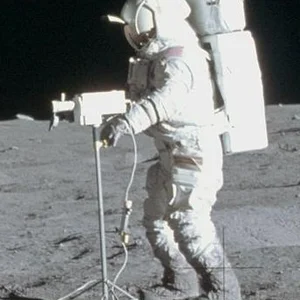
Apollo 11 landing site, on July 20, 1969. Aldrin was the second human being to walk on its dusty surface, describing the landscape as “magnificent desolation.”
Typical Objects

Pressurized suit worn during the Apollo 11 mission, made up of 21 layers of special materials. Aldrin wore it during his 2h31 moonwalk in the Sea of Tranquility.

Two-stage vehicle piloted by Aldrin and Armstrong to descend to and ascend from the lunar surface. Aldrin co-piloted the landing on July 20, 1969.

Small kit provided by his Presbyterian church containing a communion wafer and a vial of wine. Aldrin used it to celebrate the first communion on the Moon, a few minutes after landing.

Nylon flag reinforced with a horizontal rod to keep it deployed in the lunar vacuum. Aldrin and Armstrong planted it approximately 8 meters from the lunar module.

Long-handled telescoping scoop used to quickly collect lunar soil samples. Aldrin used these tools to gather part of the 21.55 kg of rocks brought back by Apollo 11.

Medium-format camera used on the lunar surface. Aldrin took the famous “visor selfie” — the shot in which Armstrong is reflected in his helmet visor.

American jet fighter piloted by Aldrin during the Korean War. He shot down two MiG-15s and flew 66 combat missions, forging the piloting experience that opened the doors of NASA to him.
School Curriculum
Vocabulary & Tags
Key Vocabulary
Tags
Daily Life
Morning
During the years of intensive training in Houston (1966–1969), Aldrin rose around 6 a.m. for a run or swim, with his physical fitness checked medically every week. He then moved on to cockpit simulations or technical meetings with NASA engineers.
Afternoon
Afternoons were devoted to simulations in the LMS lunar module simulator or pool sessions for EVA training. Aldrin also spent time in the MIT laboratories refining trajectory calculations — his area of expertise. Ground team briefings filled the rest of his time.
Evening
In the evenings, the astronauts returned to their families in Clear Lake, a residential neighborhood of Houston close to the space center. Aldrin had dinner with his family, though the pre-launch periods imposed strict diets and a preventive quarantine in the final weeks. He read widely in technical literature and science fiction.
Food
The astronauts' diet was strictly controlled by NASA physicians. In training, Aldrin followed a high-protein, low-salt regimen to protect cardiovascular health. On mission, the Apollo 11 astronauts ate freeze-dried foods reconstituted with hot water, along with cereal bars and fruit juice pouches.
Clothing
Day-to-day at NASA offices, Aldrin wore the standard navy flight suit or a suit and tie for official meetings. During simulations, he wore lightweight garments to test suit interfaces. On mission, the pressurized A7L suit — 21 layers and 81 kg on Earth — was worn during critical flight phases and the moonwalk.
Housing
Aldrin lived with his family in the Nassau Bay or Clear Lake residential neighborhood, immediately adjacent to the Johnson Space Center in Houston. These typical single-story Texas homes of the 1960s were shared by nearly all the astronaut families, forming a tight-knit community. After Apollo 11, he relocated to California.
Historical Timeline
Period Vocabulary
Liens externes & ressources
Références
Œuvres
Thèse de doctorat : « Line-of-sight guidance techniques for manned orbital rendezvous »
1963
Mission Gemini 12
Novembre 1966
Mission Apollo 11 — premier alunissage habité
16-24 juillet 1969
Return to Earth (autobiographie)
1973
Magnificent Desolation: The Long Journey Home from the Moon
2009
Mission to Mars: My Vision for Space Exploration
2013