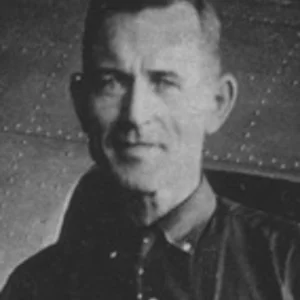

An American navigator and aviator, Fred Noonan served as navigator for Amelia Earhart during their attempted around-the-world flight in 1937. He disappeared with her over the Pacific, leaving behind one of aviation's greatest mysteries.
Fred Noonan(1893 — 1938)
Fred Noonan
États-Unis
8 min read
Frequently asked questions
Key Facts
- 1893: Fred Noonan is born in Haverford, Pennsylvania
- 1930s: Chief navigator for Pan American Airways on transpacific routes
- 1937: Navigator for Amelia Earhart during the around-the-world attempt aboard the Lockheed Electra
- July 2, 1937: Disappears over the Pacific near Howland Island, during the longest leg of the flight
- 1938: Officially declared dead after fruitless search efforts
Works & Achievements
Noonan took part in the survey flights that enabled Pan Am to launch the first regular commercial air service between San Francisco and Manila. These routes, crossing more than 12,000 km of ocean with only four intermediate stops, represented an unprecedented feat of navigation.
Noonan served as chief navigator on Pan American's inaugural transpacific airmail flight aboard the Martin M-130 China Clipper, linking Alameda to Manila in 59 hours of flying time. This event marked the opening of the era of commercial air travel across the Pacific.
Noonan handled navigation on several survey flights between California and Hawaii, charting routes and weather conditions to help Pan American establish a reliable regular service along this strategic leg.
Noonan's crowning achievement and final act: navigating alongside Amelia Earhart on the first attempt at an aerial circumnavigation along the equator. After successfully covering 35,000 km, their disappearance over the Pacific left the journey unfinished and passed into legend.
Anecdotes
Before becoming an aviator, Fred Noonan was an experienced maritime navigator, crossing the oceans on merchant ships during World War I. It is said that he was torpedoed three times without ever losing his composure, already forging his reputation as a man unbreakable in the face of danger.
Noonan was one of the architects of Pan American Airways' legendary transpacific routes in the 1930s. He personally took part in the exploratory flights that established the legs between San Francisco and Manila, thereby inaugurating the first regular commercial air service across the Pacific with the China Clipper in November 1935.
Just a few weeks before taking off with Amelia Earhart on their attempt to circumnavigate the globe, Fred Noonan married Mary Bea Martinelli in Los Angeles on March 27, 1937. This hasty wedding, on the eve of such a perilous flight, captured the public imagination of the time and added a tragic dimension to his disappearance.
On July 2, 1937, during their final radio contact before disappearing, Noonan and Earhart were attempting to locate Howland Island, a tiny atoll of less than 2 km² lost in the middle of the Pacific. The U.S. Coast Guard cutter Itasca, stationed near the island, was picking up their transmissions but could not establish two-way contact, making radio direction-finding navigation impossible — a fatal combination of circumstances.
The disappearance of Noonan and Earhart triggered one of the largest search operations in American aviation history: ten warships and sixty-five naval aircraft swept more than 260,000 km² of ocean for two weeks, without ever finding the slightest trace of the aircraft or the two aviators.
Primary Sources
0742: “KHAQQ calling Itasca. We must be on you but cannot see you. Gas is running low. Been unable to reach you by radio direction finding.” 0843: “We are on the line of position 157-337. We will repeat this on line 157-337.” Last message received.
The aircraft failed to establish a usable radio frequency for direction finding. Messages received indicated a strong signal strength, suggesting close proximity, but no two-way communication could be established before contact was lost.
Fred is the best navigator in the world. He knows the Pacific better than anyone, having crossed its routes countless times with Pan American. I could not have hoped for a better partner for this journey.
Noonan had developed a system of celestial navigation adapted for long-distance flights over the Pacific Ocean, combining sextant sightings, wind drift calculations, and the use of stars as fixed reference points to correct dead reckoning errors.
Key Places
Fred Noonan's birthplace, on April 3, 1893. He grew up in this region before enlisting in the merchant navy and beginning his career as a navigator.
The departure base for Pan American Airways' transpacific flights. Noonan coordinated the survey flights that opened the route to Hawaii and the Philippines, navigating the inaugural flight of the China Clipper in November 1935.
The departure point for the round-the-world attempt with Amelia Earhart, on June 1, 1937. It was here that their 46,000 km odyssey around the globe began.
The last known refueling stop for Noonan and Earhart, on June 29, 1937. It was from here that they took off for the fateful Pacific crossing toward Howland Island, 4,100 km away.
A tiny uninhabited American atoll of 1.6 km², the final destination of the transoceanic flight on July 2, 1937. Noonan and Earhart never managed to locate it; it was in these waters that they vanished forever.
Liens externes & ressources
Références
Œuvres
Établissement des routes transpacifiques de Pan American Airways
1934-1936
Premier vol commercial transpacifique — China Clipper
22 novembre 1935
Navigation des vols de reconnaissance hawaïens pour Pan Am
1935-1936
Tentative de tour du monde avec Amelia Earhart — Lockheed Electra 10E
1er juin – 2 juillet 1937