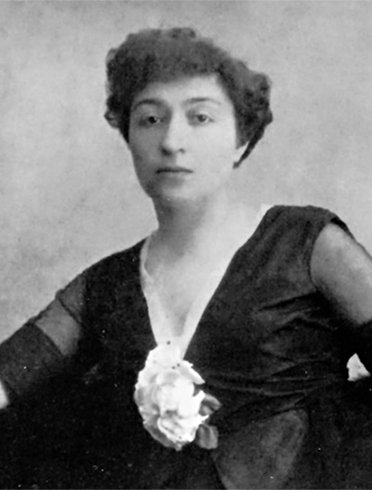
Diane Arbus(1923 — 1971)
Diane Arbus
États-Unis
9 min read
American photographer (1923–1971), Diane Arbus is celebrated for her portraits of people on the margins of society: dwarfs, giants, transvestites, nudists. Her work profoundly renewed the documentary gaze in photography.
Frequently asked questions
Famous Quotes
« A photographer makes a portrait for a reason the subject does not know.»
« A photograph is a secret about a secret. The more it tells you, the less you know.»
Key Facts
- 1923: born in New York into an upper-class Jewish family
- 1941: marries photographer Allan Arbus, with whom she works in advertising
- 1956: leaves advertising photography to devote herself to documentary photography
- 1967: exhibits at MoMA in the "New Documents" show alongside Lee Friedlander and Garry Winogrand
- 1971: dies by suicide in New York; in 1972, the first American photographer exhibited at the Venice Biennale
Works & Achievements
Portrait of a young boy in a white shirt holding a toy grenade, his face twisted into a striking grimace. One of Arbus's first iconic images, revealing the tension lurking beneath the surface of American childhood in the 1960s.
Portrait of twin sisters dressed identically but with slightly mismatched expressions. It became one of the most celebrated photographs of the twentieth century and directly inspired the twin girls scene in Stanley Kubrick's *The Shining*.
Eddie Carmel, who had acromegaly, stands hunched beneath the ceiling of the family apartment, his parents dwarfed at his feet. An obsessive image, the result of ten years of repeated encounters with the same subject, and a symbol of the radical otherness so central to Arbus's work.
Portrait of a young man wearing hair curlers, photographed in the intimacy of his apartment. The image reflects Arbus's empathy toward non-conforming identities, at a time when homosexuality was still criminalized in the United States.
An elderly woman in a wheelchair wearing a party mask, photographed in the grounds of an institution. Part of her series in psychiatric hospitals, this image questions the boundary between dignity, madness, and carnival.
Published posthumously with the help of her daughter Doon Arbus and designer Marvin Israel, this book brings together 80 photographs and texts by the photographer. It sold over 100,000 copies within months, making it one of the best-selling photography books in history.
Anecdotes
Born Diane Nemerov in 1923 into a wealthy Jewish family that owned Russeks, a fashionable department store on Fifth Avenue in New York, Diane grew up in a sheltered, privileged world she found suffocating. At 18, she married Allan Arbus and together they became fashion photographers; their elegant images appeared in Vogue and Harper's Bazaar. But Diane felt trapped in a world where beauty was an obligation, and dreamed of photographing everything her social class preferred to ignore.
Around 1956, Diane Arbus studied under Lisette Model at the New School for Social Research in New York. Lisette Model, a celebrated Austro-American photographer known for her portraits of ordinary people, reportedly told her: “Photograph what you are afraid of.” This advice changed her life: she abandoned fashion and devoted herself to portraits of marginalized individuals — dwarfs, cross-dressers, nudists, psychiatric patients.
In 1967, the Museum of Modern Art in New York presented the exhibition “New Documents,” bringing together photographs by Diane Arbus, Lee Friedlander, and Garry Winogrand. This exhibition marked a revolution in American photography: gone were the uplifting images in the style of Dorothea Lange, replaced by a direct, non-judgmental gaze on everyday reality. Some scandalized visitors spat on Arbus's prints.
Her photograph “Identical Twins, Roselle, New Jersey” (1967), depicting two sisters dressed identically but with slightly mismatched expressions, has become one of the most iconic images of the twentieth century. Stanley Kubrick was so fascinated by it that he kept a reproduction pinned to his wall during the filming of *The Shining* (1980); the image directly inspired the scene of the two little girls standing in the hotel corridor.
In 1963 and again in 1966, Arbus received two Guggenheim Fellowships, one of the most prestigious awards in the American art world. She used the funds to photograph nudist camps in New Jersey, fairgrounds, and psychiatric institutions. Exhausted and suffering from depression, she died on July 26, 1971. The following year, she became the first American photographer presented at the Venice Biennale, posthumously.
Primary Sources
I want to photograph the considerable ceremonies of our present: the beauty parlors, the hotel lobbies, the nudist camps, the boudoirs, the Christmas shopwindows — what we do pretend not to see.
I thought I could never lose anyone if I photographed them enough. In fact, my photographs show me how little I know about the people I photograph.
I've photographed 'freaks' a lot. It was one of the first things I photographed and it had a terrific kind of excitement for me. Most people go through life dreading they'll have a traumatic experience. Freaks were born with their trauma. They've already passed their test in life. They're a kind of aristocracy.
I work from awkwardness. I don't want to arrange things. If I stand in front of something, instead of arranging it, I arrange myself.
Key Places
Diane Arbus's birthplace and the primary setting of her photographic work. She photographed its streets, parks, fairgrounds, and private apartments, capturing the radical diversity of the American metropolis.
The bohemian Manhattan neighborhood where Diane Arbus lived, a hub of counterculture, artists, and the LGBTQ+ community. She kept her apartment and darkroom there, notably at the Westbeth Artists Community from 1970 onward.
A popular seaside amusement park that Diane Arbus visited regularly to photograph beachgoers, carnival stalls, and the freak shows still operating in the 1950s and 1960s.
Arbus gained access to nudist camps in New Jersey through her Guggenheim fellowships. These series, produced between 1963 and 1965, stand as one of her most singular explorations of normalcy and nudity as a social equalizer.
The institution where the landmark 1967 exhibition "New Documents" introduced Diane Arbus to a wider public. A posthumous retrospective was held there in 1972 before touring ten American cities.
A progressive university in Greenwich Village where Diane Arbus studied photography under Lisette Model between 1956 and 1957 — a pivotal encounter that decisively steered her career toward social documentary.