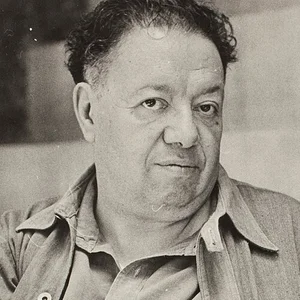

Diego Rivera was a Mexican painter and muralist, a major figure of 20th-century muralism. His monumental frescoes celebrate the history and people of Mexico from a revolutionary perspective. He was the husband of the painter Frida Kahlo.
Diego Rivera(1886 — 1957)
Diego Rivera
Mexique
6 min read
Frequently asked questions
Key Facts
- Born in 1886 in Guanajuato, Mexico
- Lived in Europe (1907-1921), where he discovered Cubism and the frescoes of the Italian Renaissance
- Created the frescoes of the National Palace in Mexico City starting in 1929, depicting the history of Mexico
- Married the painter Frida Kahlo in 1929
- Died in 1957 in Mexico City
Works & Achievements
His first major Mexican fresco, marking his debut in the muralist movement.
A vast set of panels celebrating the work, festivals, and popular traditions of Mexico.
A monumental fresco that tells Mexican history in images, from the pre-Hispanic era to the Revolution.
A cycle of frescoes glorifying modern industry and the dignity of working-class labor; regarded by Rivera as his masterpiece.
A fresco destroyed in New York for including a portrait of Lenin, then repainted at the Palace of Fine Arts in Mexico City.
A fresco gathering figures from Mexican history during a stroll, one of his most famous works.
A building of volcanic stone designed by Rivera to house his collection of pre-Columbian art.
Anecdotes
In 1933, Diego Rivera painted an immense mural, *Man at the Crossroads*, in the lobby of Rockefeller Center in New York. When he added a portrait of the revolutionary Lenin, his patrons demanded that he erase it. Rivera refused: the mural was covered over and then destroyed. He would repaint it later in Mexico City.
Diego Rivera was an enormous man, standing nearly 1.80 m tall and weighing more than 130 kg, which contrasted with the slight figure of his wife **Frida Kahlo**. People nicknamed them “the elephant and the dove.” Their passionate and stormy relationship saw them divorce in 1939 and remarry as early as 1940.
Passionate about pre-Columbian history, Rivera devoted part of his fortune to gathering thousands of sculptures and objects of Aztec and Maya art. To house them, he had an astonishing building of volcanic stone built in the shape of a pyramid, the *Anahuacalli*, near Mexico City.
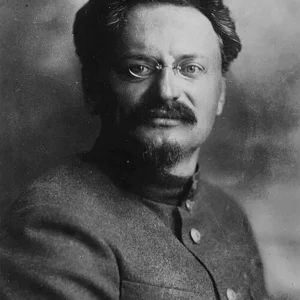
In 1937, Rivera petitioned the Mexican government to obtain political asylum for **Leon Trotsky**, who was in exile and threatened by Stalin. The Russian revolutionary was housed for a time in Frida Kahlo's Blue House in Coyoacán.
A teenage prodigy, Diego Rivera entered the prestigious San Carlos Academy in Mexico City at around the age of ten. A scholarship later allowed him to go study in Europe, where he discovered Cubism in Paris alongside **Picasso** before returning to a figurative art in the service of the people.
Primary Sources
“My most joyful and happiest art has always come from something seen in the everyday life of the people.”
“We proclaim that every aesthetic expression foreign or contrary to popular feeling is bourgeois and must disappear; art must be for all, a monumental and public art.”
A mural work depicting in images the Conquest, colonization, Independence, and the Mexican Revolution, peopled with historical figures from Quetzalcóatl to Marx.
“I want to paint murals on the walls of public buildings so that art belongs to the people and not to the salons of the rich.”
Key Places
Mining town in central Mexico where Diego Rivera was born in 1886. His birthplace is now a museum.
Rivera lived here in the 1910s and took part in the Cubist movement alongside Picasso and the avant-gardes.
Mexican government building where Rivera painted his great mural on the history of Mexico (1929-1935) along the monumental staircase.
Here, in 1932-1933, Rivera created the Detroit Industry Murals, celebrating the automobile industry and its workers.
District of Mexico City where Rivera and Frida Kahlo lived in the famous Casa Azul, the setting of their life together and their political commitment.
Capital where Rivera died in 1957 and home to most of his great public murals.
Typical Objects

A large painting made directly on the walls of public buildings, accessible to everyone. It is the signature art form of Rivera and the Mexican muralism movement.

The muralist's basic tools, used to mix pigments and apply color onto the fresh plaster. Rivera often worked perched high up on scaffolding.

A layer of fresh plaster onto which the muralist paints with water so that the pigments become permanently embedded. The *a fresco* technique requires painting quickly before it dries.

Aztec, Maya, and Olmec art objects that Rivera collected passionately. They fueled his inspiration and his attachment to Mexico's Indigenous identity.

A notebook in which Rivera drew street scenes, workers, peasants, and motifs before turning them into cartoons and then frescoes. An essential preparation tool.

Communist symbols that Rivera slipped into his murals to affirm his revolutionary commitment and celebrate the cause of the workers.
School Curriculum
Vocabulary & Tags
Key Vocabulary
Tags
Daily Life
Morning
Diego Rivera often began his day early at the sites of his frescoes, climbing onto tall scaffolding. He prepared the fresh plaster with his assistants, since *a fresco* painting had to be applied before it dried.
Afternoon
Afternoons were spent painting relentlessly, sometimes twelve to fifteen hours at a stretch, surrounded by helpers who ground the pigments. Curious and tireless, he welcomed visitors, journalists, and political figures at the foot of his walls.
Evening
In the evenings, Rivera frequented circles of artists and activists, discussing art and revolution. He shared his life with **Frida Kahlo**, amid friends, collectors, and pre-Columbian works of art.
Food
Rivera enjoyed traditional Mexican cuisine: tortillas, mole, beans, and chiles, which **Frida Kahlo** cooked with care. A notorious gourmand, he loved hearty meals and the flavors of the land.
Clothing
He most often wore simple work clothes, overalls or loose trousers and a broad hat, stained with paint. This laborer's outfit asserted his closeness to the people he celebrated.
Housing
Rivera lived in several houses in Mexico City, including the Casa Azul in Coyoacán and a modernist studio built by the architect **Juan O'Gorman**. His homes were filled with works of art and pre-Columbian sculptures.
Historical Timeline
Period Vocabulary
Liens externes & ressources
Références
Œuvres
Fresques du ministère de l'Éducation publique (SEP)
1923-1928
Anahuacalli (musée-pyramide)
années 1940-1950