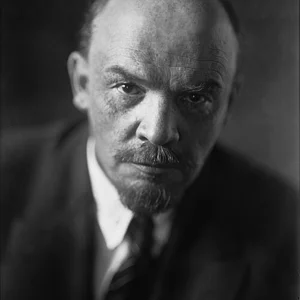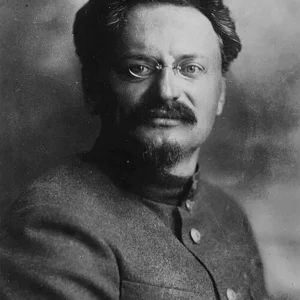

Russian revolutionary, Marxist theorist, and organizer of the Red Army, Leon Trotsky was one of the chief architects of the October Revolution of 1917 alongside Lenin. Ousted from power by Stalin and later exiled, he continued his political struggle until his assassination in Mexico City in 1940.
Leon Trotsky(1879 — 1940)
Leon Trotsky
Mexique, Union soviétique, Empire russe, république socialiste soviétique d'Ukraine, Russie soviétique
8 min read
Frequently asked questions
Famous Quotes
« You are pitiful bankrupt individuals; your role is over. Go where you belong from now on—into the dustbin of history!»
Key Facts
- Born in 1879 in Ukraine, then part of the Russian Empire, under the name Lev Bronstein
- Chairman of the Petrograd Soviet and organizer of the October 1917 insurrection
- Founder and leader of the Red Army during the Russian Civil War (1918–1921)
- Expelled from the Communist Party in 1927 and deported from the USSR in 1929 after his rivalry with Stalin
- Assassinated in Mexico City in 1940 on Stalin's orders by an agent wielding an ice axe
Works & Achievements
Foundational text in which Trotsky develops his theory of permanent revolution, according to which the proletarian revolution must spread beyond a single country to triumph.
Major military achievement: starting from almost nothing, Trotsky built an army of five million men that defeated the White armies during the Russian Civil War.
Essay in literary and cultural criticism in which Trotsky analyzes the place of artists and intellectuals in a post-revolutionary society, refusing to impose an official art.
Autobiography written in exile on Prinkipo, a first-rate historical source on the Bolshevik revolution from the inside and on Soviet power struggles.
Three-volume historical work, considered one of the most complete and vivid accounts of the 1917 revolution, combining Marxist analysis and narrative.
Critical analysis of the Stalinist regime: Trotsky demonstrates that the USSR is no longer a socialist state but a degenerate bureaucracy that has confiscated the gains of October.
Philosophical pamphlet defending Marxist revolutionary ethics against its liberal and socialist critics, written shortly after the assassination of his son Leon Sedov by the NKVD.
Anecdotes
During the Russian Civil War (1918-1920), Trotsky traveled over 100,000 kilometers aboard a personal armored train, moving from one front to another to galvanize the Red Army troops. The train was equipped with a library, a printing press, and a radio: Trotsky wrote his orders, speeches, and articles while commanding military operations.
In 1905, at just 26 years old, Trotsky presided over the first Soviet of Saint Petersburg during the abortive revolution against Tsar Nicholas II. Arrested and sentenced to exile in Siberia, he escaped by sleigh across the frozen tundra using a fake passport in the name of a prison guard named Trotsky — a pseudonym he kept for life.
Exiled in Mexico from 1937, Trotsky was hosted by painters Diego Rivera and Frida Kahlo at the Casa Azul in Coyoacán. He had a brief affair with Frida Kahlo, which ruptured his friendship with Rivera. He then moved to a fortified nearby house, transformed into a veritable bunker with watchtowers and armored doors.
On August 20, 1940, Soviet agent Ramón Mercader entered Trotsky's office in Coyoacán under the pretext of submitting an article. He struck Trotsky on the head with a mountain ice axe concealed under his coat. Trotsky died the next day from his wounds. Mercader, arrested at the scene, spent twenty years in a Mexican prison and upon release received the Hero of the Soviet Union medal.
Primary Sources
The permanent revolution means that the bourgeois revolution cannot complete itself: the proletariat is compelled to take power, to begin socialist transformations, and to appeal for the support of the workers of Europe.
I was not yet twenty when I was arrested for the first time. Prison taught me that walls do not hold back ideas, and Siberia taught me that the steppe, vast as it may be, cannot hold back a determined man.
The masses make history, but men are the lever through which the masses act on history. October 1917 was the moment when the Russian proletariat took this lever into its hands for the first and only time.
The Soviet bureaucracy appropriated the workers' state. It is not socialism that triumphed in the USSR, but a parasitic caste that confiscated the conquests of October for the benefit of a privileged oligarchy led by Stalin.
The historical crisis of humanity reduces itself to the crisis of the revolutionary leadership. The Fourth International sets itself the task of preparing the proletariat for the revolutionary conquest of power.
Key Places
Trotsky's birthplace, a farm in the Ukrainian steppe where he grew up in a family of small Jewish landowners; he returned briefly before committing to the revolution.
Heart of the October Revolution: Trotsky presided over the soviet and organized the armed insurrection of October 1917 that brought the Bolsheviks to power.
Seat of the Soviet government where Trotsky held power as Commissar for Foreign Affairs and then War, before being gradually ousted by Stalin.
First stop of Trotsky's exile after his expulsion from the USSR in 1929; there he began writing his autobiography and his *History of the Russian Revolution*.
Trotsky's final residence, turned into a fortress; there he founded the Fourth International and was ultimately assassinated by a Soviet agent in August 1940.
Typical Objects

Trotsky's round pince-nez glasses were his most recognizable distinctive feature, appearing in all photographs and Soviet propaganda posters from 1917-1927.

During the Civil War (1918-1920), Trotsky commanded the Red Army from a specially equipped train, a symbol of his mobility and authority across all fronts.

In exile, Trotsky tirelessly wrote on a portable typewriter: articles, books, political letters — his intellectual activity never ceased despite persecution.

As People's Commissar for War, Trotsky wore a black leather coat and military cap, an outfit that became emblematic of revolutionary Bolshevik cadres.

During his escape from Siberia in 1902, Trotsky used a forged passport bearing the name of a prison guard, a pseudonym he permanently adopted for his entire political life.

Trotsky's armored train carried a small mobile printing press that daily produced newspapers and leaflets for soldiers, illustrating the importance he placed on propaganda.
School Curriculum
Vocabulary & Tags
Key Vocabulary
Tags
Daily Life
Morning
During his years in power (1918-1927), Trotsky rose early and read military or political dispatches at dawn. Aboard his command train, he held a staff meeting before breakfast, setting priorities for the day on various fronts.
Afternoon
His afternoons were devoted to audiences, speeches, and writing: he could harangue entire regiments and then dictate an article for *Pravda* in the same day. In exile, these hours became a writing marathon—books, pamphlets, international correspondence with his followers scattered around the world.
Evening
In the evening, Trotsky read extensively—history, literature, philosophy—and corresponded with his family and political allies. In Coyoacán, he dined with his family, played chess, and discussed politics and art with visitors, before working late into the night by the light of a desk lamp.
Food
Trotsky ate simply, without excess: soup, black bread, fish or boiled meat in the Russian tradition. In Mexican exile, he partially adopted local cuisine but kept his Russian habits—strong tea from a samovar, nuts, dried fruits. Those close to him noted that he often forgot to eat when absorbed in his work.
Clothing
In power, Trotsky wore the iconic black leather of Bolshevik commissars—long coat, flat cap, military boots. In exile, he adopted sober civilian attire, always with his characteristic pince-nez. In Coyoacán, the Mexican heat forced him into lighter clothes: light shirts and cotton trousers.
Housing
In Moscow, Trotsky occupied a Kremlin apartment, a symbol of his status at the top of the Soviet state. In successive exiles (Prinkipo, Paris, Oslo, Coyoacán), his homes gradually turned into fortresses: high walls, watchtowers, steel doors, armed guards—a consequence of assassination threats from Stalin's NKVD.
Historical Timeline
Period Vocabulary
Visual Style
Esthétique constructiviste soviétique aux rouges éclatants et noirs tranchants, contrastant avec la palette chaude et sombre du muralisme mexicain des années d'exil.
Sound Ambience
Entre grondements révolutionnaires de Petrograd et silence pesant de l'exil mexicain, un monde sonore oscillant entre l'agitation des masses et la solitude du proscrit.
Liens externes & ressources
Références
Œuvres
Résultats et perspectives
1906
Création et organisation de l'Armée rouge
1918-1920
Littérature et révolution
1924
Ma vie — Essai autobiographique
1930
Histoire de la révolution russe
1930-1932
La Révolution trahie
1936
Leur morale et la nôtre
1938