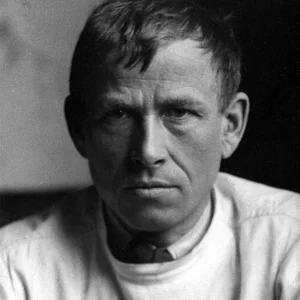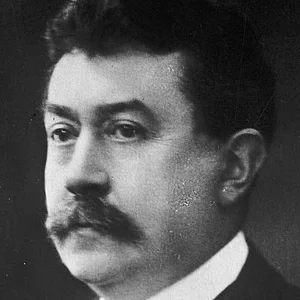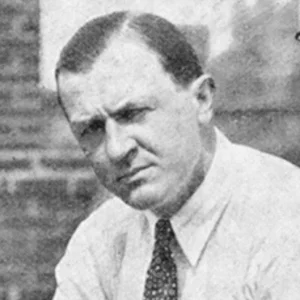

German painter and draughtsman (1893-1959), a major figure of Berlin Dada and the New Objectivity. His ferocious caricatures denounced the corruption, militarism, and inequality of the Weimar Republic.
George Grosz(1893 — 1959)
George Grosz
États-Unis, Allemagne
7 min read
Frequently asked questions
Key Facts
- Born in Berlin in 1893, died in 1959 after his return to Germany
- Co-founder of the Berlin Dada group around 1918-1920
- Leading figure of the New Objectivity movement (Neue Sachlichkeit) in the 1920s
- His satirical works attacked the bourgeoisie, the military, and the Weimar Republic
- Emigrated to the United States in 1933; his works were branded “degenerate art” by the Nazis
Works & Achievements
Manifesto-painting that layers, within a shattered Cubist-style space, the bourgeois, the priest and the soldier — pillars of a corrupt society.
A major work of the New Objectivity denouncing the elites of Weimar: open skulls reveal their thoughts (a military horse, lying newspapers).
A collection of scathing satirical drawings against industrialists, generals and profiteers; one of the high points of political caricature.
An allegorical canvas showing headless politicians led by an industrialist around a beheaded man, denouncing submission to capital.
A portfolio of watercolours and drawings on the decadence of Weimar-era Berlin, which earned him a trial for offending public morals.
A drawing depicting the crucified Christ in boots and a gas mask, which sparked a sensational trial for blasphemy.
A chaotic, glowing-red vision of the great modern city, marked by the influence of Futurism and Expressionism.
Anecdotes
In 1916, in protest against German nationalism and as a provocative show of admiration for the enemy, Georg Groß anglicized his name to “George Grosz.” His friend Helmut Herzfeld did the same, becoming “John Heartfield”: it was a way of mocking the anti-English hysteria that prevailed during the First World War.
In 1920, Grosz was taken to court for “insulting the German army” with his portfolio of drawings titled *Gott mit uns* (God With Us). It would not be his only trial: he was prosecuted three times during the 1920s, notably for blasphemy in 1928 over a drawing showing Christ on the cross wearing a gas mask and military boots.
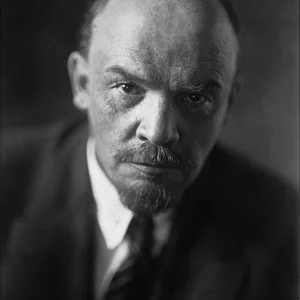
During the German revolution of November 1918, Grosz joined the brand-new German Communist Party. In 1922, he traveled through Soviet Russia for five months and met Lenin in person, but he returned deeply disillusioned by what he had seen and eventually drifted away from communism.
Sensing the Nazi danger, Grosz left Germany for the United States in January 1933, just a few days before Hitler became chancellor. The Nazis declared him the State's “number one enemy”; his works were seized and displayed as “degenerate art” (*entartete Kunst*) in 1937.
In 1959, Grosz moved back to Berlin after 26 years of American exile. A few weeks later, after a night of heavy drinking, he fell down the stairs of his apartment building and died. He had written, with irony, that he wanted to die in Berlin.
Primary Sources
I drew and painted out of a spirit of contradiction, and through my work I tried to convince the world that it was ugly, sick, and hypocritical.
A collection of 57 satirical drawings denouncing the industrialists, military officers, and bourgeois of the Weimar Republic, published by Malik-Verlag.
My drawings expressed my despair, my hatred, and my disillusionment. I drew the drunkards, the men vomiting, the men cursing the moon with raised fists.
The defendant Grosz is prosecuted for having depicted the crucified Christ wearing a gas mask and military boots, captioned “Maul halten und weiter dienen” (Shut your mouth and keep on serving).
Key Places
Grosz's birthplace and the stage for all his satirical work on the Weimar Republic. He returned there to die in 1959.
Grosz studied drawing here from 1909 to 1911. This is where he honed his craft as a draftsman.
Grosz stayed here in 1922 and met Lenin. This trip marked the beginning of his political disillusionment.
Grosz's place of exile from 1933 onward, where he taught at the Art Students League. His painting grew darker and more allegorical here.
In 1937, the Nazis exhibited works by Grosz here to ridicule them as “degenerate art.” Many were later sold or destroyed.
Typical Objects

Grosz's favorite tool for his satirical drawings, with their sharp, nervous line. The dry, incisive line gave his caricatures all their violence.

Grosz roamed the streets of Berlin, jotting down on the spot the faces, the war cripples, the profiteers and the prostitutes. These notebooks then fed into his paintings and portfolios.

His drawings were distributed in cheap printed collections by the Malik publishing house run by Wieland Herzfelde. This made his political art accessible to the general public.

Together with John Heartfield, Grosz experimented with collaging images cut from the press to create satirical works. The Berlin Dada group claimed to have invented this technique.

An emblematic object of the 1914-1918 trenches, under Grosz's pencil it becomes a symbol of militarism and hypocrisy, notably in his drawing of the crucified Christ. It embodies his condemnation of war.

In his caricatures, the top hat, the monocle and the fat cigar unfailingly mark out the well-fed capitalist and the war profiteer. These are the attributes of the ruling class he denounces.
School Curriculum
Vocabulary & Tags
Key Vocabulary
Daily Life
Morning
In 1920s Berlin, Grosz gets up in his studio and goes through the newspapers, cutting out images and headlines for his photomontages. Mornings are often devoted to pen drawing, in quick, incisive strokes.
Afternoon
In the afternoon, he goes out to observe the street: war cripples begging at the crossroads, paunchy bourgeois, prostitutes, and political agitators. He sketches these scenes from life in his notebook, scenes that will feed his paintings.
Evening
In the evening, Grosz frequents the cafés, cabarets, and Dada gatherings where he declaims and provokes. An eccentric dandy, he loves to put on a show, sometimes wearing makeup or a costume.
Food
Grosz shares the everyday fare of Weimar Berliners: black bread, sausages, sauerkraut, and beer in the taverns. The inflation years of 1923 make food scarce and expensive, something that comes through in his drawings of breadlines of the hungry.
Clothing
Mindful of his appearance, Grosz cultivated an Americanized dandy look: elegant suits, sometimes a cane and hat, in contrast to the scruffy bohemian style. This elegance was also an ironic provocation aimed at the bourgeoisie he caricatured.
Housing
He lives and works in artist's studios in Berlin, spaces cluttered with drawings, press clippings, and painting supplies. After 1933, he settles into a house in the New York suburb of Bayside.
Historical Timeline
Period Vocabulary
Liens externes & ressources
Références
Œuvres
Les Piliers de la société (Stützen der Gesellschaft)
1926
Le Visage de la classe dominante (Das Gesicht der herrschenden Klasse)
1921
Éclipse de soleil (Sonnenfinsternis)
1926
Ecce Homo
1922-1923
Christ au masque à gaz (Maul halten und weiter dienen)
1927-1928
Métropole (Metropolis)
1916-1917