
Soviet Russian composer, one of the greatest symphonists of the 20th century. His work, marked by a conflicted relationship with the Stalinist regime, swings between apparent conformity and a tragic expression of the human condition.
Dmitri Shostakovich(1906 — 1975)
Dmitri Shostakovich
Union soviétique, Empire russe
6 min read
Frequently asked questions
Key Facts
- Born in 1906 in Saint Petersburg and died in 1975 in Moscow
- In 1936, Pravda condemned his opera “Lady Macbeth of Mtsensk” in the article “Muddle Instead of Music”
- Created his Symphony No. 5 (1937), presented as a “Soviet artist's response to just criticism”
- Composed the Symphony No. 7 “Leningrad” (1941) during the city's siege by the Nazis, which became a symbol of resistance
- Was condemned again under the Zhdanov Doctrine in 1948 for “formalism”
Works & Achievements
A graduation work composed at age 19 that brought him immediate international fame.
A bold opera, triumphant at first, then condemned by Pravda in 1936, triggering his first fall from grace.
Presented as his rehabilitation after disgrace; a masterpiece of ambiguous grandeur, caught between imposed triumph and hidden tragedy.
Composed during the siege of the city, it became a worldwide symbol of resistance against Nazism.
Written after Stalin's death; it introduces his personal DSCH motif as an affirmation of self.
An intimate and deeply moving work, saturated with the DSCH motif, regarded as a self-portrait and a personal requiem.
Set to poems by Yevtushenko, it courageously denounces antisemitism and the crimes of the past.
Anecdotes
In 1936, the official Party newspaper, *Pravda*, published an anonymous article titled "Muddle Instead of Music" that demolished his opera *Lady Macbeth of Mtsensk*. It is believed that **Stalin** himself, shocked during a performance, was behind it. Overnight, **Shostakovich** went from national glory to a suspect artist, threatened with arrest.
Terrified by the Stalinist purges, **Shostakovich** slept fully dressed for months, a small suitcase ready by the door near his building's elevator. He wanted to be taken away in the hallway rather than in front of his family if the secret police came to arrest him in the middle of the night.
His Seventh Symphony, known as the "Leningrad
was composed during the Nazi siege of the city. In **August 1942**
it was performed in besieged **Leningrad** by an orchestra of starving musicians; the concert was broadcast over loudspeakers toward the enemy lines to show that the city was still holding out.
**Shostakovich** wove a secret musical signature into several works: the notes D–E flat–C–B, which in German notation spell D-S-C-H (his initials DSCH). It was his way of "signing" his music and asserting his identity in the face of the regime.
A passionate football fan, **Shostakovich** supported **Zenit Leningrad**. He even earned a referee's diploma and kept meticulous notebooks on matches and results, a hobby that offered him an escape from the political tensions.
Primary Sources
From the very first moment, the listener is thrown off by a deliberately discordant, confused stream of sounds. Snatches of melody and the beginnings of musical phrases drown, break free, and vanish once again into the din, the grinding, and the screeching.
A Soviet artist's creative reply to justified criticism.
Formalist and anti-popular tendencies in Soviet music are condemned as contrary to the people and to their artistic tastes.
The majority of my symphonies are tombstones. Too many of our people died and were buried in places unknown to anyone, not even their relatives.
Key Places
Shostakovich's birthplace in 1906, where he studied at the Conservatory. The city's siege by the Nazis inspired his Seventh Symphony.
He entered at age 13 to study piano and composition under the direction of Glazunov. His First Symphony was his graduation project there.
The Soviet capital where he lived much of his life and where his career was decided. He died there in 1975.
A city on the Volga where he was evacuated in 1941 and completed his Seventh Symphony, the “Leningrad.” The work's world premiere took place there in March 1942.
A prestigious Moscow cemetery where Shostakovich is buried alongside other great Russian figures. A site of remembrance for Soviet culture.
Typical Objects

The central instrument of his compositional work; a virtuoso pianist, he played and created his works at the keyboard. He took part in the first Chopin Competition in 1927.

Sheets of ruled paper on which he jotted down his symphonies and quartets in a rapid hand. He often composed very quickly, sometimes an entire symphony in a few weeks.

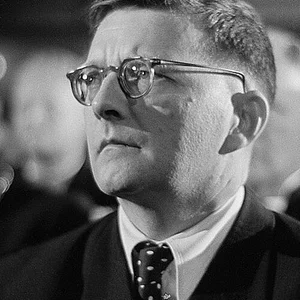
His thin round-framed glasses are part of his most famous image. They reinforced his look of a shy, tense intellectual.

A notebook in which this enthusiast scrupulously recorded match results and statistics. He even earned a referee's qualification, a sign of a pastime that helped him relax.

Soviet radio broadcast his Seventh Symphony from besieged Leningrad all the way to the German trenches. The music became a weapon of propaganda and morale.

A symbol of his forced membership in the CPSU in 1960, experienced as a humiliation. It embodies the constant compromise between the artist and those in power.
School Curriculum
Vocabulary & Tags
Key Vocabulary
Daily Life
Morning
Shostakovich rose early and worked at his desk or at the piano, often composing at an astonishing speed, sometimes writing straight to a clean copy. He loved the quiet of the morning to write down music he already heard fully in his head.
Afternoon
His afternoons were split between teaching at the Conservatory, orchestra rehearsals, and countless official meetings of the Union of Soviet Composers. He had to compose under the constant pressure of the cultural authorities.
Evening
In the evening he attended concerts, hosted musician friends, or followed football matches with passion, his great pastime. During periods of terror, he also lived in dread of a nighttime arrest.
Food
His diet was that of the Soviet urban intelligentsia: black bread, soups such as borscht, kasha (buckwheat porridge), and tea drunk from a samovar. In times of war and shortage, as in Leningrad, food became scarce and rationed.
Clothing
He wore the plain suits and ties of the twentieth-century Soviet intellectual, along with his characteristic round glasses. His understated attire reflected his nervous, reserved temperament.
Housing
He lived in urban apartments in Leningrad and later Moscow, as well as in a dacha (country house) granted to prominent artists. Under Stalin, housing — like any privilege — could be taken away in the event of disgrace.