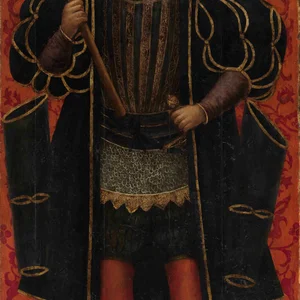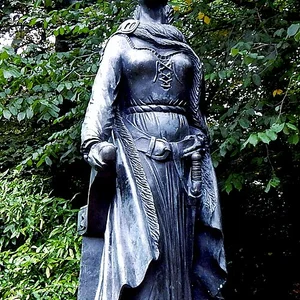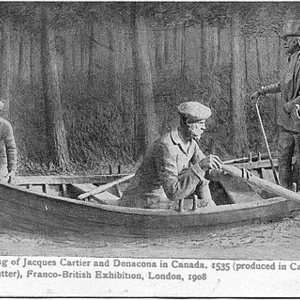

Chief of the St. Lawrence Iroquoians settled at Stadacona (present-day Quebec), Donnacona met Jacques Cartier during his voyages of 1534 and 1535. Taken to France by force by Cartier, he died at the court of King Francis I without ever seeing his homeland again.
Donnacona(1500 — 1539)
Donnacona
Canada
8 min read
Frequently asked questions
Key Facts
- 1534: first encounter with Jacques Cartier during his first voyage to Canada
- 1535: Cartier takes Donnacona and several Iroquoians to France during his second voyage
- 1536: Donnacona is presented to King Francis I at the French court
- c. 1539: death of Donnacona in France, never having been able to return to Canada
- Stadacona, his village, corresponds to the present-day location of the city of Quebec
Works & Achievements
Donnacona conveyed to the court of Francis I detailed descriptions of a fabulous inland kingdom overflowing with gold and riches. These testimonies, reported by Cartier, directly motivated the funding of the third French voyage to Canada in 1541.
During the first voyage, Donnacona negotiated with Cartier exchanges of food and furs for European goods. This first alliance laid the foundations for Franco-Amerindian relations in the St. Lawrence region.
By publicly challenging the cross planted by Cartier at Gaspé, Donnacona made one of the earliest recorded declarations of Indigenous sovereignty in the face of European colonization in North America.
Donnacona and his sons guided Cartier along the St. Lawrence during the second voyage, providing him with invaluable information about the geography, peoples, and resources of the territory. This Indigenous knowledge directly fed into the earliest French cartographies of the region.
Anecdotes
In July 1534, when Jacques Cartier erected a large ten-metre cross at Penouille (Gaspé Bay) in the name of the King of France, Donnacona paddled out by canoe to protest. Through signs, he made the French understand that this land belonged to him and his people. Cartier pretended not to understand his claim, alleging that the cross was merely a navigation marker.
In May 1536, Cartier invited Donnacona and his sons aboard his ship under the pretense of a friendly meeting. Once on board, the French held them prisoner. Donnacona and nine other St. Lawrence Iroquoians were forcibly taken to France, with no chance to say goodbye to those left on shore.
At the court of King Francis I, Donnacona captivated his audience by describing a fabulous land called the “Kingdom of Saguenay,” overflowing with gold, rubies, and spices, and inhabited by winged men. These accounts thrilled the king and helped finance Cartier’s third voyage in 1541, even though this legendary kingdom was never found.
Donnacona was baptized in France and given a Christian name. Despite the interest French nobles showed in him, he never truly adapted to European life and died around 1539, most likely from diseases to which he had no immunity, without ever seeing Stadacona or his loved ones again. When Cartier returned in 1541, he had to lie to the Iroquoians, claiming that Donnacona had died as a Christian, happy in France.
Primary Sources
And the next morning came the said Donnacona with a great multitude of people... and after several exchanges, he told us that it was a good and great land, where there was gold and rubies and other riches.
The said lord of the said savages came to us in a bark with three or four of his men, and showed us the said cross, and made this chief speak, gesturing with his hand that he had been lord of that land.
Donacona, king of those people, spoke to the Captain and said that they were content to come to France, and that they would bring many novelties to the Most Christian King.
The said Donnacona assured us it was true that there was infinite gold, rubies, and other riches in the land of Saguenay, and that the men there were as white as in France.
Key Places
An Iroquoian village established at the foot of Cape Diamond on the St. Lawrence River, Stadacona was the community of which Donnacona was chief. It was here that he welcomed and negotiated with Cartier during the voyages of 1534 and 1535.
It was at this site, in July 1534, that Cartier erected a cross to claim the land in the name of Francis I, and where Donnacona solemnly protested by canoe against this symbolic act of appropriating his territory.
A rival Iroquoian village located upriver on the St. Lawrence, which Donnacona tried to prevent Cartier from visiting during the second voyage in 1535. This rivalry between Stadacona and Hochelaga reveals the political tensions between Iroquoian groups.
The royal residence of Francis I where Donnacona was presented at the French court following his abduction in 1536. There he recounted the riches of the "Kingdom of Saguenay" and was baptized before spending his final days.
The Breton port from which Jacques Cartier's three expeditions departed. It was here that Donnacona and the other Iroquoians first set foot in Europe in 1536, encountering a world entirely foreign to their own.
Typical Objects

Made from shells carved into beads and strung on cords, the wampum belt served as a diplomatic and memorial instrument among the Iroquoians. As a chief, Donnacona used it to seal alliances and preserve the memory of important events.

Light and maneuverable, the birch bark canoe was the essential means of transport for the St. Lawrence Iroquoians on the river's waters. Donnacona used one to approach Cartier's ships during their first encounters in 1534.

The pipe, carved from stone or wood, was used during diplomatic and religious ceremonies. Smoking together symbolized peace and mutual respect between chiefs and their allies.

The cultivation of corn, squash, and beans — the “Three Sisters” — formed the foundation of Iroquoian agriculture. These staples, stored in pits or baskets, ensured the survival of the Stadacona community through the long winters.

The bow, made of ash wood strung with animal sinew, and arrows tipped with flint or bone were the hunting and warfare tools of Iroquoian warriors. Donnacona almost certainly wielded them as symbols of his authority as a war chief.

Cloaks and tunics made from softened and smoked beaver pelts protected against the harsh cold of Quebec winters. Beaver fur was also a precious trade commodity in the early commercial relations with Europeans.
School Curriculum
Vocabulary & Tags
Key Vocabulary
Tags
Daily Life
Morning
Donnacona rose at dawn in his longhouse, shared with several families of his clan. He began his day by consulting the elders and warriors about the state of food supplies, hunting activities, and the situation with neighboring nations. His role as chief required him to stay constantly informed about what was happening in and around his village.
Afternoon
The afternoon was devoted to governance: mediating internal disputes, receiving delegations from allied villages, or overseeing collective fishing activities on the St. Lawrence River. During peacetime, Donnacona also took part in discussions about trade routes with other Iroquoian or Algonquian nations.
Evening
In the evening, the community gathered around the fire in the longhouse to share a meal, listen to the elders' stories, and make important collective decisions. As chief, Donnacona led and facilitated these discussions; he was also the keeper of his people's oral traditions and diplomatic alliances.
Food
Donnacona's diet was built around the “Three Sisters”: corn, beans, and squash, cultivated by the women of the community. Fish from the St. Lawrence — salmon, sturgeon, and eel — made up a substantial portion of their food, supplemented by game hunted in the forest (deer, moose) and berries and wild plants gathered according to the seasons.
Clothing
In summer, Donnacona wore a light tunic of carefully tanned deerskin, leggings, and moccasins embroidered with porcupine quills. In winter, he wrapped himself in large cloaks of beaver or bear fur. As chief, his clothing was adorned with shell beads (wampum) and feathers — distinctive markers of his rank.
Housing
Donnacona lived in a longhouse (“ganonsia” in the Iroquoian language), a long cedar-wood frame covered with birch or elm bark, capable of sheltering several dozen people belonging to the same matrilineal clan. Stadacona comprised several of these longhouses, surrounded by a wooden palisade that protected the village from enemy attacks.
Historical Timeline
Period Vocabulary
Liens externes & ressources
Références
Œuvres
Récits oraux sur le royaume du Saguenay
1537
Alliance diplomatique avec Jacques Cartier (1534)
1534
Négociation sur la souveraineté du territoire (Gaspé, 1534)
1534
Témoignage sur la géographie du fleuve Saint-Laurent
1535