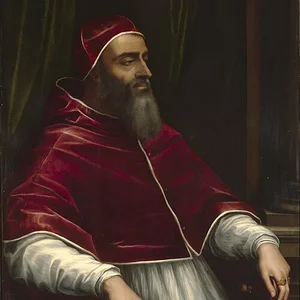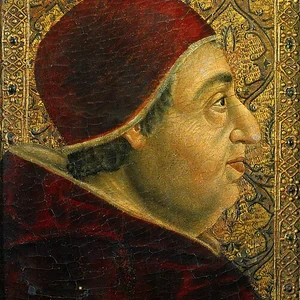

Spanish pope from 1492 to 1503, Alexander VI is one of the most controversial figures in the history of the papacy. Head of the powerful Borgia family, he blended politics, nepotism, and diplomacy in Renaissance Rome.
Alexander VI(1431 — 1503)
Alexander VI
couronne d'Aragon
8 min read
Frequently asked questions
Key Facts
- 1492: elected pope under the name Alexander VI, the same year Columbus discovered America
- 1493: issued the papal bull Inter caetera, dividing the New World between Spain and Portugal
- 1494: confirmed the Treaty of Tordesillas establishing the dividing line between colonial powers
- Father of Cesare Borgia and Lucrezia Borgia, symbols of papal nepotism
- 1503: died in Rome, leaving behind a deeply discredited papacy, foreshadowing the Protestant Reformation
Works & Achievements
Papal document dividing the New World between Spain and Portugal along a meridian line. A founding legal act of the Iberian colonial empire, it directly led to the Treaty of Tordesillas.
Hispanic-Portuguese agreement defining the oceanic line of demarcation, negotiated under the arbitration of the Holy See. It governed the division of Iberian colonial empires across the globe for more than a century.
A major cycle of frescoes of the Roman Renaissance adorning the pope's private chambers in the Vatican. These decorations blend Christian iconography with the dynastic symbolism of the Borgias, featuring an ever-present heraldic bull.
A great spiritual event drawing hundreds of thousands of pilgrims to Rome, generating immense revenues for the papacy. Alexander VI had several thoroughfares of the city redeveloped to accommodate the crowds, including the Via Alessandrina.
Papal text imposing on the Iberian crowns the obligation to evangelize the populations of the newly discovered lands. It laid the theological and legal foundations of the Catholic colonial mission in the New World.
Anecdotes
In 1493, Alexander VI published the bull *Inter caetera*, which literally divided the New World between Spain and Portugal, drawing an imaginary line across the Atlantic. This papal decision, taken without consulting the other European powers, shaped the political geography of the Americas for centuries. It illustrates the colossal power the pope claimed to exercise over world affairs.
His election to the throne of Saint Peter in 1492 was tainted by simony: Cardinal Rodrigo Borgia allegedly distributed gold, mules laden with chests, and promises of benefices to several cardinals to secure their votes. Cardinal Ascanio Sforza is said to have received four mules loaded with silverware in exchange for his decisive support. This scandalous practice was known but tolerated in the corrupt Rome of the fifteenth century.
Alexander VI shamelessly used nepotism to strengthen his family: he appointed his son Cesare as cardinal at barely eighteen, orchestrated advantageous marriages for his daughter Lucrezia, and relied on his children to consolidate his temporal power in Italy. Machiavelli, observing Cesare Borgia at work, drew directly from him when writing The Prince, making the Borgias the model of the unscrupulous prince.
On the night of 18 August 1503, Alexander VI died suddenly shortly after a dinner at the home of Cardinal Adriano Castellesi. An immediate rumour claimed he had accidentally drunk the poison he had intended for his host. Historians today agree on a malarial fever contracted in the Pontine Marshes, but the black legend of the Borgia poisoners remained alive for centuries.
Primary Sources
We, of our own accord, of our certain knowledge, and out of the fullness of our apostolic power, give, grant, and assign to you and your heirs and successors, forever, all islands and mainlands, found and to be found, discovered and to be discovered, towards the west and south.
Pope Alexander, sixth of that name, breathed his last this night at the first hour. His body swelled horribly and turned black, to the point that the guards had difficulty approaching it to perform the funeral rites.
It is openly said that the Pope purchased the votes of the conclave at great price, and that Cardinal Sforza received, on the night before the election, four mules laden with silver plate and gold in exchange for his support.
That there be fixed and assigned a boundary or straight line, from pole to pole, from the Arctic pole to the Antarctic pole, which line shall be drawn at a distance of three hundred and seventy leagues west of the Cape Verde Islands.
Key Places
Birthplace of Rodrigo de Borja, where the Borgia family held a notable social standing before establishing itself in Rome following the election of their uncle Callixtus III to the papacy in 1455.
A suite of six rooms decorated by Pinturicchio between 1492 and 1494 on the orders of Alexander VI. These apartments, the heart of Borgia power within the Vatican, combined the pope's private residence with official ceremonial spaces.
A papal fortress connected to the Vatican by a secret corridor, the Passetto di Borgo. Alexander VI took refuge there during the invasion of Charles VIII in 1494, illustrating its role as the ultimate sanctuary for popes in danger.
A region of central Italy that Cesare Borgia, his father's military enforcer, brought under control between 1499 and 1503. This conquest was intended to carve out a lasting Borgia state in central Italy — a project that collapsed upon the pope's death.
The site of grand pontifical ceremonies under Alexander VI, who celebrated the Jubilee of 1500 there before vast crowds. The old basilica was nearing the end of its life at the time; its reconstruction would not begin until the reign of Julius II.
Typical Objects

A three-crowned headdress symbolizing the pope's authority over heaven, earth, and purgatory. Alexander VI wore it during major ceremonies, and it appears in the official portraits in the Borgia Apartments.

A lead seal attached to official papal documents to give them the force of law. Alexander VI issued several that reshaped the world order, most notably the *Inter caetera* of 1493.

A gold papal ring engraved with the image of Saint Peter fishing, used to seal apostolic briefs. It was destroyed upon the pope's death to prevent any forgery of documents in the deceased's name.

A partially drawn map of the world depicting known lands and the new Atlantic discoveries. Alexander VI consulted one while drafting the bull *Inter caetera* to define the spheres of Iberian influence.

A richly ornamented cup used during papal Masses. Popular rumor linked the Borgia chalices to poisons supposedly hidden in a secret cavity — a legend with no proven historical basis, yet revealing of their reputation.

A fresco cycle commissioned by Alexander VI for his private apartments in the Vatican, blending biblical and mythological scenes with portraits of the Borgia family. The kneeling pope appears in the Resurrection scene, combining dynastic propaganda with sacred iconography.
School Curriculum
Vocabulary & Tags
Key Vocabulary
Daily Life
Morning
Alexander VI rose at dawn for Matins and Lauds celebrated privately in his chapel within the Borgia Apartments. He then received cardinals and ambassadors from the earliest hours of the day, as he was renowned for his exceptional energy and sharp mind even in old age.
Afternoon
Afternoons were devoted to diplomatic audiences, signing papal bulls, and presiding over consistories where the Church's major decisions were made. The Pope also oversaw the artistic decoration of his apartments and welcomed humanists and artists into a Vatican that aspired to be the cultural heart of Christendom.
Evening
Evenings at the Borgia court alternated between lavish dinners bringing together family and Roman aristocracy, and moments of private devotion. The presence of Lucrezia and Cesare frequently enlivened the pontifical table, blending family strategy with the pleasures of Renaissance Roman life.
Food
The pontifical table offered the finest dishes of Romano-Spanish cuisine: roasted meats in sauce, fish from the Pontine lakes, exotic fruits, and wines from Campania. State banquets could feature dozens of courses washed down with local wines and Aragonese specialties recalling the Pope's Iberian origins.
Clothing
Alexander VI wore the traditional pontifical vestments: white cassock, mozzetta, and crimson silk camail depending on the occasion. For grand ceremonies, he donned the gold-embroidered cope and the three-crowned tiara; in his private apartments, he preferred more comfortable Spanish silks embroidered with the Borgia coat of arms.
Housing
Alexander VI resided in the apartments that bear his name, on the second floor of the Apostolic Palace, freshly decorated by Pinturicchio. These six interconnecting rooms provided both formal reception spaces for official audiences and a private residence warmed by large fireplaces and lit by numerous silver candelabras.
Historical Timeline
Period Vocabulary
Visual Style
L'univers visuel d'Alexandre VI est celui de la Renaissance romaine dans toute sa splendeur : fresques de Pinturicchio aux couleurs saturées, ors pontificaux, pourpres cardinalices et symbolique héraldique du taureau des Borgia sur fond de marbre blanc.
Sound Ambience
L'ambiance sonore des appartements pontificaux mêle chants grégoriens et cérémonies liturgiques fastueuses à des conversations diplomatiques feutrées en latin, italien et castillan, dans un Vatican en pleine ébullition artistique et politique.
Liens externes & ressources
Références
Œuvres
Bulle Inter caetera
1493
Traité de Tordesillas (médiation pontificale)
1494
Appartements Borgia — commande à Pinturicchio
1492-1494
Organisation du Jubilé de l'an 1500
1500
Bulle Ineffabilis et Providentia Dei
1493