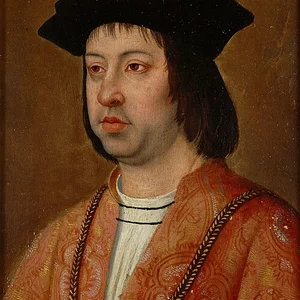

King of Aragon, Ferdinand II married Isabella of Castile in 1469, uniting the two great Iberian crowns. Together, the “Catholic Monarchs” completed the Reconquista in 1492, financed Christopher Columbus's voyage, and laid the foundations of modern Spain.
Ferdinand II of Aragon(1452 — 1516)
Ferdinand II of Aragon
couronne d'Aragon
9 min read
Frequently asked questions
Key Facts
- 1469: marriage to Isabella of Castile, union of the crowns of Aragon and Castile
- 1492: capture of Granada, end of the Reconquista, and financing of Christopher Columbus's first voyage
- 1492: Alhambra Decree ordering the expulsion of Jews from Spain
- 1494: Pope Alexander VI bestows the title “Catholic Monarchs” on Ferdinand and Isabella
- 1512: annexation of the Kingdom of Navarre, completing Spanish territorial unity
Works & Achievements
Through his marriage to Isabella and his inheritance of the throne of Aragon, Ferdinand brought previously rival kingdoms under a single authority. This dynastic union is considered the foundation of the modern Spanish state.
After eleven years of military campaign, Ferdinand and Isabella captured Granada, the last Islamic stronghold on the Iberian Peninsula. This event ended 781 years of Muslim presence and was hailed throughout Christendom as a decisive victory.
By signing the Capitulations of Santa Fe, Ferdinand and Isabella launched the exploration of the New World. This decision opened an era of conquest that would make Spain the world's leading power in the 16th century.
Ferdinand obtained from Pope Sixtus IV the right to establish an inquisition under royal control to monitor conversos. This instrument of political and religious control greatly strengthened monarchical authority over the Church in Spain.
Negotiated with Portugal, this treaty divided the world along a meridian line, granting the Americas to Spain and Africa and Asia to Portugal. It established the legal framework for European colonial empires for two centuries.
Ferdinand wrested the Kingdom of Naples from France after two successive wars, extending Spanish dominance over the western Mediterranean. This victory made Spain the dominant power in Italy for over a century.
Anecdotes
In 1469, Ferdinand and Isabella were secretly married in Valladolid despite the opposition of King Henry IV of Castile. To circumvent canonical prohibitions, they used a forged papal bull authorizing marriage between cousins. This political coup united two rival crowns and laid the foundations of modern Spain.
On January 2, 1492, the last sultan of Granada, Boabdil, symbolically handed over the keys of the city to Ferdinand and Isabella. According to tradition, as he left the city, Boabdil turned back to gaze one last time at the Alhambra and wept — hence the name of the pass 'Suspiro del Moro' (Sigh of the Moor). Ferdinand had led this military campaign for eleven years.
Christopher Columbus had initially been refused by Ferdinand before Isabella convinced her husband to finance the expedition. In April 1492, the Capitulations of Santa Fe set by contract the rights and titles Columbus would receive if he succeeded — a negotiation Ferdinand found too generous, but which he ultimately accepted.
Niccolò Machiavelli, who observed Ferdinand at work, cited him as a model of the ideal prince in his famous treatise. He admired his ability to mask his true intentions behind religious justifications, especially during the expulsion of the Jews and Moors. For Machiavelli, Ferdinand embodied the art of governing with efficiency and cunning.
In 1502, Ferdinand ordered the forced conversion or expulsion of the Moors of Castile (the future Moriscos), continuing his policy of religious homogenization. This decision deprived Spain of many skilled artisans and farmers. It illustrates the dark side of an otherwise foundational reign, combining political power with religious intolerance.
Primary Sources
That Their Highnesses make and appoint the said Don Christopher Columbus their admiral, viceroy and governor general of all the islands and mainlands that he shall discover and acquire in the said Ocean Seas.
We order all Jews and Jewesses, of whatever age they may be, who live, dwell and reside in our kingdoms and lordships, both natives and foreigners, to depart with their sons, daughters and the Jewish members of their families.
King Ferdinand was a man of great prudence, concealing his intentions and slow to make decisions, but once resolved, he never abandoned his enterprise and knew how to conceal the means until success.
The said Lords King and Queen of Castile, León, Aragon, etc., and the said Lord King of Portugal agree that a straight line be drawn from the Arctic Pole to the Antarctic Pole, three hundred and seventy leagues west of the Cape Verde Islands.
Ferdinand of Aragon, the present King of Spain, can almost be called a new prince, because from a weak king he has become, by fame and glory, the first king of Christendom. He did little but great things, and all admirable.
Key Places
The last capital of the Moorish kingdom, the Alhambra became a symbol of the Reconquista when Ferdinand and Isabella made their triumphal entry on January 2, 1492. They established a court there and are buried in the Royal Chapel adjoining the cathedral.
The main royal residence under Ferdinand, Seville was the coordination center for expeditions to the Americas and the port from which Columbus sailed. It was there that the wealth and reports from the newly discovered lands were centralized.
The city where Ferdinand and Isabella secretly married in 1469, it became one of the main residences of the Castilian court. It was in the Valladolid region, at Madrigalejo, that Ferdinand died in January 1516.
Capital of the Kingdom of Aragon and a city linked to Ferdinand's childhood, Zaragoza was the political heart of his hereditary crown. The Cathedral of the Pillar there preserves the Aragonese traditions associated with the royal lineage.
Former Visigothic capital and a symbol of the coexistence of three cultures (Christian, Jewish, Muslim), Toledo housed the most powerful archbishopric in Spain. Ferdinand relied on the Church there to bolster his authority and convened several councils.
Typical Objects

Symbol of sovereignty and military power, Ferdinand's sword was carried during major ceremonies and surrenders. The capitulation of Granada was accompanied by the symbolic handing over of keys and weapons between Boabdil and the Catholic King.

Official document sealed by the Pope, having the force of law in Christendom, the bull *Inter caetera* (1493) granted Spain sovereignty over the lands discovered by Columbus. Ferdinand skillfully used papal authority to legitimize his political and religious decisions.

Legal act by which Ferdinand and Isabella defined the rights and obligations of an explorer before his departure. The **Capitulations of Santa Fe** signed with Columbus in 1492 are the founding document of the conquest of the Americas.

Ferdinand personally took part in some military campaigns, notably during the siege of Baza in 1489. The armor of this period, forged in Spain or Northern Italy, combined maximum protection with the visual prestige of the commander-in-chief.

The double coat of arms seal — the castle of Castile and the bars of Aragon — materialized the union of the kingdoms on all official documents. It was one of the first visual symbols of a unified Spain and still appears in the current Spanish coat of arms.

Navigation sea charts used by explorers funded by the crown. Ferdinand relied on these instruments to plan routes to new lands and defend Spanish rights against Portugal during the negotiations of **Tordesillas**.
School Curriculum
Vocabulary & Tags
Key Vocabulary
Tags
Daily Life
Morning
Ferdinand began his day with a private mass in the royal chapel, accompanied by his confessors and almoners. He then consulted with his secretaries to review diplomatic dispatches that had arrived overnight, before holding an initial restricted council with his closest advisors.
Afternoon
Afternoons were often devoted to audiences and royal councils where Ferdinand decided military, judicial, and diplomatic affairs. A great lover of hunting, he sometimes allowed himself horseback outings in the vicinity of the court, an activity that was both sporty and a symbol of royal power.
Evening
Evenings at court were marked by formal banquets, musical performances, and readings of chronicles or religious texts. Ferdinand frequently received foreign ambassadors during these dinners, blending diplomacy and festivities within the strict rules of Castilian ceremonial.
Food
The 15th-century Spanish royal table brought together roast meats (game, lamb, pork), fish during Lent, white wheat bread, and boiled vegetables seasoned with Eastern spices. Rioja and Andalusian wine accompanied every meal, while sugar — a luxury product — adorned confections reserved for special occasions.
Clothing
Ferdinand wore doublets of velvet or brocade in the colors of Castile and Aragon (red, gold, blue), often adorned with embroidery and ermine furs on ceremonial attire. During military campaigns, he donned a full plate armor with a surcoat bearing the royal arms; in daily life, the more sober woolen hunting outfits contrasted with the splendor of the court.
Housing
Ferdinand and Isabella moved with an itinerant court among their main residences: the Alcázar of Seville, the royal palace of Valladolid, and, after 1492, the royal apartments of the Alhambra in Granada. These palaces combined Castilian Gothic architecture with Mudéjar decoration inherited from Moorish rulers, featuring vast throne rooms, interior gardens with fountains, and scriptoria where clerks and royal secretaries worked.
Historical Timeline
Period Vocabulary
Visual Style
Le style visuel de la cour de Ferdinand mêle gothique tardif espagnol et influences mauresques (Mudéjar), avec une palette de ors, pourpres et ocres caractéristique de la peinture flamande prisée à la cour de Castille.
Sound Ambience
Une cour royale espagnole à la charnière du Moyen Âge et de la Renaissance : fanfares militaires, chants liturgiques, rumeur des palais de pierre et échos d'une Espagne en pleine transformation religieuse et politique.