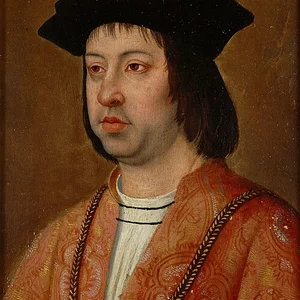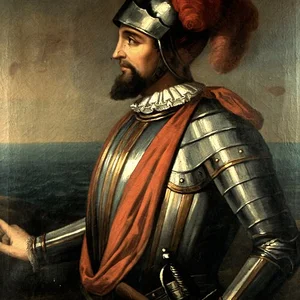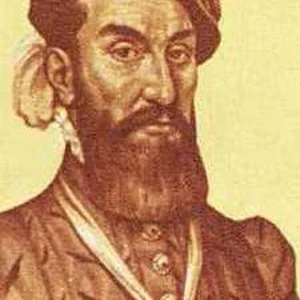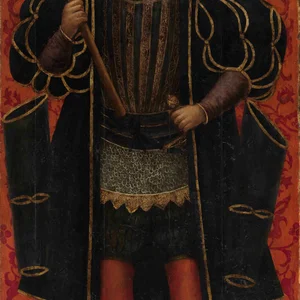

First Viceroy of Portuguese India (1505–1509), Francisco de Almeida consolidated the Lusitanian presence in the Indian Ocean. He won the decisive Battle of Diu (1509) against the Ottoman-Egyptian fleet, securing Portuguese maritime supremacy in Asia.
Francisco de Almeida(1450 — 1510)
Francisco de Almeida
royaume de Portugal
8 min read
Frequently asked questions
Key Facts
- 1505: appointed first Viceroy of Portuguese India by King Manuel I
- 1509: decisive victory at the Battle of Diu against the Ottoman-Egyptian-Indian coalition
- 1509: refused to hand over his post to Afonso de Albuquerque, leading to a conflict
- 1510: died at the Cape of Good Hope during a skirmish with the Khoikhoi on the return journey to Portugal
Works & Achievements
A decisive defeat of the Ottoman-Mamluk-Gujarati coalition, considered one of the founding naval battles of European hegemony in Asia. It secured Portugal's monopoly over the spice trade for several decades.
The first major Portuguese fortification on the East African coast, enabling control over the gold trade from Zimbabwe and the ivory trade. It illustrates Almeida's strategy of dominance through key maritime chokepoints.
The second major fortification on the Swahili coast, taken by force after the city resisted. Mombasa would later become a permanent stronghold of Portuguese presence in East Africa.
A system of paid maritime licenses imposed on all trade in the Indian Ocean. The first form of colonial maritime taxation, it established a model of economic control without direct territorial occupation.
A body of letters and reports addressed to the king describing the state of Portuguese India, its battles, alliances, and administrative difficulties. A major primary historical source for understanding Portuguese colonial policy.
Anecdotes
During the Battle of Chaul in 1508, Francisco de Almeida's son, Lourenço, was killed in combat by the Ottoman-Egyptian fleet. Consumed by grief, Francisco refused to delegate revenge to his lieutenants and personally led the punitive expedition. The following year, at Diu, he crushed the enemy coalition himself, crying out — according to tradition — that he had finally avenged his son.
In 1509, when Afonso de Albuquerque arrived in India bearing royal orders to succeed him as governor, Almeida categorically refused to relinquish power. He even had Albuquerque imprisoned for several weeks at Cannanore. It was only upon the arrival of a reinforcement fleet from Lisbon that he finally complied, believing he still had unfinished business to settle.
On his way back to Portugal in 1510, Almeida stopped near the Cape of Good Hope. A skirmish broke out with Khoikhoi warriors (the indigenous people of southern Africa) during a trade exchange that went wrong. In the fighting, Francisco de Almeida was killed by a spear thrust — a tragic and unexpected end for the victor of Diu.
The Battle of Diu (February 1509) was one of the first great naval confrontations between Europe and the Islamic world for control of the spice trade routes. Almeida fielded around twenty Portuguese vessels equipped with heavy artillery against a far larger fleet. His tactical victory secured Lisbon's monopoly over maritime trade between Europe and Asia for several decades.
Francisco de Almeida established the cartaz system: any ship wishing to trade in the Indian Ocean had to obtain a paid Portuguese pass. This indirect tax on Asian trade helped finance the Portuguese military presence without the need for large-scale territorial occupation — a model of commercial rather than territorial empire.
Primary Sources
Your Highness should know that Lourenço, my son, died fighting the Moors and the Rumes at Chaul, as did many hidalgos of your household. I beseech Your Highness to allow me to avenge this defeat before my return.
Dom Francisco de Almeida, with a fleet of nineteen ships, attacked the Moorish and Rume fleet anchored at Diu and defeated it so thoroughly that few escaped, thus establishing His Majesty's power over that entire sea.
Dom Francisco de Almeida was chosen as the first viceroy of the Indies — a man of great counsel and experience in the art of war — with the authority to administer justice and to make peace or war with the kings and lords of those lands.
Dom Francisco de Almeida refused to hand over the governance of the Indies to Governor Afonso de Albuquerque, saying he did not recognize his credentials, and had him imprisoned at Cannanore, where he remained for some time.
Since the Battle of Diu, no Moorish vessel dares to sail freely in these seas without Portuguese permission, so widely has the terror of their artillery and naval power spread from Hormuz to Malacca.
Key Places
Capital of the kingdom, Almeida's city of birth and education, from which he set sail in 1505 at the head of his fleet bound for the Indies.
Administrative capital of the Estado da India under Almeida, where he established his headquarters and reinforced the Portuguese presence along the Malabar Coast.
Site of the decisive battle of 3 February 1509, where Almeida destroyed the Ottoman-Egyptian-Gujarati fleet and secured Portuguese maritime dominance in Asia.
A prosperous Swahili city-state where Almeida landed in 1505, captured the sultan, and built a fortress to control the gold and ivory trade in East Africa.
The place where Almeida met his death in March 1510, killed in a skirmish with Khoikhoi warriors on his return from the viceroyalty. He would never see Portugal again.
A major port on the Malabar Coast, stronghold of Arab merchants and the chief center of resistance to Portuguese dominance, and the scene of several naval confrontations.
Typical Objects

Heavy three-masted warship armed with bronze cannons, which Almeida used as his flagship. Its firepower was superior to that of Arab or Ottoman galleys, which largely explains the victory at Diu.

Official document that every ship had to purchase from the Portuguese in order to trade without risking being boarded or sunk. Almeida developed this system to tax Indian Ocean trade without having to conquer any territory.

Brass navigation instrument used to measure the height of the sun and determine latitude at sea. Essential during Atlantic and Indian Ocean crossings for Almeida's fleets.

Almeida wore full metal armor during naval battles and fortress assaults. At Diu, Portuguese knights in armor represented a major psychological and defensive advantage against enemy archers.

Artillery mounted aboard Portuguese naus, fundamental to Almeida's tactics. At Diu, the cannons fired at long range, preventing enemy galleys from closing in to board.

Hand-drawn maritime map depicting coastlines, ports, and navigation routes. Almeida's pilots had partial portolan charts of the Indian Ocean, supplemented by knowledge gathered from captured Arab and Indian navigators.

Chivalric insignia worn by Almeida as a member of this Portuguese military order. The stylized red cross identified the rank and dignity of its bearer within the Lusitanian military nobility.
School Curriculum
Vocabulary & Tags
Key Vocabulary
Daily Life
Morning
Almeida began his day with prayer and Mass, an essential practice for a Catholic knight of the Order of Santiago. He would then inspect the fortifications, ships, and troops, checking the state of the artillery and the night watch reports from the previous evening.
Afternoon
The afternoon was devoted to diplomatic audiences: receiving representatives of local rulers, negotiating cartazes and trade treaties, and sometimes arbitrating disputes between merchants. He also held war councils with his captains to plan expeditions or respond to intelligence on enemy fleets.
Evening
In the evening, Almeida would dictate or write his reports and letters bound for Lisbon, detailing battles, conquests, and the need for reinforcements. The social life of the viceregal court at Cochin brought together captains, Portuguese merchants, and sometimes local dignitaries around a shared meal.
Food
At sea, the standard ration consisted of ship's biscuit (dried bread), salted fish, lard, and dried pulses. In India, the viceroy's table enjoyed rice, fresh fish, tropical fruits (coconuts, mangoes), and local spices, along with wines and provisions brought from Portugal.
Clothing
In peacetime or during audiences, Almeida wore Portuguese noble dress: an embroidered doublet, breeches, a cloak, and the cross of the Order of Santiago embroidered on his chest. On naval campaigns or during assaults, he donned full plate armor with helmet and gauntlets, a symbol of his role as knight-commander.
Housing
In Cochin, Almeida resided in the Portuguese trading-post fortress — a stone building surrounded by ramparts that served at once as viceregal palace, court of law, warehouse, and arsenal. The rooms were soberly furnished in the Iberian style, adorned with a few precious fabrics and local objects, far removed from the comfort of Lisbon's palaces.
Historical Timeline
Period Vocabulary
Liens externes & ressources
Références
Œuvres
Victoire de la bataille de Diu
3 février 1509
Construction du Fort de Kilwa
1505
Construction du Fort de Mombasa
1505
Mise en place du système des cartazes
1505-1509
Correspondance officielle avec le roi Manuel Ier
1505-1509