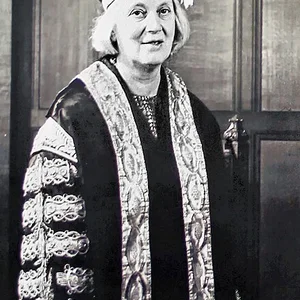

British chemist (1910-1994)
Dorothy Hodgkin(1910 — 1994)
Dorothy Crowfoot Hodgkin
Royaume-Uni
8 min read
Frequently asked questions
Key Facts
- Dorothy Crowfoot Hodgkin naît en 1910 en Égypte, dans une famille britannique passionnée d'archéologie et de sciences.
- Elle développe la technique de la cristallographie aux rayons X pour déterminer la structure tridimensionnelle de molécules biologiques complexes.
- En 1945, elle élucide la structure de la pénicilline, contribuant au développement des antibiotiques.
- En 1964, elle reçoit le prix Nobel de chimie pour la détermination par rayons X de la structure de substances biochimiques importantes, notamment la vitamine B12.
- Elle est la troisième femme à recevoir le prix Nobel de chimie et milite toute sa vie pour la paix et la coopération scientifique internationale.
Works & Achievements
Elucidation of the exact molecular structure of penicillin by X-ray crystallography. This discovery enabled the industrial synthesis of the antibiotic and saved millions of lives during and after the Second World War.
Determination of the three-dimensional structure of vitamin B12, the most complex biological molecule ever analysed by crystallography at the time. This work was the primary reason she was awarded the Nobel Prize in Chemistry.
After 35 years of effort, Dorothy published the complete three-dimensional structure of insulin. This monumental breakthrough opened the way to a detailed understanding of diabetes and the development of improved synthetic insulins.
A major methodological contribution that standardised X-ray crystallography techniques and served as a reference for an entire generation of researchers in structural chemistry.
As president of the Pugwash organisation, Dorothy Hodgkin used her Nobel prestige to actively campaign for world peace, nuclear disarmament, and international scientific cooperation between the Eastern and Western blocs.
Anecdotes
Dorothy Hodgkin solved the structure of penicillin in 1945, a feat considered impossible by many of her male colleagues. She used X-ray crystallography, a technique she mastered better than anyone, to reveal the exact arrangement of atoms in this molecule vital to medicine.
When she received the Nobel Prize in Chemistry in 1964, a major British newspaper ran the headline: 'Oxford grandmother wins Nobel' — deliberately ignoring her professorship and her decades of pioneering research. This anecdote illustrates the gender bias she faced throughout her career without ever letting it discourage her.
Dorothy had suffered from rheumatoid arthritis since adolescence, which progressively deformed her hands. Despite constant pain and increasingly stiff joints, she continued to handle her crystals and work in the laboratory well into old age, refusing to let the disease define her limits.
The structure of insulin, which she began studying in 1934, was not fully elucidated until 1969 — 35 years of relentless work. This titanic project mobilised entire teams and was one of the first to use computers to analyse thousands of crystallographic data points.
Margaret Thatcher, a former student of Dorothy's at Oxford, kept a portrait of her teacher in her office at Downing Street. Yet the two women held radically opposing political convictions: Dorothy Hodgkin actively campaigned for world peace and nuclear disarmament, and served as president of the Pugwash organisation.
Primary Sources
«The X-ray analysis of complicated molecular structures has been developed during the last thirty years into a powerful method for their direct determination.»
«We have found the structure of penicillin — it is a beta-lactam ring. The result is extraordinary and rather beautiful.»
«The structure of penicillin has been determined by X-ray crystallographic analysis of a number of derivatives, all pointing to a beta-lactam structure.»
«The structure of vitamin B12 is one of the most complex natural products whose structure has been determined by X-ray analysis.»
«Scientists bear a particular responsibility for the consequences of their discoveries. We must speak out for peace and against the misuse of science.»
Key Places
Where Dorothy completed her higher education and worked for most of her career. Oxford was her intellectual home for over sixty years, despite the institutional barriers faced by women.
Laboratory where Dorothy worked with J.D. Bernal and discovered her vocation for X-ray crystallography. This legendary site of British physics shaped her scientific method.
Dorothy's birthplace in 1910, where her father worked for the British educational service. She spent her early years there and developed a fascination for mineral crystals in the desert.
The town where Dorothy Hodgkin resided in the final years of her life, and where she died in 1994. She is commemorated there by a plaque and remains a source of local pride.
The venue where Dorothy presented several of her major discoveries and participated in the great British scientific conferences of the 20th century.
Typical Objects

The central instrument of Dorothy Hodgkin's work, it directs a beam of X-rays onto a crystal and records the diffraction patterns on photographic film. These patterns, analysed mathematically, made it possible to reconstruct the position of each atom in the molecule.

Dorothy carefully grew and selected microcrystals of penicillin, vitamin B12, and insulin. Crystal quality was critical: an imperfect crystal produced unreadable data, and their preparation was as much an art as a science.

Sheets of photographic paper darkened by diffracted X-rays, covered with spots arranged in circular patterns. Dorothy spent hours measuring the position and intensity of each spot to deduce the molecular structure.

Before 3D software, researchers manually built physical models of molecules using metal rods and coloured spheres representing each atom. Dorothy's vitamin B12 model stood over a metre tall.

The thousands of calculations required for crystallography were initially performed by hand or with a mechanical calculator, before Dorothy became one of the first researchers to use computers to analyse her insulin data in the 1960s.

Dorothy meticulously recorded every experiment, measurement, and hypothesis in detailed laboratory notebooks. These archives, held at the Bodleian Library in Oxford, bear witness to decades of scientific rigour.
School Curriculum
Vocabulary & Tags
Key Vocabulary
Tags
Daily Life
Morning
Dorothy started her days early, preparing breakfast for her three children before walking to her laboratory at Oxford. Despite the pain of her rheumatoid arthritis, she consistently refused to slow down and often arrived at the lab before her assistants.
Afternoon
Afternoons were devoted to analysing X-ray diffraction photographs, laid out on light boxes in a darkened room. She would use a magnifying glass to measure the position and intensity of hundreds of spots, filling sheets of calculations that her students would then verify. She also supervised the work of her many doctoral students.
Evening
In the evenings, Dorothy returned home for family dinner, often with colleagues or visiting scientists. She read widely — scientific papers, but also literature and history — and wrote her international correspondence, maintaining relationships with researchers behind the Iron Curtain.
Food
Dorothy had a typically British diet for her era: porridge in the morning, sandwiches for lunch often eaten at the laboratory, and a family dinner with meat and vegetables in the evening. She enjoyed shared meals and long tables filled with lively scientific and political discussions.
Clothing
In the laboratory, Dorothy always wore a white lab coat over plain, practical clothing — mid-calf dresses or skirts in neutral tones, typical of British academic women in the 1950s and 1960s. For official ceremonies, she proudly wore her Oxford academic gown adorned with the colours of her doctoral degree.
Housing
Dorothy and her husband Thomas Hodgkin lived in a large family home in Oxford, lively and often filled with students, colleagues, and political activists. The house reflected their dual identity as scholars and committed intellectuals: books everywhere, world maps on the walls, and a dining table well suited to animated debates.
Historical Timeline
Period Vocabulary
Visual Style
Esthétique sobre et précise des laboratoires universitaires britanniques du milieu du XXe siècle, entre austérité d'après-guerre et élégance académique oxonienne, dominée par les noirs et blancs des clichés de diffraction et les tons chauds du bois sombre des paillasses.
Sound Ambience
Ambiance feutrée d'un laboratoire d'Oxford des années 1940-1960, mêlant le bourdonnement des appareils à rayons X, le froissement des films photographiques et la concentration silencieuse d'une équipe de chercheurs déchiffrant des structures moléculaires inconnues.
Liens externes & ressources
Références
Œuvres
Structure de la pénicilline
1945
Structure de la vitamine B12
1956
Structure de l'insuline
1969
Atlas des structures moléculaires par diffraction X
1951