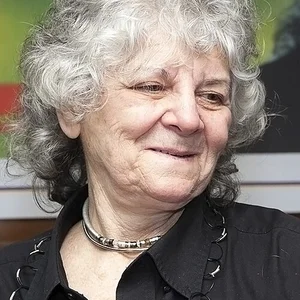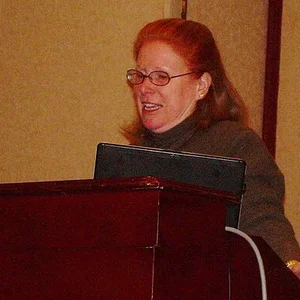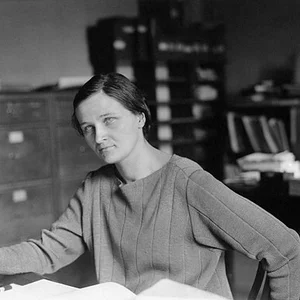

British-born American astronomer (1900–1979), she discovered that stars are composed primarily of hydrogen and helium. Her 1925 doctoral thesis revolutionized astrophysics, even though her conclusions were initially rejected by her peers.
Cecilia Payne-Gaposchkin(1900 — 1979)
Cecilia Payne-Gaposchkin
États-Unis, Royaume-Uni
7 min read
Frequently asked questions
Key Facts
- 1900: born in Wendover, England
- 1925: defended her doctoral thesis demonstrating that stars are composed predominantly of hydrogen
- 1956: first woman appointed full professor at Harvard
- 1979: died in Cambridge, Massachusetts
Works & Achievements
Revolutionary doctoral thesis demonstrating that stars are primarily composed of hydrogen and helium. Described by Otto Struve as “the most brilliant PhD thesis ever written in astronomy.”
Monograph published in the Harvard Observatory Monographs series, devoted to the atmospheres of giant and supergiant stars, extending and deepening the discoveries of her thesis.
A comprehensive study of variable stars, the product of many years of systematic observation carried out with her husband Sergei Gaposchkin. A reference work for the next generation of astronomers.
A popular science book aimed at the general public and high school students, explaining the birth and evolution of stars in an accessible yet rigorous way.
A university textbook synthesizing the astronomical and astrophysical knowledge of its time, drawn from her Harvard courses and widely adopted at American universities.
An in-depth study of galactic novae carried out with Sergei Gaposchkin, contributing to the understanding of stellar explosions and their systematic classification.
Anecdotes
In 1925, Cecilia Payne concluded in her doctoral thesis that stars are composed of more than 90% hydrogen and helium. The eminent astronomer Henry Norris Russell firmly advised her to remove this conclusion, dismissing it as "almost certainly wrong" since it ran counter to the scientific consensus of the time. Four years later, Russell himself published identical findings, publicly acknowledging that she had been right from the start.
When Cecilia Payne studied at Cambridge in the 1920s, the university still did not award degrees to women: she attended lectures, passed her examinations brilliantly, but could receive no official qualification. It was this injustice that led her to cross the Atlantic and join the Harvard Observatory, where her work would finally be recognised.
The astronomer Otto Struve, one of the greatest names in twentieth-century astrophysics, called Cecilia Payne's thesis "the most brilliant doctoral dissertation ever written in astronomy." This verdict, echoed by many historians of science, reflects the enormous impact her work had on the entire discipline.
In 1956, after more than thirty years at Harvard, Cecilia Payne-Gaposchkin became the first woman appointed as a full professor at the university and the first to chair a department. Throughout all those years, she had produced first-rate scientific work without enjoying the same titles or the same pay as her male colleagues.
Cecilia Payne met the Russian astronomer Sergei Gaposchkin during a visit to Europe in the 1930s. A political refugee, he was unable to obtain an American visa through normal channels. She used all her influence with Harvard to help him enter the United States — a remarkable act of solidarity for the time, and the beginning of a life together and a scientific collaboration that would span several decades.
Primary Sources
The outstanding discrepancy between the astrophysical and terrestrial abundances of hydrogen is almost certainly not real. An enormous relative abundance of hydrogen in the stellar atmosphere is indicated.
It is clearly impossible that hydrogen should be so enormously abundant. Your result is almost certainly wrong. I think you should omit it from your thesis.
The spectra of the most luminous stars reveal exceptional conditions in their atmospheres, conditions far removed from those obtaining in the solar atmosphere.
I was to blame for much of the misunderstanding. I had submitted to authority when I should have stood by my convictions.
Key Places
Cecilia Payne's hometown, where she grew up and developed a passion for science at an early age — notably after attending a lecture by Arthur Eddington on relativity.
The women's college where Payne studied physics and astronomy with distinction, yet was never able to receive an official degree because of her sex — which ultimately drove her to emigrate to the United States.
The site of her entire scientific career, where she completed her groundbreaking doctoral thesis in 1925 and worked for more than fifty years, eventually becoming the first woman to hold a full professorship at the university.
A Harvard observing station used for large-scale photographic surveys. Payne had a significant portion of the photographic plates she analysed in her work on variable stars taken there.
Typical Objects

An instrument that breaks down starlight into colored spectral lines, making it possible to identify the chemical elements present in stellar atmospheres. It was through spectroscopy that Payne was able to demonstrate the predominance of hydrogen.

Rigid supports coated with a photosensitive emulsion, used to record stellar spectra. Payne analyzed thousands of them throughout her career, carefully examining each one with a magnifying glass or on a light table.

Indispensable before the computer age, these calculation references enabled the rapid processing of numerical data. Payne used them daily for her calculations of chemical abundances and stellar magnitudes.

A corpus of 225,300 stars classified according to their spectra, compiled by Harvard Observatory. Payne relied heavily on this vast dataset to build her comparative analyses.

A piece of furniture fitted with a surface lit from below, allowing photographic plates to be viewed and compared by transparency. It was the everyday working tool of all the astronomers at Harvard.

A device that measures the degree of darkening of lines on a photographic plate, making it possible to deduce light intensity and thus the abundance of the corresponding chemical elements.
School Curriculum
Vocabulary & Tags
Key Vocabulary
Tags
Daily Life
Morning
Cecilia arrives at the observatory by 8 a.m., often the first one there. She begins by examining the photographic plates obtained the previous night, methodically comparing them against reference catalogues to identify and measure the spectral lines characteristic of each star.
Afternoon
The afternoon is devoted to calculating chemical abundances and magnitudes, to the statistical analysis of data, and to writing scientific papers. She also supervises her students' work with a rigor and warmth recognized by all.
Evening
On clear nights, she takes part in telescopic observation sessions or oversees the acquisition of new plates. On other evenings, she reads international astronomical publications — in English, German, and French — to stay at the cutting edge of global research.
Food
Simple, functional eating habits, typical of American academic life in the first half of the twentieth century: meals taken quickly in the campus cafeteria between work sessions, tea in abundance — a legacy of her British upbringing — and little concession to fine dining.
Clothing
Understated, practical attire: wool or cotton dresses in classic cuts, straight-cut jackets suited to the university setting of the 1930s–1950s. She often wears a lab coat or apron when handling photographic plates and sensitive instruments.
Housing
She lives in the university district of Cambridge, Massachusetts, close to Harvard. Her apartment, modest but warm, houses a personal library densely stocked with works on astronomy and physics, and a desk where she often continues her calculations late into the evening.
Historical Timeline
Period Vocabulary
Visual Style
Style illustration scientifique des années 1920-1950 : contraste entre la chaleur ambrée du laboratoire et le bleu profond du ciel nocturne, avec les raies spectrales colorées comme motif graphique central, dans une esthétique précise et élégante proche de la gravure académique.
Sound Ambience
Ambiance nocturne de Harvard Observatory dans les années 1920-1950 : mécanismes du télescope et de son entraînement horaire, manipulation de plaques photographiques en verre, grattement de crayon sur les cahiers d'observation dans le silence du dôme.
Liens externes & ressources
Références
Œuvres
Stellar Atmospheres
1925
Stars of High Luminosity
1930
Variable Stars
1938
Stars in the Making
1952
Introduction to Astronomy
1954
Galactic Novae
1957