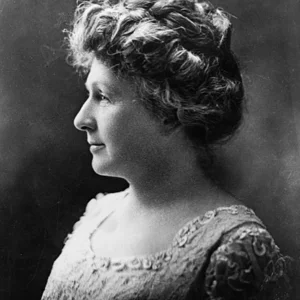

A pioneering American astronomer, Annie Jump Cannon revolutionized astronomy by classifying the spectra of more than 350,000 stars. Her spectral classification system (OBAFGKM) is still in use today.
Annie Jump Cannon(1863 — 1941)
Annie Jump Cannon
États-Unis
8 min read
Frequently asked questions
Key Facts
- 1863: Born in Dover, Delaware (United States)
- 1896: Joined the Harvard College Observatory as a “human computer”
- 1901: Proposed the OBAFGKM spectral classification system, adopted internationally
- 1922: Her system was officially adopted by the International Astronomical Union
- 1941: Died after classifying more than 350,000 stars
Works & Achievements
A catalogue of 225,300 stars classified by their spectra, published in 9 volumes in the Annals of the Astronomical Observatory of Harvard College. A monumental work still used today as a standard reference in stellar astronomy.
An extension of the main catalogue bringing the total number of classified stars to over 350,000. Cannon continued this titanic work well into old age, building the largest spectral database of the era.
Cannon's first major classification work, covering bright stars in the southern hemisphere photographed at Arequipa. This volume laid the groundwork for what would become the OBAFGKM system.
A landmark paper published in Harvard Circular No. 100, presenting the mature form of spectral classification as a temperature sequence. This text formed the basis for the IAU's international adoption of the system in 1922.
A sequence for classifying stars by surface temperature, ranging from very hot blue stars (type O) to cool red stars (type M). Adopted in 1922 by the International Astronomical Union as the global standard, this system remains in use to this day.
Anecdotes
In the 1890s, Annie Jump Cannon contracted scarlet fever, which left her nearly completely deaf. Far from being a hindrance, this condition allowed her to focus intensely on the visual work of analyzing photographic plates, and she developed a remarkable power of concentration that impressed her colleagues at the Harvard College Observatory.
Annie Jump Cannon could classify up to three stars per minute by examining spectra on glass plates. Over the course of her career, she classified more than 350,000 stars by hand — an absolute record for the time. Her colleagues joked that she had a photographic memory for stellar spectra.
In 1925, Annie Jump Cannon became the first woman to receive an honorary doctorate from the University of Oxford in England. This belated recognition — she was 61 years old at the time and had been working at Harvard for thirty years — illustrates the obstacles women scientists had to overcome to gain official acknowledgment from their male peers.
Annie Jump Cannon was a committed suffragist. She took an active part in the women's suffrage movement in Massachusetts and did not hesitate to display her convictions in a conservative scientific environment. Her political engagement went hand in hand with her determination to prove that women could excel in the sciences.
The OBAFGKM spectral classification system she developed was memorized by generations of students through the English mnemonic "Oh Be A Fine Girl/Guy, Kiss Me." Adopted internationally in 1922 by the International Astronomical Union, this system remains the world's standard reference tool for classifying stars by their surface temperature.
Primary Sources
A catalogue of stellar spectra, photographically determined, including the Harvard classification and visual magnitude of each star. Classified and arranged by Annie J. Cannon.
The spectra of the brighter southern stars have been classified by Miss A. J. Cannon from photographs taken at the Harvard Observatory station at Arequipa, Peru.
My love of the stars began in my mother's attic, where she taught me the constellations. I have always felt that the astronomer who studies the light of the stars is dealing with the most wonderful things in the universe.
The classifications here given are based on a study of the Harvard photographs, and represent a considerable revision and extension of those previously published.
Key Places
Annie Jump Cannon's hometown, where her father introduced her to stargazing from the attic of the family home. This warm, domestic setting was the young astronomer's first informal observatory.
A women's higher education institution where Cannon earned her physics degree in 1884 under the guidance of Sarah Frances Whiting. One of the few establishments of the era to train women in the exact sciences.
The site of Cannon's entire career, where she spent more than forty years classifying hundreds of thousands of stars. It was here that she compiled the archives of the Henry Draper Catalogue and refined her classification system.
A Harvard observation station set at high altitude in the Peruvian Andes to photograph the southern sky. A large portion of the stars Cannon classified came from photographic plates taken at Arequipa.
Prestigious university that awarded Annie Jump Cannon an honorary doctorate in 1925, making her the first woman to receive this distinction from Oxford. This recognition symbolized the international acceptance of her work.
Liens externes & ressources
Références
Œuvres
Henry Draper Catalogue (HD Catalogue)
1918–1924
Henry Draper Extension (HDE)
1925–1936
Spectra of Bright Southern Stars (Annals Vol. 28)
1901
Classification of 1477 Stars by Means of Their Photographic Spectra
1910
Système de classification spectrale OBAFGKM
1901–1922