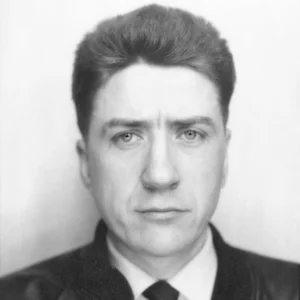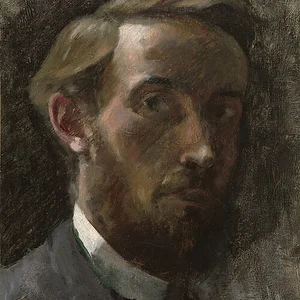

Édouard Vuillard was a French painter, printmaker, and illustrator, a leading figure of the Nabis group. A master of intimism, he depicted domestic scenes and bourgeois interiors in muted colors and decorative patterns.
Édouard Vuillard(1868 — 1940)
Édouard Vuillard
France
5 min read
Frequently asked questions
Key Facts
- Born in 1868 in Cuiseaux (Saône-et-Loire), died in 1940 in La Baule
- Founding member of the Nabis group from 1889–1890 with Bonnard, Denis, and Sérusier
- Developed “intimism”: domestic interior scenes with decorative patterns (1890s)
- Created large decorative panels and theater sets (Théâtre de l'Œuvre)
- Elected to the Académie des Beaux-Arts in 1937
Works & Achievements
An intimate painting with simplified forms and muted colours, emblematic of Vuillard's Nabi style.
A set of large decorative panels painted for Alexandre Natanson, the pinnacle of Vuillard's decorative art.
A scene from his mother's workshop where the figures blend into the patterns of the fabrics, a manifesto of his intimism.
A tense domestic portrait in which the space and wallpapers create a singular psychological atmosphere.
A scene of everyday life bathed in soft light, typical of his eye for the intimate.
Programmes and sets created for the Symbolist theatre, attesting to the links between the Nabis and the stage.
Anecdotes
Vuillard lived with his mother, a seamstress and corset-maker, for much of his life, until her death in 1928, when he was nearly 60. He affectionately called her “my muse”: his mother's sewing workshop, with its fabrics, its seamstresses and its cloths, nourished his entire intimate body of work and his love of decorative patterns.
Together with his friends Pierre Bonnard, Maurice Denis and Paul Sérusier, Vuillard formed the group known as the Nabis (from the Hebrew *nevi'im*, “prophets”). These young painters met in secret and gave themselves nicknames: Vuillard was dubbed the “Zouave Nabi” because of his military bearing and his beard.
Vuillard kept a private diary for much of his life, filled with reflections on painting and daily life. A keen photographer, he used his Kodak camera to take hundreds of snapshots of his loved ones in interior settings, which he then used as the basis for his paintings.
In the 1890s, Vuillard painted large decorative panels for bourgeois Parisian apartments, such as the *Public Gardens*. He believed that painting should be integrated into domestic life, adorning the walls like tapestries rather than being merely isolated pictures.
Elected to the Académie des Beaux-Arts in 1938, Vuillard received official recognition only late in life. In 1940, fleeing the German advance, he left Paris and died at La Baule a few weeks after the start of the Occupation.
Primary Sources
I do not paint portraits, I paint people in their own homes.
Remember that a painting, before being a war horse, a nude woman or some anecdote, is essentially a flat surface covered with colours assembled in a certain order.
The simplest things of everyday life are the ones that move me the most and that I want to paint.
Key Places
Small market town in Saône-et-Loire where Vuillard was born in 1868. His childhood memories there nourished his attachment to interiors and family life.
City where Vuillard spent most of his life, painting bourgeois interiors and moving in the Nabi artistic and literary circles.
Private art school where Vuillard trained and met the future Nabis such as Bonnard, Denis and Sérusier.
Prestigious institution where Vuillard briefly continued his academic training before turning toward Nabi painting.
Seaside resort in Loire-Atlantique where Vuillard took refuge in June 1940 and died shortly after the start of the Occupation.
Liens externes & ressources
Références
Œuvres
Les Jardins publics
1894
La Couturière
vers 1890
Intérieur, mère et sœur de l'artiste
vers 1893
Le Déjeuner du matin
vers 1900
Décors pour le Théâtre de l'Œuvre
années 1890