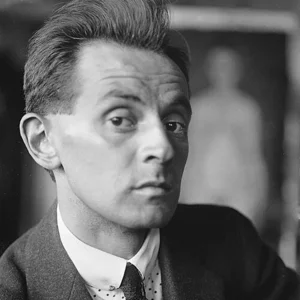

Austrian painter, draughtsman and lithographer, a major figure of Viennese Expressionism. A pupil and protégé of Gustav Klimt, he developed a raw and tormented style centered on the body and self-portraiture, before dying of the Spanish flu at the age of 28.
Egon Schiele(1890 — 1918)
Egon Schiele
Cisleithanie
6 min read
Frequently asked questions
Famous Quotes
« Art cannot be modern; art is eternal.»
Key Facts
- Born on 12 June 1890 in Tulln an der Donau (Austria-Hungary)
- Entered the Vienna Academy of Fine Arts in 1906, where he met Gustav Klimt, who became his mentor
- Arrested and briefly imprisoned in 1912 for drawings deemed scandalous (the Neulengbach affair)
- Achieved recognition at the Vienna Secession exhibition in 1918
- Died on 31 October 1918 in Vienna of the Spanish flu, at the age of 28, three days after his wife Edith
Works & Achievements
A double portrait of the artist and his companion Wally Neuzil, emblematic of his obsession with self-representation. Schiele depicts himself with a raw, frontal intensity.
A large canvas in which Schiele portrays himself alongside Klimt as two spectral figures shrouded in black. A declaration of artistic kinship and solitude.
A provocative reinterpretation of Klimt's *The Kiss*, recast in a sulfurous, anticlerical register. A work that captures Schiele's transgressive boldness.
A painted farewell to his companion Wally at the time of his marriage to Edith. A dramatic embrace blending love, separation, and the presence of death.
Schiele's last major composition, showing a man, a woman, and a child. A poignant vision of a family's future, painted shortly before the death of the painter and his pregnant wife.
A portrait of his wife in a striped dress, of a rare tenderness within his body of work. It reflects the relative serenity of his final years.
A view of Krumau with its tightly packed houses and windows like eyes, an urban landscape rendered with the same tension as his bodies. Schiele was also a great painter of cities.
Anecdotes
In 1912, Egon Schiele was arrested in Neulengbach, near Vienna, and imprisoned for 24 days. Accused of having displayed drawings deemed immoral where children could see them, he watched the judge symbolically burn one of his drawings during the hearing. He spent his days in the cell painting watercolors in which he depicted himself as a prisoner.
Schiele was a draftsman of astonishing speed: he often traced his outlines in a single continuous stroke, without lifting his hand, and added color afterward. His models recounted that he could capture a pose in just a few minutes, his eyes fixed on them while his hand raced across the paper.
As a teenager, Schiele was obsessed with trains: his father was the stationmaster in Tulln, and young Egon spent hours drawing locomotives with maniacal precision, to the point that his teachers grew concerned. This childhood beside the railway tracks shaped his keen sense of observation.
At only 16, Schiele was admitted to the prestigious Academy of Fine Arts in Vienna, the very one that would reject Adolf Hitler shortly afterward. He soon felt stifled by the rigid academic teaching and eventually slammed the door to found his own group of artists, the Neukunstgruppe.
In October 1918, the Spanish flu first claimed his wife Edith, six months pregnant, then Egon himself three days later, at the age of 28. As Edith lay dying, he made one last drawing of her, a final testament to a couple struck down at the height of their artistic ascent.
Primary Sources
I shall be the fruit that, after its decay, will still leave behind an eternal life; how great, then, must be your joy at having given birth to me.
To hinder the artist is a crime, it is to murder life in the bud!
Everything is living dead. The bodies of those who have enjoyed their lives afterward smell of bitterness.
The war is over and I must go. My paintings will be shown in all the museums of the world.
Key Places
Town in Lower Austria where Schiele was born in 1890, in the train station his father managed. The railway world of his childhood left a lasting mark on his eye.
Schiele enrolled here at 16 in 1906 but left as early as 1909, finding the teaching too academic. There he encountered the Viennese art scene at its most vibrant.
Capital of the Austro-Hungarian Empire and heart of modernism, where Schiele developed his work alongside Klimt and the Secession. It was here that he found fame and met his death.
A small town near Vienna where Schiele settled with his companion Wally and where he was arrested and then imprisoned for 24 days in 1912 over drawings deemed immoral.
His mother's birthplace, in Bohemia, where Schiele stayed and painted many townscapes of tangled rooftops. The townsfolk eventually drove him out, scandalized by his way of life.
Typical Objects

Schiele's favorite tools — he was above all a virtuoso draftsman able to capture a body in a single continuous stroke. The taut, angular line is the signature of his art.

Schiele heightened his drawings with washes of color applied in vivid, raw patches. These pigments give his bodies their characteristic sickly, expressive complexion.

A central tool of his work, the mirror let him multiply the tortured self-portraits that make up a major part of his output. He scrutinized his own body as an object of study.

Schiele never went anywhere without his sketchbook, filling thousands of sheets with studies of models, nudes, and landscapes. His graphic output runs into the thousands of drawings.

Schiele also practiced lithography to spread his images. This printmaking technique allows a drawing traced on limestone to be reproduced.

In his studio, Schiele draped his models in colorful fabrics or left them nude against bare backgrounds. The crumpled cloths set the rhythm of his watercolor compositions.
School Curriculum
Vocabulary & Tags
Key Vocabulary
Daily Life
Morning
Schiele rose early to make the most of the light in his Vienna studio. From the morning onward, models and friends came by to pose while he produced a steady stream of sketches and watercolors with a quick, confident line.
Afternoon
The afternoon was devoted to relentless work on his large oil canvases and studies of nudes. Meticulous, he carefully organized his drawings and kept precise records of his sales.
Evening
In the evening, Schiele frequented the Viennese cafés, gathering places for artists and intellectuals. There he talked with his patrons and collectors, tending a network essential to his career.
Food
Like many penniless Viennese artists in his early days, Schiele ate simply and went through periods of great poverty. Vienna's café culture came with pastries, bread, and modest dishes of the Austro-Hungarian Empire.
Clothing
Mindful of his appearance, Schiele dressed with care, sometimes eccentrically, in the bohemian taste of the Secession artists. He designed clothing himself and tended carefully to the image he projected in his self-portraits.
Housing
Schiele lived in various studios in Vienna and its suburbs, as well as in Krumau and Neulengbach. His lodgings served at once as home, studio, and posing place for his models.
Historical Timeline
Period Vocabulary
Liens externes & ressources
Références
Œuvres
Autoportrait à la lanterne chinoise
1912
Les Ermites
1912
Le Cardinal et la Nonne (Caresse)
1912
La Mort et la Jeune Fille
1915
La Famille (Les Époux accroupis)
1918
Portrait d'Edith Schiele (la femme de l'artiste)
1915
Maisons au bord de la rivière (la vieille ville)
1914