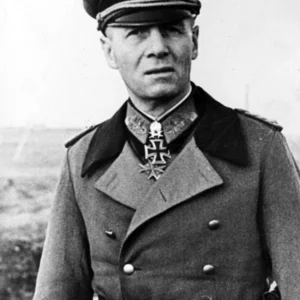

Erwin Rommel was a German field marshal of the Second World War, nicknamed the “Desert Fox” for his command of the Afrikakorps in North Africa. Marginally implicated in the 20 July 1944 plot against Hitler, he was forced to commit suicide.
Erwin Rommel(1891 — 1944)
Erwin Rommel
Troisième Reich, république de Weimar, Empire allemand
6 min read
Frequently asked questions
Key Facts
- Born on 15 November 1891 in Heidenheim, Germany
- Author of the military work “Infanterie greift an” (1937) on infantry tactics drawn from the First World War
- Commanded the Afrikakorps in North Africa from 1941, where he earned the nickname the “Desert Fox”
- Defeated by the British at the Second Battle of El Alamein (October–November 1942)
- Forced to commit suicide on 14 October 1944 after being linked to the 20 July plot against Hitler
Works & Achievements
An infantry tactics manual drawn from his experience of 1914-1918, which became a military classic and brought him to Hitler's attention.
A lightning advance nicknamed the “Ghost Division,” a demonstration of blitzkrieg and a springboard for his fame.
Leading the German-Italian forces in North Africa, which earned him the nickname “Desert Fox” and an international reputation.
The lightning conquest of the Libyan port, his greatest success, rewarded with the rank of field marshal.
Strengthening the French coastal defenses against the Allied invasion, with obstacles and fortifications along the beaches of Normandy.
A collection of his notebooks and letters gathered under the title “The Rommel Papers,” a major inside source on his campaigns.
Anecdotes
Nicknamed the “Desert Fox” (Wüstenfuchs) by his own British adversaries, Rommel earned this respect for his fast and unpredictable maneuvers in the deserts of Libya and Egypt. Even Winston Churchill called him a “great general” before the House of Commons in 1942 — a rare tribute for an enemy.
During the North African campaign, Rommel insisted that prisoners be treated well and refused to carry out certain criminal orders coming from Berlin, such as the order to execute captured commandos. This reputation as a “fair” commander helped build his legend, even if historians today qualify that image.
In 1940, leading the 7th Panzer Division during the campaign in France, his unit advanced so fast and so far that it was nicknamed the “ghost division”: even the German high command did not always know exactly where it was.
Rommel wrote a book on infantry tactics, *Infanterie greift an* (1937), drawn from his experience in the First World War. The book's success caught Hitler's attention, who entrusted him with command of his personal guard.
In October 1944, after the failed July 20 plot against Hitler, Rommel was offered a choice: a public trial or suicide with a national funeral to protect his family. He swallowed a cyanide capsule; the regime officially announced that he had died of a stroke and held a state funeral for him.
Primary Sources
“Boldness, combined with speed of decision, is often the key to success. To surprise the enemy, to strike him where he least expects it: that is what throws his defense into disorder.”
“We have a very daring and skillful opponent against us, and, may I say across the havoc of war, a great general.”
“The desert battle is won by mobility and supply as much as by weapons; the soldier best supplied with fuel and water prevails over the bravest.”
“In an hour, I shall be no more. I am accused of having taken part in the plot against the Führer. I am being given the choice of poison.”
Key Places
Town in Württemberg where Erwin Rommel was born in 1891, the son of a school principal.
Strategic Libyan port whose capture by Rommel in June 1942 marked the peak of his career in North Africa.
Site of the decisive battle of October–November 1942, where Montgomery's British army halted the advance of the Afrika Korps.
Region where Rommel, in charge of the Atlantic Wall, faced the Allied landings of 6 June 1944 and where he was wounded on 17 July.
Village near Ulm where Rommel lived and where he was forced to take his own life on 14 October 1944.
Site of the 1917 offensive on the Italian front where Lieutenant Rommel distinguished himself and earned the “Pour le Mérite” decoration.
Typical Objects

German medium tank, the backbone of Rommel's armored divisions early in the war. Its mobility embodies the tactics of "lightning war" (Blitzkrieg).

Badge of honor awarded to Rommel upon his promotion to the rank of Generalfeldmarschall in 1942. A prestige object symbolizing the pinnacle of the German military hierarchy.

Equipment characteristic of Rommel in the desert, often visible in propaganda photographs. The goggles, taken from a British vehicle, protected him from the sand.

The highest military distinction of the German Empire, received by Rommel in 1917. Nicknamed the “Blue Max” (Blauer Max), it was worn around the neck.

Essential tools of command: Rommel planned his maneuvers and rapid movements on desert maps. He often led from the front line, map in hand.

All-terrain vehicle from which Rommel directed his troops as close as possible to the fighting. His presence on the ground inspired his men and astonished his opponents.
School Curriculum
Vocabulary & Tags
Key Vocabulary
Daily Life
Morning
On campaign, Rommel rose very early, often before dawn, to inspect the front. Famously tireless, he would gulp down a quick breakfast before climbing into his command car to join his armored units.
Afternoon
In the afternoon, he directed operations in person, sometimes under fire, refusing to stay behind at a distant headquarters. He studied maps, gave his orders by radio, and moved constantly between the columns of tanks.
Evening
In the evening, Rommel wrote reports and long letters to his wife Lucie, almost daily. He slept little, wearing out his officers with his pace and his demands.
Food
In the desert, daily fare was spartan: tinned food, bread, coffee, and rationed water, shared with his men. Rommel boasted of eating the same thing as his soldiers and suffered, like them, from supply problems and the heat.
Clothing
He wore the uniform of the Wehrmacht, adapted to the climate with a light tropical outfit in Africa. He was recognizable by his cap, his goggles for protection against the sand, and the “Pour le Mérite” decoration at his neck.
Housing
On operations, Rommel lived as close as possible to the front: tents, fitted-out trucks, or requisitioned buildings. In Germany, he lived with his family in a house at Herrlingen, near Ulm, where he spent his final weeks.
Historical Timeline
Period Vocabulary
Liens externes & ressources
Références
Œuvres
Infanterie greift an (L'infanterie attaque)
1937
Campagne de France à la tête de la 7e Panzerdivision
1940
Commandement de l'Afrikakorps
1941-1943
Prise de Tobrouk
1942
Organisation du mur de l'Atlantique
1944
Krieg ohne Hass (Guerre sans haine), notes de guerre publiées à titre posthume
1950