
British field marshal, one of the principal Allied military commanders of the Second World War. He led the victorious 8th Army at El Alamein and then commanded the Allied ground forces during the Normandy landings.
Bernard Montgomery(1887 — 1976)
Bernard Montgomery
Royaume-Uni
5 min read
Frequently asked questions
Key Facts
- Born in 1887 in London, died in 1976
- Won the second Battle of El Alamein in October–November 1942 against Rommel's Afrika Korps
- Commanded the Allied ground forces during the Normandy landings (Operation Overlord) in June 1944
- Led Operation Market Garden in the Netherlands in September 1944, which failed at Arnhem
- Received the surrender of German forces in north-western Europe on 4 May 1945 at Lüneburg
Works & Achievements
The first major Allied ground victory against the Axis, marking a turning point in the war in North Africa.
Led the Allied ground forces (21st Army Group) during Operation Overlord, the largest amphibious operation in history.
A vast airborne offensive in the Netherlands aimed at crossing the Rhine, which failed at Arnhem despite its ambition.
Accepted the capitulation of the German forces in north-western Europe, a major step toward the end of the war.
His memoirs, in which he recounts his career and defends his strategic choices, at times stirring controversy.
A leading role in organizing the defense of Western Europe during the Cold War.
Anecdotes
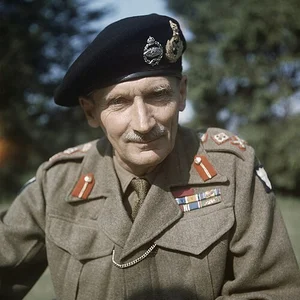
Montgomery was famous for his black beret bearing two badges, one for the tank corps and one for general rank. He wore it so his soldiers would recognize him instantly, even from a distance, and this headgear became his personal emblem throughout the desert war.
Before the decisive Battle of El Alamein in 1942, Montgomery had a message posted and read out to his troops stating that there would be no retreat and no surrender: they would conquer where they stood or die where they stood. This show of determination restored the confidence of an Eighth Army that had until then often been beaten by Rommel.
Montgomery led a life of great austerity: he did not smoke, drank no alcohol, and went to bed early, demanding not to be disturbed once asleep except in an absolute emergency. He believed that a well-rested commander made better decisions than exhausted subordinates.
He admired his opponent Erwin Rommel so deeply that he is said to have hung a portrait of the German field marshal in his command vehicle, the better to understand the way his desert enemy thought.
In 1944, the airborne operation Market Garden, which he had designed to cross the Rhine in the Netherlands, ended in a costly failure at Arnhem, nicknamed “a bridge too far.” This is one of the few major Montgomery operations to have turned into a disaster.
Primary Sources
We will fight the enemy where we now stand. There will be no withdrawal. I cannot conceive of defeat; we will destroy Rommel and his army.
I have always striven never to fight a battle without being certain I could win it; the soldiers' confidence in their commander is half the victory.
To the soldiers of the Allied armies: we are setting out on the greatest military adventure of all time, towards victory in Europe.
Key Places
District of London where Bernard Montgomery was born in 1887, into a family of Irish origin.
Site of the decisive battle of October-November 1942 where his Eighth Army halted and drove back Rommel's Afrika Korps.
French coast where he commanded the Allied ground forces during the landings of 6 June 1944.
Town that was the scene of the failure of Operation Market Garden in September 1944, the “bridge too far”.
Place where he received the surrender of the German forces of north-western Europe on 4 May 1945.
Region where he spent his final years and died in 1976.
Typical Objects

His famous tank commander's beret, bearing both the badge of the Royal Tank Regiment and a general's insignia. He had made it his trademark among his troops.

Tank or armoured vehicle from which he observed and directed operations in the desert. A symbol of the Eighth Army's mechanised warfare.

Detailed maps of the terrain on which he meticulously planned every battle before fighting it. Preparation was at the heart of his method.

An essential instrument for observing the battlefield from a distance and tracking enemy movements in the desert or in Normandy.

Military dress signalling his highest rank, adorned with decorations and braid. Montgomery, however, often preferred a simple field outfit.

A casual garment he liked to wear at the front, contrasting with the strictness of traditional uniforms. It contributed to his image as a man close to his soldiers.
School Curriculum
Vocabulary & Tags
Key Vocabulary
Tags
Daily Life
Morning
Montgomery rose early and began his day by studying maps and intelligence on the enemy. A man of iron discipline, he devoted his mornings to the meticulous planning of operations.
Afternoon
In the afternoon, he frequently visited his units in the field to observe the men and keep up their morale. He liked to address the soldiers directly, standing on top of a vehicle, to explain his intentions.
Evening
In the evening, he dined frugally and then retired early to his command caravan. He had a strict rule never to be disturbed once in bed, except in a life-or-death emergency.
Food
He led a life of great temperance: no alcohol, no tobacco, and simple, regular meals. This healthy lifestyle stood in sharp contrast to that of many officers of his time.
Clothing
On campaign, he favored simple, practical outfits, such as a turtleneck sweater and his famous black beret with two badges, rather than the pomp of a field marshal's uniform.
Housing
At the front, he lived in fitted-out command caravans and trailers, some of which had belonged to Italian officers captured in the desert. They served as both his office and his bedroom.
Historical Timeline
Period Vocabulary
Liens externes & ressources
Références
Œuvres
Victoire d'El Alamein
1942
Opération Market Garden
1944
Reddition allemande à Lunebourg
1945
The Memoirs of Field-Marshal Montgomery
1958
Commandement adjoint des forces de l'OTAN
1951-1958