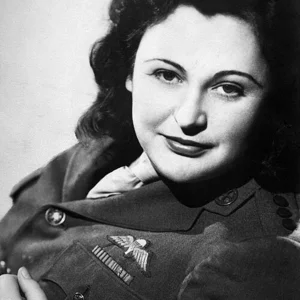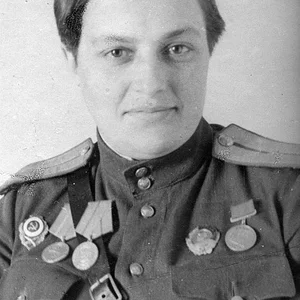

Lyudmila Pavlichenko is the deadliest sniper in history, credited with 309 confirmed kills on the Soviet-German front. Nicknamed “Lady Death,” she became a symbol of Soviet resistance and an international ambassador as early as 1942.
Lyudmila Pavlichenko(1916 — 1974)
Lyudmila Pavlichenko
Union soviétique
8 min read
Frequently asked questions
Famous Quotes
« Gentlemen, I am 25 years old and I have killed 309 fascist occupants by now. Don't you think, gentlemen, that you have been hiding behind my back for too long?»
Key Facts
- Born on July 12, 1916, in Bila Tserkva (Ukraine), she enlisted in the Red Army at the time of the German invasion in June 1941.
- Between 1941 and 1942, she fought on the Odessa and Sevastopol fronts, accumulating 309 confirmed kills, including 36 enemy snipers.
- Wounded in 1942, she was withdrawn from the front and sent on a diplomatic tour to the United States, Canada, and the United Kingdom to rally the Allies.
- She met American First Lady Eleanor Roosevelt, who welcomed her at the White House in 1942.
- After the war, she earned her history degree from Kyiv University and worked as a historian for the Soviet Navy until her death in 1974.
Works & Achievements
World record still unbroken for a female sniper, achieved on the fronts of Odessa and Sevastopol. This tally earned her the nickname 'Lady Death' and made her one of the most effective sharpshooters of the entire Second World War.
Official mission to the United States and Canada to rally public opinion to the Soviet cause and call for the opening of a second front. Her speeches before crowds of several tens of thousands of people had a considerable impact on Allied diplomacy.
After her withdrawal from the front, Pavlichenko trained new snipers within the Red Army, passing on her techniques and experience of combat in urban and natural environments. Her instruction helped develop the Soviet school of precision shooting.
Autobiographical account of her years of combat, published in the USSR under the title 'Invincible Heroine'. The work constitutes a first-hand testimony on the daily life of Soviet snipers and the combat conditions on the Eastern Front.
Her portrait was reproduced on stamps issued by the USSR, a sign of her recognition as a national heroine. These philatelic issues helped spread her image throughout the entire Soviet bloc.
Anecdotes
During her 1942 North American tour, Lyudmila Pavlichenko addressed a crowd of 100,000 people in Chicago. A female journalist asked her whether Soviet women wore lipstick in combat. She replied calmly: 'Gentlemen, I am a representative of a country that is fighting for its life. I see no point in discussing my underwear.' Her speech was met with a standing ovation.
Pavlichenko counted 309 confirmed enemy kills to her credit, including 36 enemy snipers — particularly dangerous targets, as they were themselves trying to eliminate her. Each sniper duel could last hours, or even entire days of complete immobility, each waiting for the other to make a mistake.
U.S. President Franklin D. Roosevelt received Pavlichenko at the White House in August 1942 — she was the first Soviet citizen to be received by a sitting American president. Her handshake with Roosevelt was photographed and distributed worldwide as a symbol of the alliance between the two countries.
American folk singer Woody Guthrie was so impressed by Pavlichenko's visit to the United States that he dedicated a song to her titled 'Miss Pavlichenko' in 1946. The song celebrated her courage and her 309 confirmed kills, helping to cement her legend on the other side of the Atlantic.
Wounded four times in combat, Pavlichenko was withdrawn from the front in 1942 after a serious shoulder wound caused by a mortar fragment. Despite her repeated requests to return to combat, her superiors refused: she had become too valuable a symbol to risk, and was assigned to training future snipers.
Primary Sources
Gentlemen, I am twenty-five years old and I have killed 309 fascist occupants by now. Don't you think, gentlemen, that you have been hiding behind my back for too long?
All I wanted was to defend my homeland. I had never thought I would become a soldier, but when the enemy invaded our soil, there was no other choice for me.
Comrade Pavlichenko demonstrated exceptional composure and remarkable accuracy. Her tally of 187 enemy soldiers neutralized in the defense of Odessa represents a decisive contribution to the city's resistance.
American workers welcomed us with warmth and brotherhood. They understand that our fight is theirs as well. But we need a second front, now, not tomorrow.
Key Places
Black Sea port city where Pavlichenko fought during the 1941 siege (August–October), achieving 187 of her 309 confirmed kills. The heroic defense of Odessa against Romanian and German forces earned her her first renown.
Strategic Crimean city besieged by Axis forces from November 1941 to July 1942, where Pavlichenko reached her record of 309 kills before being wounded. The siege of Sevastopol remains one of the deadliest engagements of the conflict on the Eastern Front.
American capital where Pavlichenko met President Roosevelt at the White House in August 1942 and spoke during her diplomatic tour to call for the opening of a second Allied front in Europe.
Soviet capital where Pavlichenko lived after the war, worked as a military historian, and died in 1974. Her name is etched in Russian collective memory as a symbol of Soviet resistance.
City where Pavlichenko grew up, joined a sports shooting club, and began her history studies at university before the outbreak of the war. It was here that she learned to handle firearms as a teenager.
Typical Objects

Standard Red Army sniper rifle, with which Pavlichenko achieved the vast majority of her 309 confirmed kills. The PU scope offered 3.5x magnification, sufficient for accurate shots up to 800 meters.

White oversuit in winter and greenish-colored in summer, allowing the sniper to blend into the surroundings for long hours. Stillness and camouflage were just as important as shooting accuracy for surviving at the front.

Each kill had to be recorded and attested by a witness according to Soviet military regulations. This rigorous register gave official legitimacy to Pavlichenko's tally and allowed the high command to track the performance of its snipers.

Pavlichenko successively held the ranks of lieutenant, then Guards Major following her acts of valor. During her American tour, her military uniform contrasted sharply with civilian attire and underscored her status as a combatant.

Essential tool for the sharpshooter to spot targets at long range without exposing herself. Pavlichenko could spend hours observing enemy positions before firing a single shot.

Supreme distinction received in 1943 for the entirety of her combat at Odessa and Sevastopol. This medal, accompanied by the Order of Lenin, made Pavlichenko one of the most decorated women in Soviet history.
School Curriculum
Vocabulary & Tags
Key Vocabulary
Daily Life
Morning
At the front, the sniper would rise before dawn to take position before daylight — the only time to move without risking detection. She meticulously checked her rifle, cleaned the scope, and observed enemy positions through binoculars during long, silent minutes.
Afternoon
Afternoons were devoted to patient observation of the enemy, sometimes without firing a single shot for hours. Duels against opposing snipers demanded absolute concentration and total stillness; the slightest movement could give away her position and cost her her life.
Evening
In the evening, back at camp, she wrote up her daily report, recorded her confirmed kills, and exchanged words with her comrades over a frugal meal. She made the most of rare moments of rest to maintain her equipment and, when conditions allowed, read letters from her family.
Food
The Soviet military ration at the front was spartan: black bread, buckwheat or barley porridge, vegetable soup (shchi), salted fish, and very strong black tea. During periods of intense siege at Odessa and Sevastopol, rations were severely reduced and soldiers regularly went hungry.
Clothing
At the front, Pavlichenko wore the standard Red Army uniform: a khaki tunic (gymnastiorka), baggy trousers (sharovary), leather boots, and a steel helmet. On missions, she wore a camouflage suit suited to the season — white in snow, green and brown in summer — which allowed her to blend into the terrain during her long hours in ambush.
Housing
At the front, snipers slept in makeshift shelters dug into the earth, in the cellars of bombed-out buildings, or in trenches fitted with wooden planks. Between missions, soldiers lived in collective military barracks with no comforts whatsoever, exposed to bombardments and the intense cold of Ukrainian winters.
Historical Timeline
Period Vocabulary
Visual Style
Esthétique réaliste soviétique mêlant photographie documentaire de guerre et affiche de propagande constructiviste, dominée par les verts kaki, les gris béton et les rouges bolcheviques des médailles et bannières.
Sound Ambience
Ambiance sonore du front de l'Est soviétique : artillerie, tir de précision, décombres urbains d'Odessa et Sébastopol, mêlés aux échos de la grande salle américaine lors de la tournée diplomatique de 1942.
Liens externes & ressources
Références
Œuvres
309 victoires confirmées au combat
1941-1942
Tournée diplomatique en Amérique du Nord
Août-novembre 1942
Formation de tireurs d'élite soviétiques
1943-1945
Publication de mémoires militaires
1965
Timbre commémoratif soviétique
1943 et 1976