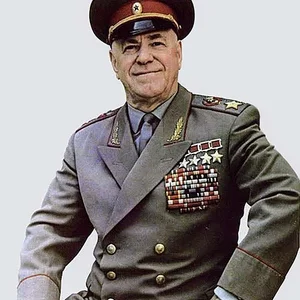

Marshal of the Soviet Union and the leading military commander of the Red Army during the Second World War. Victorious in decisive battles against Nazi Germany, he led the final assault on Berlin in 1945.
Zhukov(1896 — 1974)
Georgy Zhukov
Union soviétique, Empire russe
5 min read
Frequently asked questions
Key Facts
- Leads the victorious defense of Moscow against the Wehrmacht (1941)
- Plays a decisive role in the victory at Stalingrad with Operation Uranus (1942-1943)
- Commands the 1st Belorussian Front at the Battle of Berlin (April-May 1945)
- Receives the German surrender on behalf of the USSR on 8 May 1945
- Becomes Minister of Defense of the USSR under Khrushchev (1955-1957)
Works & Achievements
An encirclement maneuver that annihilated the Japanese 6th Army and secured the Soviet Union's eastern border.
The first major check inflicted on the Wehrmacht, shattering the myth of German invincibility.
An encirclement plan, coordinated with Vasilevsky, that trapped the German 6th Army and marked the turning point of the war.
Zhukov helped plan both the defense and the counteroffensive during the largest tank battle in history.
A massive offensive that destroyed Army Group Centre and liberated Belarus, opening the road to Germany.
The final assault on the capital of the Reich, followed by receiving Germany's unconditional surrender.
War memoirs that became a classic, a major testimony on the Soviet command during the war.
Anecdotes
In the summer of 1939, near the Khalkhin Gol river in Mongolia, Zhukov crushed the Japanese army in a tank battle little known in the West. This victory convinced Japan not to attack the USSR, which would later allow Stalin to transfer Siberian divisions to defend Moscow.
During the Victory Parade on Red Square on June 24, 1945, Zhukov reviewed the troops mounted on a magnificent white horse named Kumir. In pouring rain, soldiers cast 200 standards of defeated Nazi Germany at the foot of Lenin's Mausoleum.
Zhukov was renowned for his iron character and his bluntness: he dared to contradict Stalin himself during staff meetings, which was extremely rare and dangerous. This independence earned him both the respect of the soldiers and the suspicion of those in power.
After the war, his immense popularity worried Stalin, who sidelined him by sending him to command a provincial military district. Zhukov fell from grace twice, once under Stalin and once under Khrushchev in 1957, despite his decisive role in the victory.
In 1941, before besieged Moscow, Zhukov organized a winter counteroffensive that pushed the Wehrmacht back dozens of kilometers: it was the first major failure of the German army, until then reputed to be invincible.
Primary Sources
The Battle of Moscow showed that the German army was not invincible and that it could be defeated.
The German command acknowledges the complete and unconditional surrender of all its armed forces, signed in the presence of Marshal Zhukov for the Soviet command.
In the name and on the orders of the supreme command, the Marshal of the Soviet Union reviews the victorious troops.
Key Places
Zhukov's native village, where he grew up in a poor peasant family before enlisting in the army.
River near which Zhukov won a decisive victory over the Japanese army in 1939.
Soviet capital defended by Zhukov in 1941 during a decisive counteroffensive; he died here in 1974.
City that was the setting of the turning-point battle of the war, whose counteroffensive (Operation Uranus) Zhukov coordinated in 1942.
Capital of the Reich where Zhukov led the final assault in April-May 1945 and received the German surrender.
Resting place of Zhukov's ashes, among the great figures of the Soviet state.
Typical Objects

Supreme ornate command insignia awarded to the Marshals of the Soviet Union. It symbolizes the highest military rank reached by Zhukov.

The highest Soviet distinction, which Zhukov received four times, an exceptional record. This gold medal rewarded heroic deeds in service of the State.

An iconic Soviet medium tank, the backbone of the great armored offensives commanded by Zhukov. Its sturdiness and mass production weighed heavily in the victory.

Zhukov's ceremonial uniform, recognizable by its wide-crowned cap and its decorations. He wore it during great ceremonies such as the Victory Parade.

A large topographic map on which Zhukov planned troop movements and offensives. An indispensable everyday tool of the war commander.

A multiple rocket launcher mounted on a truck, nicknamed “Stalin's organ” by the Germans. A feared weapon widely used in the Red Army's offensives.
School Curriculum
Vocabulary & Tags
Key Vocabulary
Daily Life
Morning
On campaign, Zhukov rose early to study the night's reports and the positions on his general-staff maps. Mornings were devoted to meetings with the generals and to planning operations.
Afternoon
In the afternoon he often inspected the front lines, sometimes at the closest reach of danger, to judge the situation for himself. He demanded precise reports and did not hesitate to rebuke failing officers harshly.
Evening
Evenings stretched late, paced by communications with the Supreme High Command (the Stavka) and by Stalin's frequent telephone calls. Zhukov slept little during the great offensives.
Food
Like most officers of the Red Army, his diet rested on simple, hearty Russian dishes: soups (*shchi*, *borscht*), black bread, *kasha* (cooked cereal porridge) and scalding tea served from the samovar.
Clothing
He wore the Soviet military uniform, and for ceremonies his marshal's tunic covered in decorations, with the characteristic wide-crowned cap. In the field he favored a plainer outfit, warm in winter.
Housing
In wartime he lived in mobile headquarters, requisitioned *izbas* or shelters near the front. In Moscow he had a residence and later a dacha assigned to high-ranking dignitaries.
Historical Timeline
Period Vocabulary
Liens externes & ressources
Références
Œuvres
Victoire de Khalkhin Gol
1939
Défense et contre-offensive de Moscou
1941-1942
Opération Uranus (Stalingrad)
1942
Bataille de Koursk
1943
Opération Bagration
1944
Bataille de Berlin
1945
Souvenirs et réflexions
1969