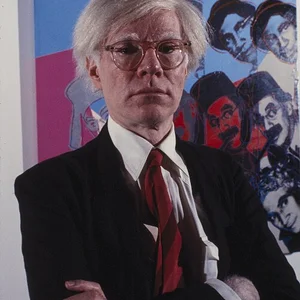

Andy Warhol (1928-1987) was the leading figure of the American Pop Art movement. He transformed images from mass culture into works of art, blurring the boundary between art and commerce.
Andy Warhol(1928 — 1987)
Andy Warhol
États-Unis
9 min read
Frequently asked questions
Famous Quotes
« In the future, everyone will be world-famous for 15 minutes.»
« Art is what you can get away with.»
Key Facts
- 1962: exhibits his first Campbell's Soup Cans, an iconic work of Pop Art
- 1963: founds the Factory, a collective studio in New York that became a landmark cultural hub
- 1964: creates his famous silkscreen portraits of Marilyn Monroe and Elvis Presley
- 1968: survives an assassination attempt by Valerie Solanas
- 1987: dies in New York, leaving behind a vast body of work and a lasting influence on contemporary art
Works & Achievements
A series of 32 canvases each depicting a variety of Campbell's canned soup, exhibited in Los Angeles. This groundbreaking work questions the boundary between art and consumerism, transforming an ordinary industrial object into an artistic icon.
A diptych of 50 silkscreened images of Marilyn Monroe created just after her death, alternating between vivid colors and grayscale. The work explores celebrity, media repetition, and death in American mass culture.
A series of five portraits of Marilyn Monroe in different colors, made famous after an assistant shot a bullet through the stacked canvases. These works are now among the most expensive paintings ever sold at auction.
An experimental 8-hour 5-minute film showing the Empire State Building at dusk in a single, unmoving shot. This radical work pushes to the extreme a meditation on time, stillness, and the act of watching, challenging the traditional conventions of cinema.
A series of silkscreened portraits of Chairman Mao Zedong created around the time of Nixon's visit to China. Warhol applies American advertising techniques to Communist visual codes, creating an ironic dialogue between opposing ideologies.
A series of contemporary vanitas paintings depicting human skulls in vivid colors, placing Warhol within the pictorial tradition of meditating on death. These works reflect his obsessive relationship with mortality following the 1968 assassination attempt against him.
Anecdotes
As a child, Andy Warhol suffered from a neurological condition called Sydenham's chorea, which forced him to spend long periods bedridden. During these bouts of illness, he developed his passion for drawing and celebrity magazines, collecting photos of Hollywood stars that he cut out and pasted into scrapbooks.
In 1962, Warhol asked his assistant to choose the subject for his next paintings. The assistant suggested he paint whatever he saw most often in his daily life. Warhol replied that he had been eating Campbell's soup almost every day for twenty years — and so the famous Campbell's Soup Cans were born, forever changing the art world.
On June 3, 1968, a radical feminist activist named Valerie Solanas shot Andy Warhol in his studio, the Factory. Warhol was clinically dead for several minutes and never fully recovered from his wounds. The event left a deep mark on him, intensifying his relationship with fame, death, and vulnerability.
Warhol was a compulsive, obsessive collector. When he died in 1987, thousands of objects were found in his home, packed into cardboard boxes he called his 'time capsules' — more than 600 boxes crammed with invoices, photographs, jewelry, cash, and even food. The collection was auctioned off for several million dollars.
Primary Sources
In the future, everyone will be world-famous for 15 minutes. [...] Making money is art and working is art and good business is the best art.
What's great about this country is that America started the tradition where the richest consumers buy essentially the same things as the poorest. You can be watching TV and see Coca-Cola, and you know that the President drinks Coca-Cola, Liz Taylor drinks Coca-Cola, and just think, you can drink Coca-Cola, too.
Went to the office. Worked on the portraits. [...] I've been thinking about death again. I keep a skull on my desk to remind me. It makes the work feel more urgent.
I want everybody to think alike. I think everybody should be a machine. I think everybody should like everybody. [...] Is that what Pop Art is all about? Yes. It's liking things.
Key Places
Warhol's legendary studio, originally located at 231 East 47th Street before moving several times around Manhattan. Covered in silver aluminum foil, it was a hub of creation, parties, and encounters between artists, rock musicians, and celebrities throughout the 1960s and 70s.
Andy Warhol's hometown, where he grew up as the son of Ukrainian immigrants in a working-class neighborhood. The Andy Warhol Museum, opened in 1994, houses the world's largest collection of his works and archives.
Where Warhol received his earliest artistic training as a child through the museum's free workshops for young people. This institution was instrumental in shaping his artistic education and his passion for the visual arts.
Manhattan's legendary nightclub, frequented by Warhol and New York's cultural elite between 1977 and 1980. The venue embodied the blend of art, celebrity, nightlife, and popular culture that he sought to capture in his work.
An institution that recognized the importance of Pop Art early on and incorporated Warhol's works into its permanent collections. His consecration by MoMA definitively established Pop Art's place in the canon of modern art.
Liens externes & ressources
Références
Œuvres
Campbell's Soup Cans
1962
Marilyn Diptych
1962
Skulls (Crânes)
1976