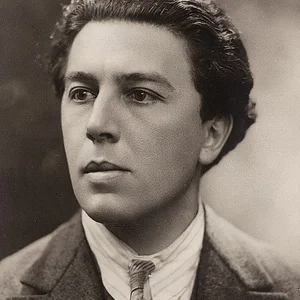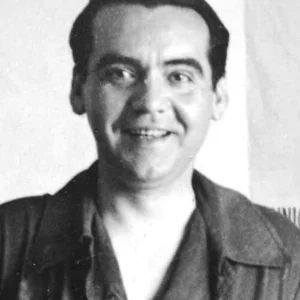

Spanish poet and playwright, a major figure of the Generation of '27. Author of the Romancero gitano and rural tragedies such as Blood Wedding, he was assassinated in 1936 at the start of the Spanish Civil War.
Federico García Lorca(1898 — 1936)
Federico García Lorca
Espagne
6 min read
Frequently asked questions
Famous Quotes
« El más terrible de los sentimientos es el sentimiento de tener la esperanza muerta.»
« En España, los muertos están más vivos que los muertos de cualquier otro sitio del mundo.»
Key Facts
- Born in 1898 in Fuente Vaqueros, near Granada, in Andalusia
- Published the Romancero gitano in 1928, the collection that made him famous
- Stayed in New York (1929-1930), which gave rise to Poet in New York
- Founded the university theatre troupe La Barraca in 1932
- Wrote his rural trilogy: Blood Wedding (1933), Yerma (1934), The House of Bernarda Alba (1936)
- Assassinated in August 1936, at the start of the Spanish Civil War
Works & Achievements
A collection inspired by Andalusian deep song, a tribute to the soul of flamenco.
A collection of ballads blending popular tradition with modern imagery; it made Lorca famous.
A dark, surrealist collection born of his time in America, a critique of the dehumanized city.
A travelling company bringing classical Spanish theatre to villages, a major cultural project of the Republic.
A rural tragedy about love, honour, and death; the first part of his great dramatic trilogy.
A tragedy about a woman's longing for a child within a rigid rural society.
A poignant elegy dedicated to a bullfighter friend who died in the ring, a high point of Lorca's poetry.
His final play, a drama of confinement and stifling authority in a household of women.
Anecdotes
Before becoming a poet, the young Federico dreamed of being a musician. He played the piano remarkably well and remained close his whole life to the great composer Manuel de Falla, with whom he organized a *cante jondo* competition in Granada in 1922 — the deep song of flamenco that he wanted to save from oblivion.
At the Student Residence in Madrid, Lorca became friends with the painter Salvador Dalí and the future filmmaker Luis Buñuel. This band of bold young artists would remake the world by night; Dalí painted several portraits of his poet friend.
In 1932, Lorca founded La Barraca, a student theater troupe that travelled across the villages of Spain aboard a truck. Dressed in simple blue overalls, these young actors performed the great Spanish classics for free in front of peasants who had often never set foot in a theater.
In 1929-1930, Lorca stayed in New York and studied at Columbia University. Disoriented by the giant city and the Wall Street stock market crash, and barely speaking English, he drew from the experience a dark and visionary collection, *Poet in New York*.
Lorca theorized the idea of *duende*, that mysterious and overwhelming force that runs through the flamenco artist or the poet. In a famous lecture, he quoted the singer Manuel Torre: “All that has dark sounds has duende.”
Primary Sources
“Verde que te quiero verde. / Verde viento. Verdes ramas.” (Green, how I want you green. / Green wind. Green branches.)
“A las cinco de la tarde. / Eran las cinco en punto de la tarde.” (At five in the afternoon. / It was exactly five in the afternoon.) An elegy written for his bullfighter friend killed in the arena.
“La aurora de Nueva York tiene / cuatro columnas de cieno.” (The dawn of New York has / four columns of mire.)
“Todos los sonidos negros tienen duende.” (All dark sounds have duende.) In it, Lorca explains the dark, deep force that animates the true artist.
Key Places
Andalusian village where Lorca was born in 1898, in the middle of the fertile countryside of the Vega. Its landscapes and folk songs would feed his entire body of work.
A hub of intellectual ferment where Lorca lived during the 1920s. There he met Dalí and Buñuel and took part in avant-garde life.
The Lorca family's summer home, surrounded by gardens, where Federico wrote several of his major works. Today it is a museum.
Lorca stayed here in 1929-1930, shaken by the metropolis and the stock market crash. From it he drew the collection Poet in New York.
A ravine near Granada where Lorca was shot in August 1936 at the start of the civil war. A memorial park now honors the victims.
Typical Objects

Before poetry, music was Lorca's first passion—he was an excellent pianist. He arranged popular Spanish songs at the piano.

An emblematic instrument of the *cante jondo* that Lorca admired and sought to preserve. It accompanies the deep Andalusian song found throughout his poetry.

The writer's tools, where Lorca jotted down verses, plays, and lectures. He also recorded sketches and ideas in them.

The uniform work garment worn by the young actors of La Barraca. It symbolized the popular, collective spirit of the travelling troupe.

Lorca was also a talented draughtsman who illustrated his letters and his poetry collections. His drawings blend surrealism with popular imagery.

A vehicle carrying sets, trestles, and costumes from village to village. It made it possible to bring classical theatre to the most remote rural areas.
School Curriculum
Vocabulary & Tags
Key Vocabulary
Daily Life
Morning
A bit of a night owl, Lorca slept in when he could. Mornings were devoted to reading, to correspondence with his artist friends, and to writing out clean copies of the verses he had penned during the night.
Afternoon
In the afternoon, he worked on his plays and poetry collections, or rehearsed with the La Barraca theatre company when he was directing it. He also loved to take walks and to draw.
Evening
Evening was his favourite time of day: gatherings with friends, poetry readings, music at the piano, and long conversations in the cafés and tertulias of Madrid or Granada.
Food
He shared in the Andalusian and Castilian cuisine of his day: bread, olive oil, vegetables from the Vega, fruit, as well as the convivial meals of the Madrid cafés. Wine often accompanied the evenings among artists.
Clothing
In the city, Lorca wore the elegant suit and tie of the intellectuals of the 1920s and 1930s. With La Barraca, he donned the blue overalls (*mono*) that united the whole company.
Housing
He lived between the family home in Granada and the Huerta de San Vicente, a sprawling country house surrounded by gardens. In Madrid, he stayed at the Residencia de Estudiantes, a hub for the artistic youth.
Historical Timeline
Period Vocabulary
Liens externes & ressources
Références
Œuvres
Poema del cante jondo
écrit en 1921, publié en 1931
Romancero gitano
1928
Poeta en Nueva York
écrit en 1929-1930, publié en 1940
La Barraca (troupe de théâtre)
1932
Bodas de sangre (Noces de sang)
1933
Llanto por Ignacio Sánchez Mejías
1935