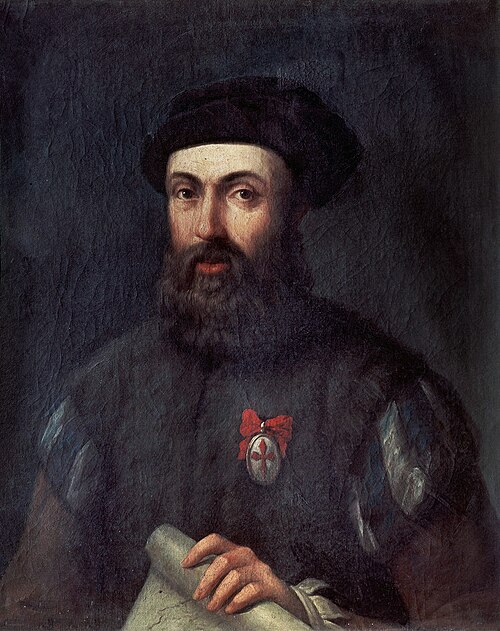
Ferdinand Magellan(1480 — 1521)
Ferdinand Magellan
royaume de Portugal
9 min read
Portuguese navigator and explorer in the service of the Spanish Crown (1480–1521). He organized and led the first expedition to circumnavigate the globe, opening the westward sea route to the Spice Islands.
Key Facts
- 1519: departure from Seville with 5 ships and 270 men to circumnavigate the globe
- 1520: discovery and crossing of the strait that bears his name, connecting the Atlantic to the Pacific
- 1521: death in the Philippines during the Battle of Mactan against chief Lapu-Lapu
- 1522: the Victoria, the sole surviving ship of the expedition, returns to Spain under the command of Elcano
- The expedition definitively proved that the Earth is round and established its true circumference
Works & Achievements
Magellan organized and led the first expedition to sail all the way around the Earth, definitively proving the roundness of the globe and the existence of a single great world ocean. Even though he died before the voyage was completed, it was his plan, his preparation, and his iron will that made the feat possible.
By meticulously exploring the fjords of southern America, Magellan found the passage connecting the Atlantic to the Pacific, confirming the hypothesis of a westward route to Asia. The strait has borne his name ever since and remains one of the great geographical discoveries of the Renaissance.
When the fleet emerged into the vast unknown ocean, Magellan named it "Mar Pacífico" because of its calm waters after the storms of the strait. This name has endured in every language in the world and designates the largest ocean on the planet.
The expedition demonstrated that it was possible to reach the Spice Islands from Europe by sailing westward and rounding the southern tip of America. This durably reignited commercial and geopolitical competition between Spain and Portugal.
Anecdotes
Magellan was Portuguese, but he offered his services to the Spanish Crown after King Manuel I of Portugal refused to fund his expedition. This change of allegiance made him a traitor in his homeland's eyes: his property in Portugal was confiscated and he was officially declared a renegade. Yet it was under the Spanish flag that he would achieve the greatest feat of his life.
In November 1520, after more than a year of sailing and a bloody mutiny, Magellan discovered the strait that bears his name today, at the southern tip of South America. Navigating that labyrinth of icy fjords took thirty-eight days. When his ships finally emerged onto a calm, luminous ocean, Magellan wept with joy and named it *Mar Pacífico* — the Pacific Ocean.
Magellan was killed on 27 April 1521 at the Battle of Mactan in the Philippines, while personally joining the fight to support his local ally, Chief Humabon. He underestimated the resistance of the warrior Lapu-Lapu and was overwhelmed by hundreds of opponents armed with spears and bows. He thus never reached the Moluccas, the Spice Islands he had set out to find.
Of the five ships and 270 men who left Seville in 1519, only the Victoria returned to Spain in September 1522, commanded by Juan Sebastián Elcano, with eighteen survivors. The spice cargo they brought back was so valuable that it alone covered all the costs of the expedition. Those eighteen men were the first humans ever to have circumnavigated the entire globe.
Aboard the expedition was Antonio Pigafetta, a young Venetian knight who kept a meticulous journal of the voyage. Thanks to his notes, we know that the crew crossed the Pacific for ninety-eight days without sighting land and nearly starved to death, resorting to eating boiled leather and rats sold at a steep price. This journal remains one of the most valuable historical sources on the Age of Exploration.
Primary Sources
The captain-general set sail with five ships, the largest of which carried one hundred and thirty men... After crossing that vast ocean which we called the Pacific, we reached the islands that the Portuguese call the Moluccas.
Your Majesty should know that we have discovered a passage between the two seas, by which it is possible to reach the Moluccas from the west, without violating the treaties concluded with the King of Portugal.
The Armada de la Especiería, consisting of five ships, departed from the port of Sanlúcar de Barrameda on 20 September 1519, under the command of Captain Ferdinand Magellan, to sail toward the Spice Islands by the western route.
All lands to the west of a line drawn three hundred and seventy leagues west of the Cape Verde Islands belong to the Crown of Castile, and all those to the east belong to Portugal.
Key Places
Andalusian port from which Magellan's armada set sail on 20 September 1519, and where the Victoria returned triumphantly in September 1522 with its eighteen survivors. Nearby Seville was home to the Casa de Contratación, which organized and financed the expedition.
A maritime passage of roughly 570 km discovered by Magellan in October–November 1520, between Patagonia and Tierra del Fuego. It links the Atlantic to the Pacific and has borne its discoverer's name ever since.
A small island in the Visayas where Magellan was killed on 27 April 1521 during a confrontation with the chieftain Lapu-Lapu. A monument today commemorates both protagonists of this decisive battle.
The expedition's final destination, these islands — producers of cloves and nutmeg — represented the commercial eldorado of the age. Magellan never reached them, but his successors loaded the spices there that funded the return voyage to Spain.
The city where Magellan first found his footing as a page at the court of King Manuel I and learned the art of navigation. It was in Lisbon that he prepared his early voyages to India, before falling out with the king and offering his services to Spain.