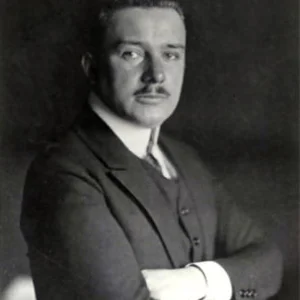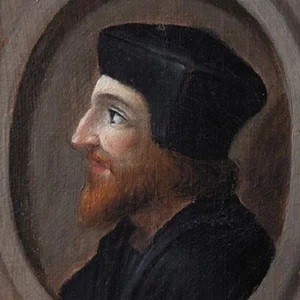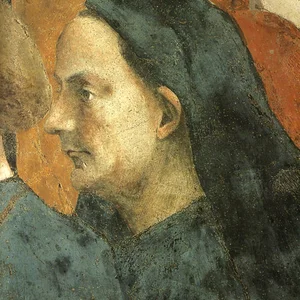

Florentine architect and engineer (1377–1446), he is considered the father of Renaissance architecture. He is renowned for designing the dome of the Cathedral of Santa Maria del Fiore in Florence and for formalizing the laws of linear perspective.
Filippo Brunelleschi(1377 — 1446)
Filippo Brunelleschi
Italie
8 min read
Frequently asked questions
Key Facts
- 1377: born in Florence
- 1401: competes in the contest for the doors of the Florence Baptistery, a competition won by Ghiberti
- Around 1420: formalizes the principles of linear perspective
- 1420–1436: construction of the dome of Santa Maria del Fiore, an unprecedented feat of engineering
- 1446: dies in Florence
Works & Achievements
A major technical feat of the Renaissance: a double octagonal dome 45.5 meters in diameter and 116 meters tall, built without scaffolding using herringbone brickwork. It remains to this day the largest masonry dome ever erected.
The first fully Renaissance building in history, its loggia of nine round arches on uniform Corinthian columns embodies Brunelleschi's ideal of harmony, light, and mathematical proportion.
A church commissioned by the Medici in which Brunelleschi transformed the interior space through a modular system based on simple proportions (1:2), creating the sense of order, clarity, and serenity characteristic of Florentine Renaissance architecture.
A masterpiece of small-scale architecture commissioned by the Pazzi family, universally admired for the perfection of its geometric proportions, the alternation of *pietra serena* and white plaster, and the mastery of an interior space centered on a dome.
Brunelleschi's last major project, whose construction continued after his death. The church carries his principles of proportion and modularity to their fullest expression, with continuous columns running around the entire interior space.
Two painted panels experimentally demonstrating the laws of single-point linear perspective. Lost today, they are considered the starting point of all theory of spatial representation in Renaissance painting and architecture.
Anecdotes
In 1401, Brunelleschi took part in the famous competition to decorate the north doors of the Florence Baptistery. His panel depicting the Sacrifice of Abraham was considered by many to be equal to that of Lorenzo Ghiberti. Rather than share the commission, he proudly refused and abandoned sculpture to devote himself entirely to architecture.
Around 1413, Brunelleschi carried out a remarkable experiment to demonstrate the laws of perspective: he painted the Florence Baptistery on a small panel, then drilled a hole in its center. By holding the panel with its back to the building and looking through the hole at a mirror placed in front of him, the viewer saw the image align perfectly with reality — proof that perspective could reproduce the world with mathematical precision.
During the 1418 competition to build the dome of the Cathedral, Brunelleschi challenged his rivals to make an egg stand upright on a smooth marble surface. All failed; he then placed the egg on its end by slightly flattening its base and made it stand. He went on to explain that anyone who saw his plan would understand the dome just as easily — but he refused to reveal it until he was chosen.
To hoist tons of materials to the top of the dome without the oxen having to descend after each trip, Brunelleschi invented an ingenious double-gear winch that could reverse the direction of rotation simply by moving a lever. This machine so fascinated his contemporaries that Leonardo da Vinci made detailed sketches of it several decades later.
Primary Sources
Filippo di ser Brunellesco fu di mediocre statura... e di tanta intelligenzia e memoria e ingegno che si può agguagliare agli antichi artefici, e anche in molte cose passargli.
Fu trovatore della prospettiva e regola di essa, e con tanta diligenza e cura operò questa cosa che meritò in questa arte lode grandissima dagli uomini dotti e dall'altre nazioni.
Io suole in ogni cosa difficile e peregrina richiedere prima diligente elezione de' soggetti... In te, Filippo, e in quel nostro amicissimo Donato scultore vedo ingegno da non cedere ad alcuno degli antichi.
Fu di grande ingegno Filippo di ser Brunellesco, fece molte opere di grande artificio nella città di Firenze. Fu inventore e trovatore di molta scrittura e di molti ornamenti.
Key Places
Brunelleschi's birthplace and the setting for his entire career. It was here that he was born, learned his craft, revolutionized architecture, and died, leaving behind monuments that permanently transformed Western art.
Brunelleschi's absolute masterpiece: he designed and oversaw the construction of the octagonal dome, 45 meters in diameter and 116 meters tall — a unique technical feat that remains the largest masonry dome ever built.
Brunelleschi spent time in Rome with Donatello in the early 15th century to study ancient ruins — the Pantheon, imperial baths, and triumphal arches. This immersion in Roman architecture laid the entire foundation for his Renaissance architectural vision.
The first fully Renaissance building designed by Brunelleschi (from 1419 onward), admired for its loggia of nine round arches resting on Corinthian columns of perfect harmony. It housed one of the first organized orphanages in Europe.
Brunelleschi designed this church for the Medici family from 1421, introducing the principles of mathematical proportion and modular grid into sacred architecture and creating a space of new clarity and serenity.
Typical Objects

Fundamental tools Brunelleschi used to draw his plans with mathematical precision. He relied on them to design his buildings according to rigorous geometric proportions inherited from Roman Antiquity.

Brunelleschi built scale models of his projects to present them to his patrons and experts. His large model of the Dome's cupola, still preserved at the Museo dell'Opera del Duomo in Florence, bears witness to the care he devoted to preparing his construction sites.

A small painted panel with a central hole, invented by Brunelleschi to demonstrate the laws of linear perspective. The viewer looked through the hole at the reflection of the image in a mirror to verify that the representation aligned exactly with the actual building.

A revolutionary lifting machine designed by Brunelleschi to raise heavy materials to the top of the dome. Its double-gear mechanism allowed the direction of rotation to be reversed without moving the oxen, saving considerable time on the construction site.

Brunelleschi invented a technique of laying bricks in an alternating diagonal pattern that allowed each course to support itself without wooden centering. This ingenious solution was the key that made it possible to build the dome without scaffolding.

Measuring tools Brunelleschi used on his construction sites to ensure the perfect alignment of his columns, arches, and vaults according to the mathematical proportions he had studied in Rome.
School Curriculum
Vocabulary & Tags
Key Vocabulary
Daily Life
Morning
Brunelleschi rose early to personally inspect the dome's construction site, sometimes climbing to the highest work areas to check the alignment of the brick courses. He would confer with his foremen, assign tasks, and ensure his hoisting machines were functioning properly before work began.
Afternoon
In the afternoon, he would withdraw to his bottega to work on his plans, design wooden scale models, or refine his construction machinery. He also received his patrons — merchant guilds, representatives of the Opera del Duomo, and noble families such as the Medici — to report on project progress and discuss the next steps.
Evening
In the evening, Brunelleschi frequented the circle of Florentine humanists and artists, particularly his lifelong friend Donatello. In the workshops and loggias of the city, he took part in lively discussions on Antiquity, ideal proportions, and the new artistic theories that were making Florence the center of the European Renaissance.
Food
Like any Florentine of bourgeois standing, Brunelleschi ate wheat bread, meat (pork, poultry), vegetables (broad beans, cabbage, leeks), and cheese, and drank Tuscan wine diluted with water. On building sites, the Opera del Duomo provided workers with rations of bread, wine, oil, and sometimes cheese as a supplement to their wages.
Clothing
Brunelleschi wore the garments of a prosperous master craftsman of the Quattrocento: a long dark woolen robe, a doublet and hose, often topped with a chaperon or cap. On the building site, he wore simpler, sturdier clothing suited to the dust, heat, and frequent movement across the scaffolding.
Housing
Brunelleschi lived in a building in the parish of Santo Michele Visdomini, in a bourgeois neighborhood just steps from the cathedral. His home included a workroom where he kept his instruments, scale models, and drawings, as well as living quarters furnished simply but with quality pieces, reflecting his recognized social standing.
Historical Timeline
Period Vocabulary
Liens externes & ressources
Références
Œuvres
Coupole de Santa Maria del Fiore
1420-1436
Ospedale degli Innocenti
1419-1445
Basilique San Lorenzo
1421-1446
Chapelle Pazzi (Cappella dei Pazzi)
c. 1429-1461
Basilique Santo Spirito
1436-1482 (achevée posthume)