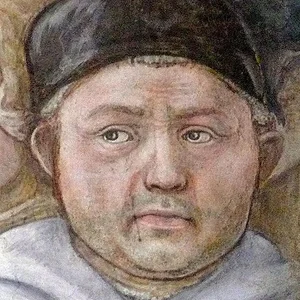

Florentine painter of the Quattrocento (1406–1469), a Carmelite friar who became one of the masters of Italian religious painting. Celebrated for his Madonnas with tender, human features, he influenced Botticelli, whom he trained.
Filippo Lippi(1406 — 1469)
Fra Filippo Lippi
République florentine
8 min read
Frequently asked questions
Key Facts
- Born around 1406 in Florence, orphaned and placed in a Carmelite convent at age 8
- Influenced by Masaccio, whose frescoes he studied in the Brancacci Chapel
- Worked under the patronage of Cosimo de' Medici from the 1430s onward
- Painted celebrated frescoes for Prato Cathedral (1452–1466)
- Master of Botticelli, whom he trained in his workshop; died in Spoleto in 1469
Works & Achievements
Housed in the Uffizi in Florence, this work is Lippi's absolute masterpiece: Lucrezia Buti posed as the model for the Virgin. Mary's melancholic gaze, the window landscape, and the tenderness of the angels make it an icon of Renaissance painting that directly inspired Botticelli.
A large altarpiece commissioned for the Uffizi chapel, now in the Uffizi Gallery. Lippi included a self-portrait as a monk gazing at the viewer — a gesture of unprecedented modernity — and combined medieval celestial hierarchy with Renaissance naturalism.
A monumental fresco cycle executed over fourteen years in the choir of Prato Cathedral. The Funeral of Saint Stephen and the Feast of Herod (featuring the dance of Salome) rank among the most inventive narrative scenes of the Quattrocento.
A private devotional painting commissioned for the Martelli family of Florence, now in San Lorenzo. Lippi develops a rigorously perspectival architecture and an unprecedented psychological tenderness between the angel and Mary.
Lippi's final commission, completed after his death by his son Filippino and Fra Diamante. The Nativity, the Dormition of the Virgin, and the Coronation of the Virgin attest to a serene mastery of monumental composition.
Commissioned by Cosimo de' Medici for the sacristy of Sant'Ambrogio in Florence, this altarpiece is one of the first to show the direct influence of Donatello on Lippi in the treatment of drapery and the monumentality of the figures.
Anecdotes
Orphaned in early childhood, Filippo Lippi was placed in the Carmelite convent in Florence at the age of eight. It was there that he watched, transfixed, as Masaccio worked in the Brancacci Chapel — a formative experience that drew him toward painting rather than monastic life.
Cosimo de' Medici, his great patron, would sometimes lodge him in his palace so he could work without interruption. According to Vasari, the painter was so hungry for freedom that he fashioned a rope from his bedsheets and slipped out the window to meet a woman he had fallen for — Cosimo eventually had no choice but to let him come and go as he pleased.
In 1456, Fra Filippo ran off with Lucrezia Buti, a young novice at the convent in Prato whose portrait he had been commissioned to paint. The scandal was enormous: a monk abducting a nun! It took the direct intervention of Cosimo de' Medici with Pope Pius II for the two lovers to be released from their vows and allowed to live together. Their son, Filippino Lippi, would also become a great painter.
Fra Filippo revolutionized the depiction of the Virgin Mary by giving her human, tender features inspired by real Florentine women. Where his predecessors had painted hieratic, golden Madonnas, he created gentle, melancholy mothers — a modernity that would deeply influence his pupil Sandro Botticelli.
Lippi died in Spoleto in 1469, his frescoes in the cathedral still unfinished. Lorenzo de' Medici asked the pope to have the body returned for burial in Florence, but the people of Spoleto refused: too proud to give up the tomb of so great an artist, they erected a magnificent funerary monument in their cathedral, created by his own son Filippino.
Primary Sources
Filippo di Tommaso Lippi, pittore fiorentino, fu messo l'anno 1421 nel convento del Carmine... e quivi, vedendo le opere di Masaccio e piacendogli sommamente, si diede a studiarle.
Fra Filippo è singularissimo maestro nella sua arte ed è uomo di buona vita; preghiamo che gli sia data ogni comodità per finire l'opera cominciata.
Considering the services rendered to the sacred arts and at the intercession of the Lords of Florence, we grant dispensation to Brother Filippo Lippi and to Lucrezia Buti from their respective monastic obligations.
Fra Filippo di Tommaso de' Lippi, pittore, conviene dipingere le storie di santo Stefano e di san Giovanni Battista nella cappella maggiore della chiesa di Santo Stefano di Prato.
Key Places
A working-class neighborhood on the south bank of the Arno where Filippo Lippi was born in 1406. This lively artisan community shaped his sensitivity to ordinary faces, which he would later capture in his Madonnas.
The Carmelite convent where Lippi grew up from the age of eight and took his vows. It was here that he discovered Masaccio's revolutionary frescoes in the Brancacci Chapel, which shaped his entire artistic vision.
The Tuscan city where Lippi worked for more than fifteen years on his most ambitious frescoes (the Stories of Saint Stephen and Saint John the Baptist) and where his relationship with Lucrezia Buti began.
Cosimo and later Lorenzo de' Medici were Lippi's greatest patrons, commissioning works from him and shielding him from his scandals. The painter was a regular at this palace, the heart of Florentine cultural power.
Lippi's final major commission: the apse frescoes depicting the Life of the Virgin. He died there in 1469 before completing them and was buried with the honors befitting a great master.
Typical Objects

Fra Filippo wore the habit of the Carmelite order, a symbol of his two contradictory identities — monk and artist. He depicted himself as a monk in several of his works, notably in the Coronation of the Virgin.

An essential tool for Quattrocento painters, these fine brushes enabled the delicate strokes and subtle glazes characteristic of Lippi's technique, particularly for transparent veils and delicate flesh tones.

Lippi used gold for the halos and backgrounds of his religious panels, a medieval tradition he combined with Renaissance perspective — a tension visible in his early Madonnas.

For his large frescoes in Prato and Spoleto, Lippi prepared preliminary sketches traced in sinopia (a red-brown pigment) directly on the intonaco, then transferred his compositions using perforated cartoons.

Egg tempera was Lippi's primary medium for his panels: pigments ground and bound with egg yolk, enabling translucent layers and unmatched precision in rendering fabric and facial details.

Like every Florentine master, Lippi kept a register of commissions, contracts, and payments received from his patrons — the Medici, confraternities, the Opera del Duomo of Prato — precious documents recovered from the Florentine archives.
School Curriculum
Vocabulary & Tags
Key Vocabulary
Daily Life
Morning
Fra Filippo began his day at morning prayers in the convent chapel, but his devotion was notoriously distracted. From the early hours, he would make his way to his bottega — his workshop — to take advantage of the eastern light, ideal for working the delicate tempera glazes on the panels in progress.
Afternoon
In the afternoon, Lippi supervised his assistants (notably Fra Diamante, his faithful collaborator) on backgrounds and decorative elements, while reserving faces and hands for his own brush. The great frescoes at Prato required working quickly on fresh intonaco — each giornata (day's fresco session) corresponded to a precisely calculated surface area.
Evening
In the evening, contrary to monastic rules, Fra Filippo was known for his escapades around the city — taverns, romantic encounters — indifferent to the discipline of the cloister. After the scandal with Lucrezia Buti, he lived openly with her and their son Filippino, leading the life of a Florentine painter far more than that of a monk.
Food
At the Carmelite convent, the rule prescribed fasting and frugal meals — bread, legumes, vegetables, and fish on lean days. But commissions from the Medici and the great Florentine families allowed him to dine at their tables during banquets, enjoying roasted meats, honey pastries, and Tuscan wines.
Clothing
Fra Filippo wore the white and brown habit of the Carmelite order, with a scapular and leather belt. In the workshop, he would hitch it up and protect it with a coarse linen apron stained with pigments. After his dispensation from vows in 1461, he likely adopted more secular clothing while retaining the title of “Fra” (brother).
Housing
Lippi lived successively in a cell at the Carmine convent, then in rooms provided by his patrons (the Medici frequently lent him apartments). In Prato, he had lodgings adjoining the Duomo workshop, allowing him to oversee the fresco project over the course of several years.
Historical Timeline
Period Vocabulary
Liens externes & ressources
Références
Œuvres
Couronnement de la Vierge (Pala Maringhi)
1439-1447
Fresques de l'abside de la cathédrale de Spoleto — Vie de la Vierge
1467-1469
Vierge à l'Enfant entre saints Frédéric et Augustin
vers 1437-1438
See also
Related Characters
Ferdinand II of Aragon
1452 — 1516
Akhenaten
1400 av. J.-C. — 1335 av. J.-C.
Amenhotep III
1399 av. J.-C. — 1350 av. J.-C.

Aten
Caspar David Friedrich
1774 — 1840
Dante Alighieri
1265 — 1321