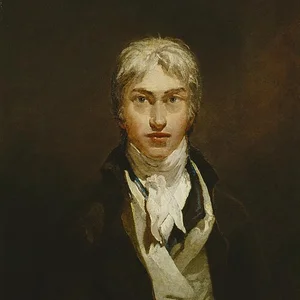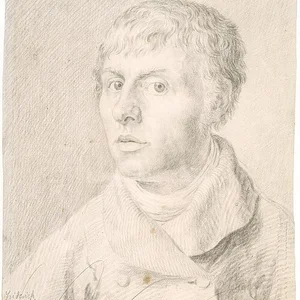

German Romantic painter (1774–1840), a leading figure of pictorial Romanticism. His melancholic and sublime landscapes explore human solitude in the face of infinite nature and divine transcendence.
Caspar David Friedrich(1774 — 1840)
Caspar David Friedrich
Suède, royaume de Prusse
9 min read
Frequently asked questions
Famous Quotes
« Close your bodily eye so that you may see your picture first with the spiritual eye.»
« The painter should not only paint what he sees before him, but also what he sees within himself.»
Key Facts
- Born on 5 September 1774 in Greifswald (Swedish Pomerania), died on 7 May 1840 in Dresden.
- He painted *Wanderer above the Sea of Fog* around 1818, an iconic work of Romanticism.
- Member of the Dresden Academy of Fine Arts from 1816.
- Rediscovered in the 20th century after decades of obscurity, notably through the 1906 exhibition in Berlin.
- His works influenced generations of artists in Europe and America (Hudson River School).
Works & Achievements
A crucifix atop a wooded mountain, framed like a church altarpiece. This work asserts that landscape painting can attain the dignity of sacred art, upending academic hierarchies — its unveiling sparked a national controversy in Germany.
A tiny, solitary figure faces an infinite horizon of sea and hazy sky, with no ship or landmark in sight. This radically empty composition — unprecedented for its time — is a meditation on human solitude and the insignificance of the individual before divine immensity.
Monks in funeral procession move through the ruins of a Gothic abbey in a snow-covered cemetery amid a bare, skeletal forest. The painting is an allegory of death and Christian resurrection, suffused with an atmosphere of absolute melancholy.
A man in a frock coat, seen from behind, stands on a rocky peak overlooking a sea of fog. This *Rückenfigur* has become the universal symbol of Romanticism: the lone individual confronting sublime nature, caught between wonder and existential vertigo.
Three figures stand at the edge of dizzying white chalk cliffs overlooking the turquoise Baltic Sea. The painting plays on the contrast between human fragility and natural grandeur, bathed in a light of almost unreal clarity.
Colossal sheets of ice crush the remains of a shipwrecked vessel in a desolate Arctic landscape. Inspired by polar expeditions, the painting is a meditation on human failure in the face of natural forces — some also read it as a metaphor for post-Napoleonic Europe.
A landscape of flooded plains in the golden light of dusk, with trees reflected in still water. A late work of melancholic serenity, it bears witness to Friedrich's mastery of atmosphere even as illness weakened him.
Anecdotes
At the age of thirteen, Caspar David Friedrich helplessly witnessed the drowning of his brother Johann, who had thrown himself into the water to save him after he slipped on the ice of a lake. This family tragedy left a deep mark on the young Friedrich and fed an intense melancholy throughout his life that can be felt in each of his works, where death often lurks in the background.
Friedrich invented an original compositional technique called *Rückenfigur* (figure from behind): he placed anonymous figures seen from the back in the foreground of his paintings, gazing out at vast landscapes. The viewer naturally identifies with this silhouette and shares its vertigo before infinite nature, without ever seeing its face — a revolutionary device for its time.
When Napoleon invaded the German states after 1806, Friedrich categorically refused to paint anything in praise of the French occupier. Instead, he wove into his paintings symbols of German identity — Gothic cathedrals, oak forests, medieval ruins — as so many silent acts of resistance expressed through the brush.
In 1835, a serious stroke left Friedrich partially paralyzed in his right arm. Unable to paint in oils as before, he confined himself to small watercolors and died in 1840 in near-total obscurity, forgotten by a public that now preferred other styles. His rediscovery did not begin until the late nineteenth century.
Friedrich studied from 1794 to 1798 at the Royal Academy of Fine Arts in Copenhagen, one of the finest in Europe. There he acquired an exceptional mastery of drawing and atmospheric effects, which he then put at the service of a personal and almost mystical vision of nature, far removed from the classical academic conventions of his era.
Primary Sources
The painter should paint not only what he sees before him, but also what he sees within himself. If he sees nothing within himself, then he should also refrain from painting what he sees before him.
Close your bodily eye, so that you may see your picture first with the spiritual eye. Then bring to the light of day that which you have seen in the darkness, so that it may react on others from the outside inwards.
I must let myself be fully pervaded by what I wish to depict; I must surround myself, merge with my clouds and my rocks, in order to be what I am.
When your spirit is troubled, do not dare to paint; lay down your work until you are at peace again. A painting made in agitation resembles a stammering speech.
Key Places
Friedrich's birthplace, on the Baltic coast, surrounded by flat landscapes, marshes, and medieval ruins. The ruins of Eldena Abbey and the endless Baltic horizons nourished his imagination throughout his life and reappear frequently in his paintings.
Friedrich settled there in 1798 and lived until his death in 1840. Dresden was then one of the most vibrant centers of German Romanticism, bringing together poets, philosophers, and painters; his studio overlooked the Elbe, and the city inspired several of his nocturnal canvases.
This island in northern Germany, with its vertiginous chalk cliffs, wind-twisted beech trees, and desolate beaches, was a major source of inspiration. Friedrich visited it several times and drew from it some of his most celebrated landscapes, including *Chalk Cliffs on Rügen*.
A mountain range covered in dark fir forests and often shrouded in mist. Friedrich made several study trips there and found the grand, mysterious landscapes — snow-capped peaks, shadowy ravines, raking light — that characterize his most celebrated canvases.
Friedrich studied at the Royal Danish Academy of Fine Arts there from 1794 to 1798. This rigorous training gave him the technical foundations that later allowed him to freely experiment with an entirely new pictorial language.
Typical Objects

Friedrich tirelessly roamed the forests, cliffs, and Baltic beaches, stick in hand, observing and memorizing the landscapes he would later recreate in his studio. This object embodies his method: walk, contemplate, and feel before painting.

During his travels through the Harz mountains or on the island of Rügen, Friedrich filled notebooks with meticulous drawings: trees, rocks, clouds, raking light. These studies from nature formed his visual library, from which he composed his finished paintings back in the studio.

Working in his studio from his sketches, Friedrich handled oil on canvas with exceptional precision to capture atmospheric effects: fog, moonlight, dawns. His transparent glazes give his skies a luminous depth that remains unmatched.

Friedrich was fascinated by twilight landscapes and moonlit scenes. A lantern allowed him to observe nature at dusk, those in-between moments of light that appear so often in his canvases as a metaphor for the passage between life and death.

Friedrich was a devout Lutheran; his Protestant faith deeply shaped his vision of nature as a place of divine revelation. The Bible provided him with a reservoir of symbols for his compositions: solitary crosses, Gothic cathedrals, and divine light signifying God's presence in the visible world.

The silhouette in a dark coat seen from behind — that of the *Wanderer Above the Sea of Fog* — was directly inspired by the clothing Friedrich himself wore on his hikes. This understated bourgeois garment, now iconic, symbolizes the Romantic individual confronting the vastness of nature.
School Curriculum
Vocabulary & Tags
Key Vocabulary
Daily Life
Morning
Friedrich rose early and began his day with a long walk in the countryside around Dresden, sketchbook in hand. He carefully observed the effects of morning light on the trees, the Elbe, and the mist. These solitary walks were at once a creative act and a form of Lutheran spiritual meditation.
Afternoon
Back in his studio, he worked at length on his canvases, composing from his sketches synthetic landscapes — never copied from a single location, but assembled from multiple sites and atmospheres. His work was slow and painstaking: a painting could take him months. He sometimes received poet and philosopher friends such as Kleist, or the painter Runge.
Evening
Friedrich loved to observe sunsets and moonlit nights from the heights of Dresden or the banks of the Elbe. These twilight hours, so dear to Romanticism, fed his imagination for nocturnal scenes and the raking light effects he reproduced in his paintings. He also read philosophy and theology.
Food
Friedrich lived modestly, on the simple meals of an artist without a steady income. Like many Dresdeners of his station, he ate mainly rye bread, vegetables, fish — a nod to his Baltic coastal origins — and light beer. He had no interest in the pleasures of fine dining.
Clothing
Friedrich wore sober, functional clothes typical of the educated German bourgeoisie of the early nineteenth century: a dark frock coat, a wide-brimmed hat, sturdy boots for walking. In his studio he worked in a linen smock. His understated appearance was consistent with his Romantic ideal of sincerity.
Housing
Friedrich lived in a studio apartment in Dresden whose windows looked out onto the Elbe. His studio was functional and sparsely decorated — what mattered above all was north-facing light, essential for a painter. After his marriage in 1818, he shared the apartment with his wife Caroline and their three children, in relative financial modesty throughout his life.
Historical Timeline
Period Vocabulary
Liens externes & ressources
Références
Œuvres
Moine au bord de la mer
1808-1810
Le Voyageur contemplant une mer de nuages
vers 1818
Les Grandes Réserves
vers 1832