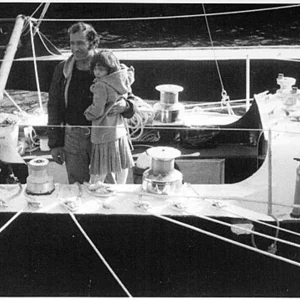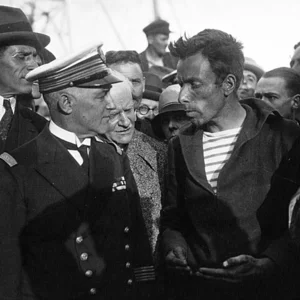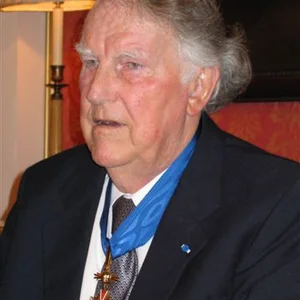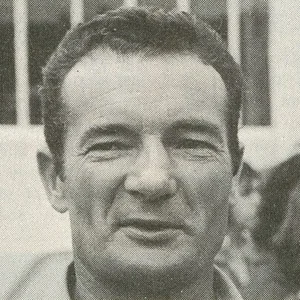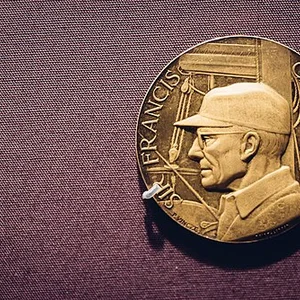

British aviator and sailor (1901-1972), a pioneer of solo navigation. In 1966-1967 he completed a solo round-the-world voyage under sail with just one stopover, aboard the Gipsy Moth IV.
Francis Chichester(1901 — 1972)
Francis Chichester
Royaume-Uni
6 min read
Frequently asked questions
Key Facts
- 1929-1931: long-distance solo flights, including an England-Australia air crossing aboard a plane named Gipsy Moth
- 1960: wins the first single-handed transatlantic race (OSTAR)
- 1966-1967: solo round-the-world voyage under sail with a single stopover (Sydney), via Cape Horn, aboard the Gipsy Moth IV
- 1967: knighted by Queen Elizabeth II at Greenwich, becoming Sir Francis Chichester
Works & Achievements
One of his first great aerial crossings, which established him as a long-distance aviator.
The first solo crossing of this sea from east to west, a feat of celestial navigation to reach tiny islands.
An account of his aerial feat over the Tasman Sea.
Technical works written during the war to train navigators, the fruit of his expertise with the sextant.
He won the first single-handed transatlantic race, completing the crossing in around forty days.
His autobiography, which traces his double life as an aviator and then a sailor.
Aboard Gipsy Moth IV, at the age of 65, he sailed around the globe along the clipper route with a single stop, in Sydney.
The account of his circumnavigation, which became a classic of maritime literature.
Anecdotes
All his craft, both aircraft and sailing boats, bore the same name: Gipsy Moth. It was the model of small de Havilland aeroplane in which he had learned to fly and carried out his aerial feats of the 1930s. Having become a sailor late in life, he gave his boats the same name, right up to the famous Gipsy Moth IV.
In 1931, alone aboard a small seaplane over the Tasman Sea, without a radio, he had to find Norfolk Island and then Lord Howe Island, two tiny dots lost in the ocean. He used his sextant and a navigator's trick: deliberately aiming to one side of his target so he would know which way to turn once he reached the correct latitude. The method worked.
He completed his round-the-world voyage under sail at the age of 65, only a few years after doctors had diagnosed him with lung cancer and predicted a swift end. Setting out from Plymouth in August 1966, he made only a single stop, at Sydney, and returned in the spring of 1967 after rounding the dreaded Cape Horn.
On his return, Queen Elizabeth II knighted him at Greenwich with the very sword Queen Elizabeth I had used nearly four centuries earlier to make Francis Drake a knight. A crowd estimated at half a million people was waiting for him at Plymouth.
Chichester did not like his new boat, the Gipsy Moth IV: he found it poorly balanced, hard to steer single-handed, and complained bitterly about its faults in his logbook. Even so, it was aboard her that he sailed around the world and passed into legend.
Primary Sources
I hate being frightened, but I hate even more being kept from acting by fear.
Any fool can sail around the world sober; it takes a truly good sailor to do it with a glass in hand.
The Queen knighted Sir Francis Chichester with the sword that Queen Elizabeth I had used to knight Sir Francis Drake, nearly four centuries earlier.
Key Places
Village in south-west England where Francis Chichester was born in 1901.
Departure and arrival port of his round-the-world voyage, where a huge crowd welcomed him in 1967; he died there in 1972.
The only stopover on his solo round-the-world voyage, at the halfway point, in late 1966.
The dreaded southern tip of South America, which he rounded in March 1967, one of the most dangerous passages on the globe.
Island in the Tasman Sea where, in 1931, his seaplane was damaged by a storm; he rebuilt it before setting off again.
Site of his knighthood by the Queen in 1967; the Gipsy Moth IV was later put on display there near the Cutty Sark.
Typical Objects

Chichester's favorite instrument and a master of celestial navigation, he used it both to locate tiny islands from the air and to fix his position in the open sea.

The roughly 16-metre ketch in which he sailed around the world in 1966-1967; a boat he found hard to steer single-handed.

The small biplane, sometimes fitted with floats, in which he achieved his aviation feats and whose name he reused for his sailboats.

The navigator's everyday working tool; after the war, Chichester even founded a mapmaking and chart-publishing company.

A mechanical device linked to the rudder that held the course relative to the wind, allowing the solo sailor to sleep and to handle the sails.

Oiled waterproof clothing essential for facing the cold, the spray and the waves of the southern seas.

The notebook in which he recorded position, weather, repairs and his state of mind, the basis for his published accounts.
School Curriculum
Vocabulary & Tags
Key Vocabulary
Tags
Daily Life
Morning
Up before dawn to check his heading and the self-steering gear, and trim the sails to suit the overnight wind. As soon as the sun allowed, he measured its altitude with the sextant to begin working out his position.
Afternoon
The heart of the day went to maintaining the boat: mending a torn sail, checking the rigging, bailing out water. He ate his meals and rested in short snatches, since alone on board he always had to stay alert.
Evening
At nightfall he sighted stars and planets with the sextant to refine his position, then wrote up his logbook. He sometimes attempted a radio contact and marked the great milestones with a glass of champagne or beer.
Food
On board he lived on tinned food, dehydrated meals, biscuits, garlic and onions, and brought beer along. Meals were cooked on a small stove, often at the cost of an acrobatic balancing act because of the heel and the swell.
Clothing
At sea he bundled up in several layers of wool beneath oilskins, with boots and a woolly hat to withstand the biting cold of the Southern Ocean. On deck he clipped on a safety harness so as not to be swept overboard.
Housing
His home was the cramped cabin of the Gipsy Moth IV, a ketch of about 16 metres, crammed with gear and where everything slid with every roll. There he had a narrow bunk and a chart table for his calculations.
Historical Timeline
Period Vocabulary
Liens externes & ressources
Références
Œuvres
Vol Angleterre-Australie en solitaire
1929
Traversée de la mer de Tasman en hydravion
1931
Alone Over the Tasman Sea (récit)
1933
Manuels de navigation astronomique
années 1940
Victoire à la première OSTAR sur Gipsy Moth III
1960
The Lonely Sea and the Sky (autobiographie)
1964
Tour du monde à la voile en solitaire avec une escale
1966-1967