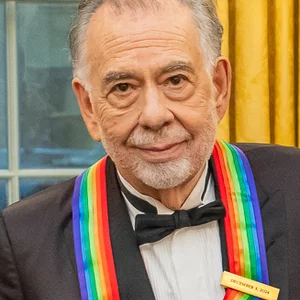

Francis Ford Coppola is an American director, screenwriter, and producer born in 1939, a major figure of New Hollywood. He is world-renowned for the Godfather trilogy and for Apocalypse Now, both of which have become cinema classics.
Francis Ford Coppola(1939 — ?)
Francis Ford Coppola
États-Unis
6 min read
Frequently asked questions
Key Facts
- Directs The Godfather in 1972, adapted from Mario Puzo's novel, a massive critical and commercial success
- Directs The Godfather Part II (1974), winner of the Academy Award for Best Picture
- Directs Apocalypse Now (1979), an epic about the Vietnam War, Palme d'Or at Cannes
- A leading figure of “New Hollywood” alongside Scorsese, Spielberg, and Lucas in the 1970s
- Wins two Palmes d'Or at the Cannes Film Festival (1974 and 1979)
Works & Achievements
The saga of an Italian-American Mafia family, regarded as one of the greatest films in history and awarded the Oscar for Best Picture.
A thriller about a surveillance expert consumed by guilt, winner of the Palme d'Or at Cannes, echoing the Watergate scandal.
A sequel and prequel to the first film, which won six Oscars including Best Picture and Best Director, a rare feat for a sequel.
A hallucinatory epic about the Vietnam War, loosely inspired by the novel *Heart of Darkness*, winner of the Palme d'Or at Cannes.
A flamboyant adaptation of Bram Stoker's novel, praised for its costumes and visual effects and awarded three technical Oscars.
A sweeping fable about a futuristic city, a lifelong project that Coppola financed himself at the cost of part of his wine estate.
Anecdotes
For The Godfather (1972), Paramount studios wanted neither Marlon Brando, deemed too difficult, nor Al Pacino, then unknown. Coppola fought to impose them and nearly got fired several times during filming. The film became one of the greatest successes in the history of cinema.
During his screen test for the role of Don Corleone, Marlon Brando slipped cotton into his cheeks to give himself the look of an old godfather with a drooping face. Convinced, Coppola then had him wear a real dental prosthesis during filming.
The filming of Apocalypse Now (1976-1977) in the Philippines turned into a nightmare: a typhoon destroyed the sets, lead actor Martin Sheen suffered a heart attack at 36, and Marlon Brando showed up overweight without having read the script. Coppola, on the verge of bankruptcy, later declared that his film was not about Vietnam, but that it “was” Vietnam.
Filmmaking is a family affair for the Coppolas: his father Carmine, a flutist and composer, wrote the music for The Godfather Part II and won an Oscar. His sister Talia Shire played Connie Corleone, his daughter Sofia Coppola became a director, and his nephew Nicolas Cage is an actor.
Primary Sources
My film is not about Vietnam. My film is Vietnam. It's what it was really like: it was crazy.
Francis said that everything he had — his house, his possessions — was tied up in this film; if it failed, they would lose everything.
We had access to too much money, too much equipment, and little by little we went insane.
Key Places
Birthplace of Francis Ford Coppola in 1939, where his father was working as a musician at the time.
Borough where Coppola spent part of his childhood in an Italian-American family passionate about music.
Heart of the American film industry, where Coppola shot and produced his major films for the studios.
Site of the chaotic shooting of Apocalypse Now, where the jungle stood in for Vietnam and a typhoon destroyed the sets.
Wine-growing valley where Coppola set up his home and winery estate, which became a second career after filmmaking.
Festival where Coppola won two Palmes d'Or, for The Conversation (1974) and Apocalypse Now (1979).
Typical Objects

The director's central tool, the camera captures the images that will make up the film. Coppola was a pioneer in using new technologies to film and edit.

Text that describes a film's story, dialogue and action. Coppola was also an award-winning screenwriter, honored with an Oscar for Patton.

The most prestigious award in American cinema, presented by the Academy. Coppola received several, notably for The Godfather Part II.

Strip of film on which images were recorded before the digital era. The shooting of Apocalypse Now consumed enormous quantities of it.

Loudhailer used on set to direct actors and crew. It symbolizes the director's authority over the shoot.

Folding seat marked with the director's name, which has become the emblem of their role on a film set.
School Curriculum
Vocabulary & Tags
Key Vocabulary
Tags
Daily Life
Morning
During a shoot, Coppola gets up early to prepare the day's scenes with his crew. He likes to reread the screenplay and discuss the shots with his director of photography over a cup of coffee.
Afternoon
Afternoons are devoted to the set: he directs the actors, adjusts the framing and does not hesitate to redo many takes to capture just the right emotion. Known as a perfectionist, he sometimes improvises last-minute changes.
Evening
In the evening, he watches the footage shot during the day (the “rushes”) and prepares the next day's work. Away from filming, he loves to host gatherings and share long family meals.
Food
Proud of his Italian roots, Coppola enjoys Italian-American cuisine: pasta, slow-simmered sauces and dishes shared around a big table. A lover of good wine, he founded his own vineyard estate in California.
Clothing
On set, he wears comfortable, practical clothes, often a shirt and a vest, with a hat or glasses. For ceremonies, he opts for the dark suit the occasion calls for.
Housing
Coppola lives notably on a large estate in the Napa Valley, in California, surrounded by vineyards. This property is home to both his family residence and his wine-production business.
Historical Timeline
Period Vocabulary
Liens externes & ressources
Références
Œuvres
La Conversation
1974
Apocalypse Now
1979
Bram Stoker's Dracula
1992
Megalopolis
2024