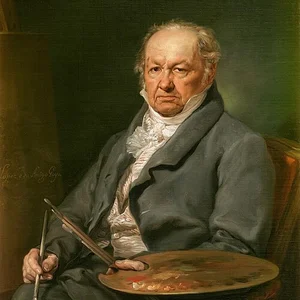

Spanish painter and printmaker (1746–1828), considered a forerunner of modern art. He served as official painter to the Spanish royal court while developing a dark and visionary personal body of work, particularly after losing his hearing in 1792.
Francisco de Goya(1746 — 1828)
Francisco de Goya
Espagne
8 min read
Frequently asked questions
Key Facts
- 1746: born in Fuendetodos, Aragon (Spain)
- 1786: appointed painter to King Charles III, then First Court Painter to King Charles IV in 1799
- 1792: complete deafness following a severe illness — a turning point in his artistic work
- 1808–1814: witness to the atrocities of the Peninsular War against Napoleon, inspiring The Disasters of War
- 1828: died in exile in Bordeaux, leaving a major body of work including the Black Paintings created at the Quinta del Sordo
Works & Achievements
A series of 80 satirical prints denouncing superstition, clerical corruption, and the follies of Spanish society. Plate 43, 'The Sleep of Reason Produces Monsters', has become one of the most iconic images in Western art.
A group portrait of the Spanish royal family painted with almost brutal honesty, in which Goya depicts his patrons with a psychological truthfulness that goes far beyond the conventions of official portraiture.
Two paintings depicting the same woman reclining, first nude and then clothed — sensual and scandalous works that led to Goya being summoned before the Spanish Inquisition.
A masterpiece of history painting depicting the execution of Spanish resisters by French soldiers. This landmark canvas ushered in the modern representation of wartime violence and would go on to influence Manet and Picasso.
A series of 82 prints documenting with unprecedented brutality the atrocities of the Spanish War of Independence against Napoleon. Considered one of the most powerful anti-war works in the history of art.
One of fourteen 'Black Paintings' painted directly onto the walls of the Quinta del Sordo, depicting the god Saturn consuming his child in a frenzy of terror. An iconic image of madness, destructive power, and old age.
A cartoon for a tapestry intended for the Royal Palace of El Escorial, depicting an elegant and luminous scene of everyday life — a testament to Goya's early period, still rooted in the Rococo tradition before his artistic transformation.
Anecdotes
In 1792, Goya contracted a mysterious illness — probably encephalitis or lead poisoning — which left him completely deaf at the age of 46. Far from ending his career, this deafness cut him off from the outside world and turned him inward, toward an increasingly dark and tormented vision that would profoundly transform his art.
Goya spent his final years in a house on the outskirts of Madrid that he ironically named the 'Quinta del Sordo' (House of the Deaf Man). Directly onto the walls of its rooms, he painted in oil a series of haunting and terrifying images, known as the 'Black Paintings', never intending them to be seen by the public.
As official painter to King Charles IV, Goya produced in 1800 a group portrait of the royal family of disconcerting frankness. Some art historians see it as veiled criticism: the faces are harsh and vulgar, and Queen María Luisa — whose domination over her husband was well known — holds center stage in the composition.
After Napoleon's invasion of Spain in 1808, Goya bore witness to the atrocities of war. From this experience he drew a series of 82 prints titled 'The Disasters of War', depicting with unprecedented brutality the massacres, famines, and horrors of the conflict. The plates were not published until 1863, thirty-five years after his death.
Well into his eighties, a voluntary exile in Bordeaux following the absolutist restoration of Ferdinand VII, Goya embraced the brand-new technique of lithography with great enthusiasm. He produced a series on bullfighting, the 'Bordeaux Bulls', proving that his artistic curiosity and creative energy remained fully intact until the very end of his life.
Primary Sources
I am unable to see anything at all. I do not know whether it is a cataract or something else, but my sight is so weak that I can barely sign my name.
To occupy my imagination, mortified by the contemplation of my afflictions, and to offset in part the great expenses they have caused me, I set myself to a series of cabinet paintings.
Painting (like poetry) selects from the universal what it deems most suited to its ends; it brings together in a single fantastical figure circumstances and traits that nature has distributed among many.
Sad forebodings of what is to come.
I am old, deaf, lazy, and ignorant in French, but I am so well and so eager to see this world.
Key Places
Goya's birthplace in 1746, located in the arid and austere region of Aragon. His very modest childhood home has been preserved as a museum.
Goya's official workplace as court painter to Charles III and later Charles IV, where he produced royal portraits and official decorations.
A country house acquired by Goya in 1819, on the banks of the Manzanares River, where he painted the terrifying 'Black Paintings' directly onto the walls. The house was demolished in the late 19th century.
A chapel whose frescoes (1798) were painted entirely by Goya; he is also buried there — though without his head, which was found to be missing when his remains were repatriated.
The city where Goya spent his final years in voluntary exile (1824–1828), surrounded by liberal Spanish friends, continuing to paint and engrave until his death in 1828.
Goya created several monumental frescoes for this basilica in his home region, which brought him national recognition from an early age.