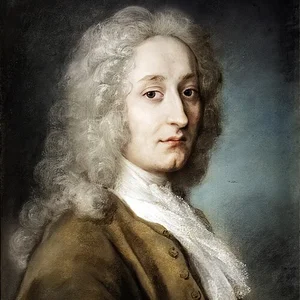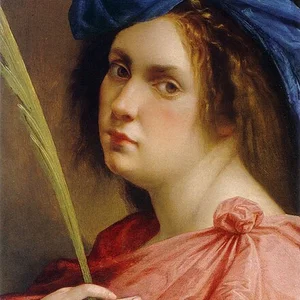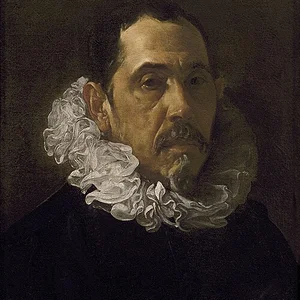

Spanish painter (1564–1644), master of Seville and father-in-law of Velázquez. A theorist of painting, he authored *El arte de la pintura*, a landmark treatise on 17th-century Spanish painting.
Francisco Pacheco(1564 — 1644)
Francisco Pacheco
Royaume de Grenade
8 min read
Frequently asked questions
Key Facts
- Born in 1564 in Sanlúcar de Barrameda, died in 1644 in Seville
- Ran a renowned workshop in Seville where Diego Velázquez trained and later married his daughter in 1618
- Censor of paintings for the Spanish Inquisition in Seville
- Published *El arte de la pintura* in 1649 (posthumously), a reference treatise on technique and iconography
- Codified the iconography of the Immaculate Conception in Spanish painting
Works & Achievements
Pacheco's theoretical masterpiece and the primary source on 17th-century Spanish painting. This three-book treatise covers technique, religious iconography, and artist biography, including the earliest descriptions of Velázquez's early works.
A manuscript collection of drawn portraits accompanied by biographical notes, forming a unique gallery of the intellectuals, poets, and artists of Golden Age Seville, among them Cervantes, Quevedo, and Góngora.
A painting held in Seville Cathedral, depicting the Immaculate Conception according to the iconographic guidelines Pacheco himself had developed, with the Sevillian poet Miguel Cid shown at the bottom holding a banner bearing verses in her honor.
A portrait of the great Spanish poet and satirist, one of Pacheco's most celebrated, bearing witness to his ties with the Hispanic literary elite and his mastery of the formal portrait.
A documented collaboration between Pacheco and his young son-in-law during Velázquez's early training years, allowing art historians to identify the respective contributions of master and pupil in the Sevillian bodegones.
Anecdotes
Pacheco's workshop in Seville was far more than a simple workplace: it functioned as a true informal academy where poets, humanists, and artists gathered. Figures such as Miguel de Cervantes, Francisco de Quevedo, and Lope de Vega were regular visitors to these circles, making it an exceptional intellectual hub of the Spanish Golden Age.
In 1618, Pacheco agreed to give his daughter Juana in marriage to his young pupil Diego Velázquez, who was only nineteen years old at the time. Far from being a mere family arrangement, this marriage bound together two exceptional artists, and Pacheco continued to influence and support his illustrious son-in-law's career until Velázquez's departure for the royal court in Madrid.
The Spanish Inquisition appointed Pacheco *visitador de imágenes sagradas* in Seville, entrusting him with the authority to judge whether religious images conformed to the standards of Catholic orthodoxy. This official role allowed him to exert considerable influence over the religious iconography of his era and to anchor his prescriptions within an institutional framework.
In 1611, Pacheco undertook a journey to Toledo to visit the celebrated painter El Greco, who was then near the end of his life. This encounter between the two artists, recorded in Pacheco's notes, bears witness to his intellectual curiosity and his desire to measure his own vision of painting against that of a master whose style was radically different from his own.
In *El arte de la pintura*, Pacheco established precise iconographic rules for depicting the Immaculate Conception: the Virgin Mary was to be clothed in white and blue, surrounded by rays of sunlight, a crown of twelve stars, and a crescent moon beneath her feet. These prescriptions, inspired by the Book of Revelation, had a lasting influence on Spanish Baroque religious painting and were adopted by Murillo and Zurbarán after him.
Primary Sources
El fin de la pintura es deleitar, enseñar y mover. Deleitar a los ojos con la hermosura y variedad de las figuras y colores; enseñar al entendimiento con la historia o fábula que se representa; mover la voluntad con la piedad de los ejemplos santos que se imitan.
Pintase esta señora en la flor de su edad, de doce a trece años, hermosísima niña, los ojos bellos y graves, la nariz y boca perfectísimas y rosadas mejillas; los cabellos tendidos, de color de oro; con las doce estrellas formando una corona alrededor de la cabeza.
This manuscript collection contains drawn portraits and biographical notes on the personalities Pacheco knew or painted, offering a firsthand account of the intellectual figures of early 17th-century Seville.
Cinco años tuvo en mi poder, aprendiéndole los principios y el arte, joven de tan grandes esperanzas que prometía lo que después mostró con tan universal aplauso.
Key Places
Francisco Pacheco's birthplace in 1564, an Andalusian port at the mouth of the Guadalquivir from which expeditions to the Americas departed. He spent his childhood there before being entrusted to his uncle, a canon in Seville.
The city where Pacheco spent his entire adult life, running a workshop and an informal academy that made it the intellectual and artistic heart of Baroque Andalusia. He died there in 1644.
Pacheco traveled there in 1611 to visit El Greco in his studio, shortly before the master's death. This journey, recounted in his notes, reflects his curiosity about the different painterly traditions of Spain.
Pacheco visited the royal capital around 1623 in the company of his son-in-law Velázquez, who had just been appointed court painter. There he was able to study the royal collections at the Escorial and the royal palace.
Typical Objects

Pacheco's everyday tools, whose use he describes in precise detail in his treatise, recommending brushes of different sizes depending on whether he was rendering flesh, drapery, or backgrounds.

Pacheco produced preparatory line drawings for his portraits, a number of which have survived in his *Libro de retratos* — a unique record of the leading personalities of Baroque Seville.

His library included the major Italian treatises (Alberti, Vasari, Lomazzo), which he cites and debates in *El arte de la pintura*, while distancing himself from them to champion a Hispanic and Catholic vision of art.

In his treatise, Pacheco describes the preparation of oil colors, the mixing of mineral and plant-based pigments, and the closely guarded formulas for flesh tones used in his Sevillian workshop.

As *visitador* of sacred images, Pacheco held official authority to approve or censor religious works — a function symbolized by the documents and institutional stamps of the Holy Office.

The autograph manuscript of his treatise, painstakingly written over several decades, was Pacheco's most prized possession; it passed to his heirs and was published five years after his death.
School Curriculum
Vocabulary & Tags
Key Vocabulary
Daily Life
Morning
Pacheco began his day with prayer and Mass, in keeping with the deep Catholic piety that shaped his life and work. He then made his way to his workshop early in the morning to make the most of the best natural light, supervising his students in the preparation of canvases and pigments before tackling the most delicate passages himself.
Afternoon
The afternoon was devoted to painting proper — altarpieces, commissioned portraits, devotional works — but also to writing his treatise and receiving visitors. His workshop functioned as an open academy where poets, humanists and collectors came to discuss art, theology and literature in a spirit characteristic of the Sevillian Golden Age.
Evening
In the evening, Pacheco took part in *tertulias* — the informal intellectual gatherings typical of Spanish Baroque culture — where poetry was read aloud, artworks were discussed and theology debated. He also spent his evenings writing his *Libro de retratos*, noting his observations on the personalities he had portrayed during the day.
Food
Pacheco's diet was that of Seville's prosperous bourgeoisie in the 17th century: wheat bread, pulses (chickpeas, lentils), dried or fresh fish from the Guadalquivir, Andalusian olive oil, and meat on non-fasting days. Local wine from Sanlúcar and Jerez accompanied meals, as in every household in Andalusia.
Clothing
As a respected painter and official of the Inquisition, Pacheco wore carefully chosen attire that reflected his social standing: a dark doublet of woollen cloth or silk depending on the season, a lace collar or starched linen ruff in the Spanish fashion, and a black cloak for official outings. In the workshop, he wore an apron or smock to protect his clothes from pigments and oils.
Housing
Pacheco lived and worked in a large, typically Sevillian house with a central courtyard, common in Andalusian architecture. The workshop occupied the best-lit room, facing north for stable, diffuse light. His home also housed his library of art and theology books, his collection of drawings and his students' works, making this space at once a home, a workplace and a hub of intellectual exchange.
Historical Timeline
Period Vocabulary
Liens externes & ressources
Références
Œuvres
Libro de descripción de verdaderos retratos de ilustres y memorables varones
commencé vers 1599
Portrait de Francisco de Quevedo
vers 1616
La Cuisine de Marthe et Marie (avec Velázquez)
vers 1618