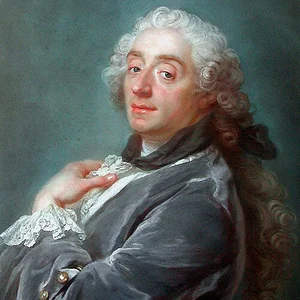

François Boucher was a French painter, draughtsman, and engraver, a leading figure of the Rococo style. First Painter to King Louis XV and protégé of the Marquise de Pompadour, he embodied the refined, gallant art of the 18th century.
François Boucher(1703 — 1770)
François Boucher
France
5 min read
Frequently asked questions
Key Facts
- Born in Paris in 1703, died in Paris in 1770.
- Won the Prix de Rome in 1723 and stayed in Italy (1727-1731).
- Became the favorite painter of the Marquise de Pompadour, of whom he made several portraits.
- Appointed First Painter to the King and director of the Royal Academy of Painting in 1765.
- An emblematic master of the Rococo with works such as 'Le Déjeuner' (1739) and 'L'Odalisque'.
Works & Achievements
Reception piece for the Royal Academy, showcasing his talent for gallant mythological subjects.
An intimate genre scene depicting a bourgeois family, a rare glimpse of everyday life in Boucher's work.
An iconic work of the Rococo, famous for the delicacy of the flesh tones and the grace of its composition.
A ceremonial portrait of his patron, a symbol of the taste and refinement of the court of Louis XV.
A sensual nude typical of gallant art, which also drew criticism regarding the morals of the period.
A pair of large mythological compositions commissioned for the Gobelins, the pinnacle of his decorative art.
A mythological subject intended for a tapestry hanging, blending energy and elegance.
Anecdotes
François Boucher was the favorite painter of the Marquise de Pompadour, the mistress of Louis XV. She commissioned numerous portraits and paintings from him, and even took engraving lessons with him. Thanks to this protection, Boucher became the most prominent artist at court.
In 1765, Boucher reached the peak of his career by becoming First Painter to the King and director of the Royal Academy of Painting. This was the highest distinction a painter could attain in France at that time.
The philosopher Diderot, who wrote commentaries on the Salon exhibitions, criticized Boucher for painting scenes that were too artificial and frivolous, judging that he had “everything except the truth.” This criticism already heralded the shift in taste toward a more moral and serious art.
Boucher also worked as a designer for the royal tapestry manufactories of the Gobelins and Beauvais. His colorful, gallant compositions were woven into large hangings that adorned palaces and private mansions.
As a young man, Boucher won the prestigious Prix de Rome in 1723, which allowed him to stay in Italy. There he studied the Italian masters, including Tiepolo, whose influence shaped his luminous palette and airy skies.
Primary Sources
What coloring! What variety! What a wealth of objects and ideas! This man has everything, except truth.
He had become the painter of the Graces and of gallantry, and his name filled all of Europe.
Monsieur Boucher was received as an Academician on the strength of his painting depicting Rinaldo and Armida.
The degradation of taste, of color, of composition, of character, of expression, of drawing has followed step by step the depravity of morals.
Key Places
Boucher's native city, where he lived and worked for most of his life, at the heart of artistic life and the court.
Boucher stayed here after winning the Prix de Rome to study the Italian masters and ancient art.
Residence of Louis XV, where Boucher decorated several royal apartments and those of Madame de Pompadour.
Royal tapestry manufactory in Paris, of which Boucher became artistic director in 1755.
Home of the Marquise de Pompadour, near Paris, which Boucher helped to decorate.
Typical Objects

Wooden board on which the painter lays out and mixes colours. Boucher used it for the pastel and pearly hues characteristic of the Rococo.

Red chalk crayon used for preparatory drawings. Boucher was a master of sanguine, prized for its warm rendering of flesh tones.

Large painted model used as a pattern by weavers to weave a tapestry. Boucher made many of them for the Gobelins and Beauvais manufactories.

Wooden support on which the canvas rests while the painting is being executed. A central piece of the painter's studio.

Pointed steel tool used to incise a copper plate for engraving. Boucher spread his compositions through prints.

An aristocratic fashion accessory often adorned with gallant scenes. Boucher's motifs inspired this kind of precious 18th-century object.
School Curriculum
Vocabulary & Tags
Key Vocabulary
Daily Life
Morning
Boucher started early in his vast studio, lit by large north-facing windows for steady, constant light. He would prepare his colors, review his red-chalk drawings, and set to work his many pupils and assistants.
Afternoon
The afternoon was devoted to prestigious commissions: paintings for the court, tapestry cartoons, stage sets. He also received visitors, dealers, and collectors who came to admire or buy his works.
Evening
In the evening, Boucher frequented the fashionable salons and refined society of Paris, where commissions and patronage were arranged. He could also be summoned to Versailles or to Bellevue at the side of the Marquise de Pompadour.
Food
Like well-off Parisians of the 18th century, he ate bread, meats, poultry, wine, and cheeses, as well as fashionable novelties such as coffee and chocolate. Refined meals were an occasion for socializing.
Clothing
Boucher wore French dress: an embroidered justaucorps, a waistcoat, breeches, silk stockings, and a powdered wig—the attire of a man of quality. In the studio, a dressing gown protected his clothes from paint stains.
Housing
Having become First Painter to the King, he was granted lodging and a studio at the Palais du Louvre, a privilege reserved for royal artists. These apartments combined living quarters with a workplace surrounded by pupils.
Historical Timeline
Period Vocabulary
Liens externes & ressources
Références
Œuvres
Le Déjeuner
1739
Diane sortant du bain
1742
Portrait de la marquise de Pompadour
1756
L'Odalisque brune
1745
Le Lever du soleil et Le Coucher du soleil
1753
Les Forges de Vulcain
1757