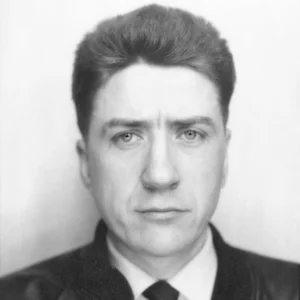

Franz Kline (1910-1962) was an American painter and a major figure of Abstract Expressionism. He is famous for his large canvases featuring powerful black brushstrokes on a white background, evoking calligraphy and gesture.
Franz Kline(1910 — 1962)
Franz Kline
États-Unis
5 min read
Frequently asked questions
Key Facts
- Born in 1910 in Wilkes-Barre, Pennsylvania
- Trained in Boston and then London before settling in New York
- From 1950 onward, developed his distinctive black-and-white abstract style
- A central figure of Abstract Expressionism alongside Pollock, de Kooning, and Rothko
- Died prematurely in 1962 in New York
Works & Achievements
Iconic canvas with broad black bands, whose title evokes a locomotive from the artist's childhood; held at the MoMA in New York.
Another black-and-white composition named after a famous train, illustrating the link between his gesture and the world of railways.
Vast structure of black beams on a light ground, named after a mining county; a major work at the Whitney Museum.
A monumental work in which the balance between black and white becomes an almost sculptural architectural tension.
A painting evoking the energy and vertical structure of the metropolis through a network of black strokes.
A late work marking the return of color to his practice, shortly before his death.
Anecdotes
Franz Kline reportedly discovered his most famous style almost by accident: his friend the painter Willem de Kooning supposedly showed him his own drawings enlarged using a projector (Bell-Opticon). Seeing his small sketches projected in large format, Kline grasped the power that his black strokes could have when stretched to the scale of a wall.
Before becoming abstract, Kline was a gifted figurative painter who depicted urban landscapes, trains, and cabaret scenes. It was only at the very end of the 1940s, when he was nearly 40, that he shifted to the large black-and-white compositions that made his name.
Many believed that his canvases evoked Japanese or Chinese calligraphy, but Kline rejected this idea: for him, the white was as painted and worked as the black, and it was not an empty background behind signs, but a genuine battle between two equal forces.
Fascinated by trains ever since his childhood in a Pennsylvania mining region, Kline gave several of his works titles evoking locomotives, bridges, and industrial cities, such as “Chief” or “Cardinal,” names of famous trains.
Kline died prematurely at 51 of a heart disease, at the height of his fame, just as he was beginning to reintroduce bright colors into his final canvases, opening a new path that his death brutally cut short.
Primary Sources
“For me, black and white are not opposing contrasts; I paint white as much as black, and the white is just as important.”
“To paint is to experience a situation. The final form of a painting depends on how one responds to it.”
Exhibition presenting for the first time the large black-and-white compositions that established the artist's reputation.
Key Places
Kline's birthplace, in the heart of a coal-mining region whose industrial landscapes, bridges, and locomotives would shape his imagination.
Kline trained in drawing here in the early 1930s and met his future wife, Elizabeth.
The heart of Kline's artistic life: he worked here and frequented the Cedar Tavern and the other painters of the New York School.
Site of his first solo exhibition in 1950, which unveiled his large black-and-white compositions.
Kline died here in 1962 of heart disease, at the height of his career.
Typical Objects

Kline often used large house-painter's brushes, wider than artist's brushes, to lay down his thick, energetic black bands.

Like several abstract expressionists, Kline used commercial black and white enamel paint—fluid and inexpensive—rather than costly artist's colors.

His works often reached several meters: he worked on huge canvases set against the wall or laid on the floor so he could engage his whole body in the gesture.

Kline sketched his ideas on phone-book pages, newspapers, or scrap paper, quickly tracing the black motifs that he would then enlarge onto the canvas.

The device that projected his small sketches at a large scale: the enlarged vision of his strokes triggered his conversion to monumental abstraction.
School Curriculum
Vocabulary & Tags
Key Vocabulary
Daily Life
Morning
Kline was not an early riser: night was his time for creating, and mornings often served to recover or to reflect in front of works in progress. He would have his coffee, gazing at length at his paintings hung on the studio wall.
Afternoon
In the afternoon, he sketched on scraps of paper, phone-book pages, or newspaper, studying his compositions at a small scale before transposing them onto a large format. He prepared his enamel paints and brushes for the work ahead.
Evening
In the evening, Kline often headed to the Cedar Tavern in Greenwich Village, where De Kooning, Pollock, and the other painters of the New York School would gather to discuss art late into the night.
Food
His New York bohemian life consisted of simple, irregular meals taken in the cafés and bars of the Village. Alcohol, ever-present in the social life of the Cedar Tavern artists, held an important place.
Clothing
He is often described as elegant in his own way, wearing a shirt and jacket, with a neatly groomed mustache that contrasted with the image of the scruffy painter. In the studio, his clothes were smeared with black and white paint.
Housing
Kline lived and worked in modest Manhattan lofts, raw spaces serving as both home and studio, where he could unroll his large canvases.
Historical Timeline
Period Vocabulary
Liens externes & ressources
Références
Œuvres
Cardinal
1950
Mahoning
1956
Painting Number 2
1954