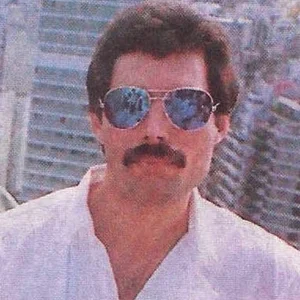

Freddie Mercury (1946-1991) was a British singer, songwriter, and pianist, the iconic frontman of the rock band Queen. Renowned for his exceptional voice and showmanship, he left a profound mark on popular music worldwide.
Freddie Mercury(1946 — 1991)
Freddie Mercury
Royaume-Uni, sultanat de Zanzibar
5 min read
Frequently asked questions
Key Facts
- Born on 5 September 1946 in Zanzibar (then a British protectorate).
- Joined and co-founded the band Queen in 1970 in London.
- Wrote and performed Bohemian Rhapsody, released in 1975, a groundbreaking worldwide hit.
- Memorable performance at the Live Aid charity concert in 1985 at Wembley Stadium.
- Died on 24 November 1991 in London from complications of AIDS.
Works & Achievements
Queen's landmark album featuring “Bohemian Rhapsody,” praised for its ambition and musical richness.
A nearly six-minute work blending ballad, opera, and rock that became a worldwide classic.
A gospel-inspired track showcasing layered choral harmonies and Mercury's vocal range.
An anthem sung in stadiums around the world, a symbol of victory and coming together.
An energetic piano-driven song that became one of the band's most popular.
A twenty-minute set regarded as one of the greatest in the history of rock.
A duet with an opera soprano, reflecting Mercury's passion for operatic singing.
The last studio album released during Mercury's lifetime, recorded while he was seriously ill.
Anecdotes
Freddie Mercury was born Farrokh Bulsara on 5 September 1946 in Zanzibar, then a British protectorate, into a Parsi family originally from India. He spent part of his childhood at a boarding school near Bombay, where he took up the piano and formed his first school band, The Hectics.
The track *Bohemian Rhapsody*, released in 1975, runs nearly six minutes and blends ballad, opera and hard rock, which was considered far too long to play on the radio. The gamble paid off, however: the song spent nine weeks at number one in the United Kingdom and became one of the greatest successes in the history of rock.
At the Live Aid charity concert at Wembley Stadium on 13 July 1985, Freddie Mercury led nearly 72,000 spectators in singing along. This twenty-minute performance is often cited as one of the most memorable in the history of rock concerts.
Mercury had a remarkable vocal range and very careful diction; he deliberately kept his prominent teeth, convinced that they gave his voice more power, refusing to have them corrected despite his self-consciousness about showing them.
On 23 November 1991, Freddie Mercury publicly announced that he had AIDS; he died the following day, on 24 November. His death helped raise public awareness of the disease, and a tribute concert was held at Wembley in 1992.
Primary Sources
Following the enormous conjecture in the press over the last two weeks, I wish to confirm that I have been tested HIV positive and have AIDS.
Bohemian Rhapsody didn't just come out of thin air. I did a bit of research, although it was tongue-in-cheek and mock opera.
We have lost the greatest and most beloved member of our family.
Key Places
Birthplace of Freddie Mercury in 1946, then a British protectorate. He spent his early years there.
The city where the family settled and where Queen formed in 1970. The hub of Mercury's career.
Site of Queen's legendary performance at Live Aid in 1985 and of the 1992 tribute concert.
Freddie Mercury's London home, where he lived his final years and died on 24 November 1991.
The town where young Farrokh was sent to boarding school at St. Peter's School and began his musical education.
Typical Objects

Freddie Mercury sang with a sawn-off microphone stand that he wielded like a baton or a scepter on stage. This accessory became his visual signature.

Mercury composed most of his songs at the piano, including “Bohemian Rhapsody.” The instrument was central to his songwriting.

White jumpsuits or colorful leotards, sometimes adorned, were part of his spectacular stage outfits. They reinforced his theatrical presence.

Queen's albums were released on vinyl records, the dominant medium of the era. “A Night at the Opera” sold millions of copies.

At the 1986 Wembley concert, Mercury wore a famous yellow jacket with braiding. It has become an icon of the band's imagery.

Queen used multitrack recording techniques to layer dozens of voices, notably on the choral parts of “Bohemian Rhapsody.” This made complex vocal arrangements possible.
School Curriculum
Vocabulary & Tags
Key Vocabulary
Tags
Daily Life
Morning
During creative periods, Freddie Mercury would often get up late, his nights being devoted to concerts or studio sessions. Quiet mornings were reserved for rest or peaceful moments at home, surrounded by his cats.
Afternoon
Afternoons might be filled with rehearsals, songwriting sessions at the piano, or meetings with the other members of Queen. He also enjoyed visiting galleries and auctions, being passionate about art and collectibles.
Evening
Evenings were devoted to concerts, studio recordings, or parties that became famous for their lavishness. Mercury would display his flair for showmanship and his love of conviviality.
Food
Mercury appreciated fine cuisine and gladly entertained his friends over refined meals. He was known for his hospitality and his champagne at receptions.
Clothing
On stage, he wore spectacular outfits: skintight bodysuits, leotards, capes, and military jackets. In everyday life, he adopted a more understated style, jeans and tank tops, with a moustache that became iconic in the 1980s.
Housing
He lived at Garden Lodge, a vast Georgian-style residence in the Kensington district of London. He furnished it with care, gathering works of art and precious objects there.