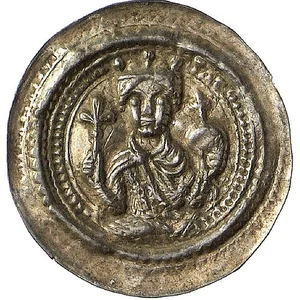

Holy Roman Emperor from 1155 to 1190 and a major figure of the Hohenstaufen dynasty. He sought to restore imperial authority in Italy against the Lombard communes and the papacy, and drowned during the Third Crusade.
Frederick Barbarossa(1122 — 1190)
Frederick Barbarossa
Saint-Empire romain germanique
7 min read
Frequently asked questions
Key Facts
- Elected King of the Romans (King of Germany) in 1152
- Crowned Holy Roman Emperor by the pope in 1155
- Defeated by the Lombard League at the Battle of Legnano in 1176
- Peace of Constance recognizing the autonomy of the Lombard communes in 1183
- Drowned in the Saleph River (Asia Minor) during the Third Crusade in 1190
Works & Achievements
Frederick adds the adjective “holy” to the Empire, asserting that its dignity comes directly from God, without depending on the pope's consecration.
Codification of the emperor's regalian rights in Italy, with the help of the jurists of Bologna; an attempt to ground imperial authority in Roman law.
The razing of Milan illustrates his determination to subdue the communes; he would ultimately fail to bring them lastingly to heel.
End of the schism and reconciliation with the papacy after years of supporting antipopes, restoring religious peace to the Empire.
A compromise recognizing the autonomy of the Lombard cities while maintaining the emperor's formal sovereignty: a model of political balance.
The marriage of his son Henry to Constance of Sicily, paving the way for the union of the Holy Empire and the Norman kingdom of Sicily under his descendants.
Frederick raises and leads the largest crusader army of the West toward the Holy Land, by land across the Balkans and Anatolia.
Anecdotes
His nickname “Barbarossa” (meaning “Redbeard” in Italian) was given to him by the inhabitants of the Italian cities because of his flaming red beard. In Germany, he was rather called “Rotbart”, which means the same thing. The Italian nickname stuck because it was in Italy that he led his most memorable campaigns.
In 1176, at the Battle of Legnano, the army of Frederick's knights was crushed by the foot militias of the Lombard League. For a moment the emperor was believed dead on the battlefield: he reappeared several days later in Pavia, to everyone's astonishment. This defeat forced him to recognize the autonomy of the Italian communes.
In 1190, during the Third Crusade, Frederick drowned while crossing the Saleph River (today's Göksu, in Turkey), perhaps the victim of a heart attack in the icy water. His sudden death threw the immense German army into disarray, and most of it turned back without ever reaching Jerusalem.
A German legend tells that Barbarossa never truly died, but lies asleep in a cave within the Kyffhäuser mountain, his red beard growing through the stone table. On the day the ravens stop circling the mountain, he will awaken to restore Germany to greatness.
In 1155, in order to be crowned emperor in Rome, Frederick at first refused to hold the stirrup of Pope Adrian IV's horse, a symbolic gesture of submission. The pope then withheld the kiss of peace. After two days of tension, Frederick finally gave in and performed the rite, showing just how much every ceremonial gesture was a matter of power.
Primary Sources
Our prince Frederick, by the grace of God august emperor of the Romans, is descended from the Henrys on his mother's side and the Welfs on his father's side; in him these two long-rival families find themselves reconciled.
The following are recognized as regalian rights belonging to the emperor: public roads, navigable rivers, ports, tolls, coinage, as well as the revenues drawn from cities and fortresses.
We grant to you, cities of the Lombard League, the regalian rights and the customs that you have exercised, both within the towns and outside them; you shall elect your consuls, save for the oath of fidelity owed to the Empire.
Know that, by divine favor and the unanimous consent of the princes, we have been raised to the summit of the kingdom, and that we are striving to restore the honor of the Empire to its ancient dignity.
Key Places
Region in south-western Germany, cradle of the Hohenstaufen dynasty of which Frederick was duke before becoming emperor. The battle cry “Waiblingen” gave its name to the Italian supporters of the emperor, the Ghibellines.
Capital of Christendom where Frederick was crowned emperor by Pope Adrian IV in 1155. The city was the recurring stage of his conflicts with the papacy and the Roman commune.
The most powerful of the Lombard communes and a fierce rival of the emperor. Frederick had it besieged and razed in 1162 before it rose again and led the resistance of the Lombard League.
Town in Lombardy where, in 1176, the imperial cavalry was defeated by the communal infantry. This battle marked the failure of Frederick's Italian policy.
River in Asia Minor, in present-day Turkey, where Frederick drowned in 1190 during the Third Crusade. His death there shattered the momentum of the great German army.
Great Romanesque cathedral, necropolis of the Salian emperors and a place tied to Germanic imperial memory. It embodies the prestige of the Holy Roman Empire that Frederick sought to restore.
Typical Objects

An octagonal gold crown set with gemstones and enamel plaques, the supreme symbol of Christian imperial dignity. Frederick made it the emblem of the “holiness” of the Empire, which he proclaimed *Sacrum Imperium*.

A long, straight, double-edged sword, both the weapon and the insignia of the dubbed knight. For a warrior emperor like Frederick, it also symbolized the “sword” of temporal power entrusted by God.

A flexible armor made of thousands of interlinked iron rings, covering the knight's torso and arms. It was the standard protection of noble fighters during the Crusades and the Italian campaigns.

A metal matrix used to press into wax the image of the enthroned emperor, which authenticated every official act (diploma, charter). Without it, a document had no legal value whatsoever.

A standard bearing the eagle, an emblem inherited from the Roman Empire and rallied around by the troops in battle. On the battlefield of Legnano, it was around the imperial standard (the enemy *carroccio*) that the fighting concentrated.

A parchment document written in Latin by the imperial chancellery, granting rights, privileges, or possessions. The Roncaglia diplomas codified the regalian rights claimed by Frederick.
School Curriculum
Vocabulary & Tags
Key Vocabulary
Daily Life
Morning
The emperor begins his day with Mass in the chapel of his palace or his camp, for imperial power claims to be sacred. Then comes the council with his princes and chancellors to examine the affairs of the Empire, read letters, and dictate replies in Latin.
Afternoon
The afternoon is devoted to governing: receiving ambassadors from the cities or the pope, dispensing justice, sealing charters. On campaign, Frederick reviews his knights, inspects the siege engines, and plans his army's marches.
Evening
In the evening, the emperor holds a banquet in the great hall, surrounded by his court, where warlike exploits are sung and where jugglers and minstrels enliven the table. It is also the moment for informal political discussions and for handing out favors to loyal vassals.
Food
The imperial table is abundant: roasted meats (boar, deer, poultry), fish on meatless days, white bread, and wines from Germany and Italy. Costly spices such as pepper and cinnamon, a sign of wealth, season the dishes during the great feasts.
Clothing
Frederick wears tunics of silk and fine wool, a fur-trimmed cloak, and, during ceremonies, the imperial regalia: crown, scepter, and orb. On campaign, he dons the mail hauberk, the helm, and the surcoat bearing the arms of the Empire.
Housing
The emperor has no fixed capital: he governs by moving from palace to palace (the Pfalzen) across the Empire. These fortified residences, like those of Kaiserslautern or Hagenau, house the itinerant court; in wartime, he lives under vast campaign tents.
Historical Timeline
Period Vocabulary
Liens externes & ressources
Références
Œuvres
Proclamation du Sacrum Imperium (Saint-Empire)
vers 1157
Constitutions de Roncaglia
1158
Destruction puis reconstruction de l'ordre lombard
1162
Paix de Venise avec le pape Alexandre III
1177
Paix de Constance
1183
Politique matrimoniale Hohenstaufen-Sicile
1186
Organisation de la troisième croisade
1189