
Andronikos III Palaiologos (1297–1341) was Byzantine emperor from 1328 to 1341. He came to power after a civil war against his grandfather Andronikos II. His reign was marked by military campaigns and the rising power of the Ottoman Empire.
Andronikos III Palaiologos(1297 — 1341)
Andronikos III Palaiologos
Empire byzantin
8 min read
Frequently asked questions
Key Facts
- 1297: birth of Andronikos III, grandson of Andronikos II Palaiologos
- 1321–1328: Byzantine civil war pitting Andronikos III against his grandfather Andronikos II
- 1328: Andronikos III seizes Constantinople and becomes sole Byzantine emperor
- 1329: defeat against the Ottomans at the Battle of Pelekanos, loss of Nicaea
- 1341: death of Andronikos III, leaving behind a weakened empire
Works & Achievements
Andronikos III established a supreme tribunal of four independent 'universal judges' tasked with delivering impartial justice throughout the Empire. It stands as one of the few lasting institutional reforms of fourteenth-century Byzantium.
Andronikos III recaptured the island of Chios from the Genoese Zaccaria family, restoring Byzantine control over this strategic position in the Aegean Sea and its prosperous trade.
Through a successful military campaign, Andronikos III brought Thessaly back under direct imperial control, ending the de facto independence this territory had enjoyed for several decades.
Andronikos III succeeded in incorporating much of the Despotate of Epirus into the Byzantine Empire, briefly consolidating Byzantine presence in mainland Greece.
Andronikos III led several naval expeditions to retake islands from Latin and Genoese lords, including Lesbos, asserting Byzantine maritime power in the eastern Aegean.
Anecdotes
In 1320, Andronikos III set armed men in ambush to surprise a romantic rival. By a fatal mistake, in the darkness these men killed his own brother Manuel. Devastated by this tragedy, their grandfather Emperor Andronikos II decided to disinherit him, thus triggering a civil war that would last nearly eight years.
To finance his military campaigns and rebuild the crumbling Byzantine army, Andronikos III relied entirely on his closest friend and Grand Domestic John Kantakouzenos, an immensely wealthy aristocrat who spent his personal fortune on the defense of the Empire. Their unshakeable friendship was one of the cornerstones of the reign, and Kantakouzenos left a heartfelt account of it in his memoirs.
In June 1329, Andronikos III personally attempted to relieve the besieged cities of Nicaea and Nicomedia from the Ottoman forces of Orhan. The Battle of Pelekanos turned into a disaster for the Byzantines: the emperor himself was wounded in combat. This defeat marked an irreversible turning point — the Empire was permanently losing Bithynia, the cradle of the rising Ottoman power.
In 1329, Andronikos III profoundly reformed Byzantine justice by creating a supreme court of four judges known as “catholic judges” (universal judges). This unprecedented institution aimed to combat endemic corruption and the arbitrariness of local courts. It is one of the few lasting administrative reforms of his reign.
Despite the military decline of the Empire, Andronikos III managed to reconquer several lost territories: he retook the island of Chios from the Genoese Zaccaria family in 1329, recovered Thessaly in 1333, and part of Epirus in 1337. These isolated successes showed that the Empire still retained some capacity for reconquest, even if they could not compensate for the considerable losses against the Ottomans.
Primary Sources
John Kantakouzenos, companion and chief minister of Andronikos III, wrote after his own reign a detailed history covering the period 1320–1357. In it he describes the civil wars, military campaigns, and the rise of the Ottomans with the precision of a direct witness and central actor in the events.
Nikephoros Gregoras, Byzantine scholar and historian, covers the reign of Andronikos III in his history in thirty-seven books. He recounts the dynastic rivalries, military defeats at the hands of the Turks, and religious tensions within the Empire, offering a critical view of imperial policy.
This official imperial document, sealed in gold according to Byzantine tradition, established the four "catholic judges" tasked with delivering impartial justice throughout the Empire's territory, independent of local pressures and powerful interests.
This text in vernacular Greek, composed in the Frankish Principality of Achaea, mentions the interactions between the Latins settled in Greece and Byzantine authority under Andronikos III, shedding light on the complex geopolitical stakes of the Peloponnese at that time.
Key Places
Capital of the Byzantine Empire and primary residence of Andronikos III. The emperor governed from the Palace of Blachernae, seat of imperial power since the 12th century.
Fortified town in Thrace that served as a rear base and refuge for Andronikos III during the years of civil war against his grandfather (1321–1328). It was from this town that he organized his reconquest of the throne.
Site of the decisive Byzantine defeat of June 1329 against Orhan's Ottomans. Andronikos III was wounded there while personally attempting to relieve Nicomedia; the battle sealed the loss of Bithynia.
Second city of the Byzantine Empire and administrative capital of Macedonia. Andronikos III stayed there on several occasions to oversee military operations in the Balkans.
Aegean island retaken from the Genoese Zaccaria family by Andronikos III in 1329, one of the few successful territorial reconquests of his reign.
Typical Objects

A rigid gold headdress adorned with pearls, enamels, and gemstones, worn by the emperor during official ceremonies. Andronikos III's stemma symbolized the continuity of imperial dignity despite the hardships of his reign.

An official document sealed with a gold medallion bearing the emperor's likeness, used for the most important imperial decrees. Andronikos III issued chrysobulls notably to reform the justice system and grant commercial privileges.

A war banner bearing the cross and imperial insignia, carried during military campaigns. Andronikos III had it borne during his ill-fated expedition against the Ottomans at Pelekanon in 1329.

A gold coin struck with the emperor's likeness, the main currency of the Empire. Under Andronikos III, the gradual devaluation of the hyperpyron reflected the financial crisis gnawing at Byzantium.

Andronikos III was renowned for his personal valor in combat; he wore heavy cavalry armor in battle, as evidenced by the wound he received at Pelekanon while fighting on the front line.

Byzantine emperors commissioned illuminated copies of sacred and historical texts. Andronikos III's court continued this tradition, keeping *scriptoria* active despite the economic difficulties of the era.
School Curriculum
Vocabulary & Tags
Key Vocabulary
Tags
Daily Life
Morning
The emperor rose at dawn to attend religious services in the palatial chapel of Blachernae, as Orthodox Christian piety set the rhythm of the imperial day. This was followed by the official levee (proskynesis), a ceremony during which senior dignitaries came to pay their respects to the emperor according to an immutable protocol inherited from the centuries.
Afternoon
Afternoons were devoted to audiences, war councils with Grand Domestic John Kantakouzenos, and the handling of the Empire's day-to-day affairs. Andronikos III, a hands-on commander, often personally prepared military strategies and oversaw the training of his palatine guard.
Evening
Evenings at the court of Blachernae alternated between diplomatic banquets with foreign ambassadors (Genoese, Venetians, and Ottoman or Bulgarian emissaries) and moments of relaxation in the company of his close entourage. Andronikos III was known for his love of hunting and physical exercise, activities he also pursued during the evenings of military campaigns.
Food
The Byzantine imperial table offered a refined Mediterranean diet: white bread, sea and freshwater fish, game, vegetables and legumes, sheep's milk cheeses, olives and olive oil, and wine diluted with water according to Greek tradition. On Orthodox fasting days (Wednesdays, Fridays, and the major liturgical periods), strictly vegetarian fare was required of the entire court.
Clothing
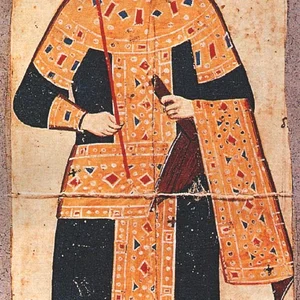
During ceremonies, the emperor wore the loros, an imperial scarf embroidered with gold and gemstones wound around the body, a symbol of sovereign dignity since ancient Rome. In daily life, he dressed in a purple silk tunic (the colour reserved for emperors), an embroidered dalmatic, and purple shoes. On campaign, he traded these ornaments for heavy cavalry armour with chainmail and helmet.
Housing
Andronikos III resided primarily at the Palace of Blachernae, in the northwest of Constantinople, a fortified palace overlooking the land walls and the Golden Horn. This palatial complex comprised private apartments, throne rooms, chapels, gardens, and barracks for the guard. During military campaigns, the emperor lived in a richly decorated command tent, surrounded by his general staff.
Historical Timeline
Period Vocabulary
Liens externes & ressources
Références
Œuvres
Réforme judiciaire : création des juges catholiques
1329
Reconquête de Chios
1329
Réintégration de la Thessalie dans l'Empire
1333
Réintégration partielle de l'Épire
1337
Campagne navale en mer Égée
1329-1335