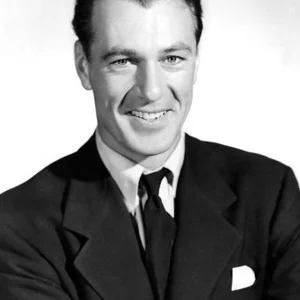

Gary Cooper (1901-1961) was one of the leading actors of classical Hollywood cinema. The embodiment of the upright, taciturn American hero, he left his mark on the western and the melodrama before winning two Academy Awards for Best Actor.
Gary Cooper(1901 — 1961)
Gary Cooper
États-Unis
7 min read
Frequently asked questions
Key Facts
- Born on May 7, 1901 in Helena, Montana, he started out as an extra and stuntman in Hollywood in the 1920s
- Brought to fame by westerns and adventure films, he became one of the biggest stars of the 1930s-1940s
- Won the Academy Award for Best Actor in 1942 for Sergeant York
- Played Sheriff Will Kane in High Noon (1952), which earned him a second Oscar in 1953
- Received an Honorary Academy Award in 1961, shortly before his death on May 13, 1961 in Los Angeles
Works & Achievements
One of his first major talking roles, which cemented his image as the upright, taciturn cowboy.
Opposite Marlene Dietrich, he confirmed his status as a screen seducer and international star.
An adaptation of Hemingway's novel that revealed his dramatic and romantic range.
A Frank Capra comedy in which he became the embodiment of the honest ordinary man standing up to corruption.
A biography of a hero of the First World War that earned him his first Academy Award for Best Actor.
A moving portrait of baseball champion Lou Gehrig, one of his roles most beloved by audiences.
Based on Hemingway, set during the Spanish Civil War; here he formed a famous on-screen couple with Ingrid Bergman.
A real-time Western about a marshal abandoned by everyone; his most legendary role, crowned with a second Oscar.
Anecdotes
At birth, Gary Cooper was named Frank James Cooper. It was his agent Nan Collins who suggested the first name “Gary,” in honor of her hometown, Gary, Indiana. The future western hero thus inherited the name of an industrial steel city.
Cooper grew up on a Montana ranch and had known how to ride horses since childhood. It was this talent as a genuine horseman that opened Hollywood's doors for him: he was first hired as a stuntman and extra in silent westerns before becoming a star.
To portray baseball champion Lou Gehrig in *The Pride of the Yankees* (1942), Cooper faced a problem: he was right-handed while Gehrig batted left-handed. The solution was clever: they had him wear a jersey with the letters reversed, run toward third base, and then they flipped the film.
When Cooper won the Academy Award for Best Actor for *High Noon* (1952), he was filming abroad and could not come to collect it. It was his friend John Wayne who took the stage to accept the statuette on his behalf.
War hero Alvin York, whose life was brought to the screen in *Sergeant York* (1941), personally insisted that it be Gary Cooper, and no one else, who portray him. Cooper won his first Academy Award for that role.
Primary Sources
I turned down quite a few scripts because I thought they were tinged with communist ideas, but I'd be hard pressed to name a single title today.
To get people to like you, I had figured out, you had to sell them the idea that you were them — the fellow next door.
We all love you, Coop. And since I know you're watching us tonight, I want to say good night to you.
Key Places
Gary Cooper's hometown, in a region of the American Northwest shaped by ranching and the spirit of the frontier. He spent part of his childhood on a family ranch.
English town where Cooper was sent to study as a child, at Dunstable Grammar School. There he acquired a British education before returning to the United States.
The institution where Cooper continued his studies in Iowa. He dropped out to try his luck as a cartoonist and then as an actor.
The studio where Cooper built the bulk of his career in the 1930s, under the studio system. There he turned out westerns, dramas, and comedies one after another.
The city where Cooper lived at the heart of the film world and where he died in 1961. The center of the Hollywood industry was the backdrop of his entire adult life.
Typical Objects

The wide-brimmed cowboy hat, inseparable from Cooper's silhouette in his westerns. On its own, it symbolized the hero of the American West.

The iconic handgun of cinema's cowboys and marshals, which appears in the famous final showdown of “High Noon.” Often a harmless replica used as a prop.

The tin star-shaped badge worn by Sheriff Will Kane in “High Noon.” It represents duty and the authority of the law in the face of the town's cowardice.

The heavy studio camera of the 1930s–1950s, which captured Cooper's understated acting on film. With the arrival of sound, it was shut away in a soundproofed booth.

The golden trophy awarded by the Academy of Motion Picture Arts and Sciences. Cooper won two for best actor, then a third, honorary one, shortly before his death.

The bound text containing dialogue and stage directions, which the actor learned scene by scene. Cooper was known for his minimalist, word-sparing acting.

With the arrival of talking pictures, the microphone hung from a pole became indispensable. It demanded careful diction from actors and hastened the end of many silent-film careers.

Leather boots with a beveled heel, originally designed to stay in the stirrups. They completed the costume of the western hero that Cooper so often played.
School Curriculum
Vocabulary & Tags
Key Vocabulary
Tags
Daily Life
Morning
During filming, Cooper would rise early to reach the studio at dawn. Makeup, costume, and hairstyling filled the first hours before the cameras started rolling. Days on set were long and tightly scheduled by the production.
Afternoon
Afternoons were spent doing take after take under the director's guidance, often waiting long hours between scenes. Cooper, known for being reserved and sparing in his gestures, refined a natural style of acting that seemed effortless. Away from filming, he loved to escape into nature.
Evening
In the evening, Hollywood life blended dinners, studio parties, and film premieres. Cooper mingled with the cinema elite, yet remained attached to a certain simplicity. He was happy to head home and enjoy his family and his hobbies.
Food
A great lover of the outdoors, Cooper enjoyed hearty American-style meals, with meats and filling dishes. His life as a star also led him to frequent the fashionable restaurants of Los Angeles. Toward the end of his life, ulcers forced him to watch his diet.
Clothing
On screen, Cooper wore the western outfit — a Stetson hat, boots, and a leather jacket — or the uniform of his soldier roles. In everyday life, he was known as an elegant man, fond of well-made suits and finely tailored sportswear.
Housing
Like the great stars of the era, Cooper lived in vast mansions in the affluent neighborhoods of Los Angeles, particularly around **Beverly Hills** and **Holmby Hills**. Passionate about the outdoors, he loved hunting, fishing, and getaways far from the bustle of the studios.
Historical Timeline
Period Vocabulary
Liens externes & ressources
Références
Œuvres
The Virginian (Le Justicier)
1929
Cœurs brûlés (Morocco)
1930
L'Adieu aux armes (A Farewell to Arms)
1932
L'Extravagant Mr. Deeds
1936
Sergent York (Sergeant York)
1941
Vers sa destinée (The Pride of the Yankees)
1942
Pour qui sonne le glas (For Whom the Bell Tolls)
1943