 flip
flipDampfnudeln mit Vanillesoße (Steamed Yeast Dumplings with Vanilla Custard)
Dampfnudeln mit Vanillesoße (Steamed Yeast Dumplings with Vanilla Custard)
Why this dish? Dampfnudeln are an emblematic sweet treat of Bavaria and the Palatinate: a pillow of leavened dough steamed in a pot, with a caramelized crust on the bottom. In a frugal household like Ohm's, such a Mehlspeise served as a Sunday meal, comforting and inexpensive.
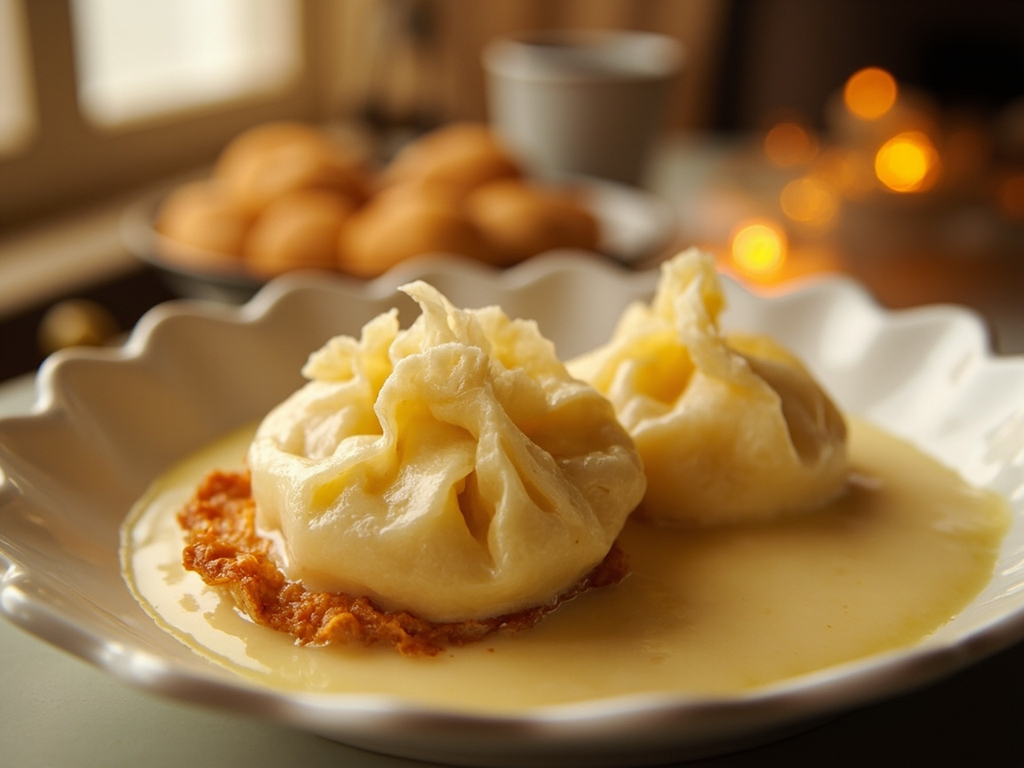
Balls of leavened dough cooked covered in a little milk and butter: the steam puffs them up while a golden crust forms on the bottom. They are topped with a vanilla custard for a soft and caramelized bite.
Here is a treat from our homeland that ruins no one — a little flour, milk, and patience suffice. The secret lies in one thing: once the lid is on, do not lift it! The steam makes the balls rise while a golden, crunchy bottom forms in the pot. Serve them drizzled with a mild custard, and you will see that a physicist knows how to appreciate a well-rounded Sunday. It was the sweet reward of a modest household.
- •Wheat flour — a good measure (dough)
- •Sourdough or brewer's yeast — a little (leavening)
- •Milk — as needed for dough (dough and cooking)
- •Butter — a knob (crust)
- •Egg — one (richness)
- •Sugar, salt — a little (flavor)
Dampfnudeln mit Vanillesoße (Steamed Yeast Dumplings with Vanilla Custard)
Balls of leavened dough cooked covered in a little milk and butter: the steam puffs them up while a golden crust forms on the bottom. They are topped with a vanilla custard for a soft and caramelized bite.
Why this dish? Dampfnudeln are an emblematic sweet treat of Bavaria and the Palatinate: a pillow of leavened dough steamed in a pot, with a caramelized crust on the bottom. In a frugal household like Ohm's, such a Mehlspeise served as a Sunday meal, comforting and inexpensive.
Here is a treat from our homeland that ruins no one — a little flour, milk, and patience suffice. The secret lies in one thing: once the lid is on, do not lift it! The steam makes the balls rise while a golden, crunchy bottom forms in the pot. Serve them drizzled with a mild custard, and you will see that a physicist knows how to appreciate a well-rounded Sunday. It was the sweet reward of a modest household.
Ingredients (period version)
- Wheat flour — a good measure (dough)
- Sourdough or brewer's yeast — a little (leavening)
- Milk — as needed for dough (dough and cooking)
- Butter — a knob (crust)
- Egg — one (richness)
- Sugar, salt — a little (flavor)
Ingredients
- All-purpose flour (T45) — 300 g (dough)
- Baker's yeast — 1 packet (7 g dry) (leavening)
- Milk — 150 ml (dough) + 200 ml (cooking) (dough and steam)
- Butter — 40 g + 20 g for cooking (crust)
- Egg — 1 (richness)
- Sugar — 40 g (flavor)
- Salt — 1 pinch (balance)
- For the custard: milk — 250 ml (sauce base)
- Egg yolks — 2 (thickener)
- Sugar + vanilla bean — 30 g + 1 (vanilla custard)
Method
- Prepare a leavened dough: mix flour, yeast dissolved in warm milk, egg, sugar, salt, and soft butter; knead and let double in size, about 1 hour.
- Shape into balls, let rise again for 20 min.
- In a heavy-bottomed pot, melt the butter with the milk, a pinch of salt, and a little sugar; place the balls in without crowding.
- Cover tightly and cook over low heat for 25-30 min WITHOUT ever lifting the lid: the milk evaporates and a crust caramelizes at the bottom.
- Prepare the custard: heat the milk with the vanilla, pour over beaten yolks with sugar, thicken gently without boiling.
- Serve the Dampfnudeln crust side up, drizzled with warm vanilla custard.
How it was made : Dampfnudeln were cooked in a heavy cast-iron pot on the stove; the sign of successful cooking was the final sizzle as the evaporated milk left the bottom to caramelize. Vanilla remained a luxury: modest households often made do with sweetened milk, fruit compote, or plum sauce.
The contemporary twist : A quenelle of very cold vanilla custard on the hot Dampfnudel, a hot-cold contrast, with a shard of caramelized crust stuck on top.
Sources : Henriette Davidis, Praktisches Kochbuch für die gewöhnliche und feinere Küche (1845)
Georg Ohm · Charactorium