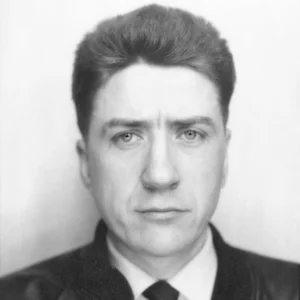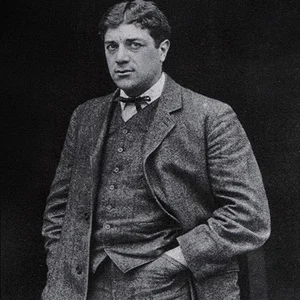

Georges Braque was a French painter, sculptor, and printmaker, a major figure in 20th-century art. Together with Pablo Picasso, he invented Cubism between 1907 and 1914, revolutionizing the representation of space and form in modern painting.
Georges Braque(1882 — 1963)
Georges Braque
France
5 min read
Frequently asked questions
Famous Quotes
« Art is meant to disturb, science reassures.»
« Truth exists; only lies are invented.»
Key Facts
- Born in 1882 in Argenteuil, died in 1963 in Paris
- Took part in the Fauvist movement around 1905-1906
- Invented Cubism with Pablo Picasso between 1907 and 1914
- Developed the papier collé technique in 1912
- First living artist to be exhibited at the Louvre Museum in 1961
Works & Achievements
A landscape of geometric volumes that prompted the remark about “cubes”: the birth certificate of Cubism.
A foundational canvas in which Braque reduces nature to planes and facets, following in Cézanne's footsteps.
A masterpiece of Analytic Cubism, one of the first paintings to incorporate stencilled letters and numbers.
The first papier collé in the history of art: Braque incorporates a paper imitating wood, inventing collage.
A major work of Synthetic Cubism blending painting, collage and typographic letters.
Large black birds on a blue ground decorating the Henri II room; a recurring theme of his maturity.
A cycle of eight large, meditative canvases on the space of the studio, the summit of his late work.
Anecdotes
In 1908, the critic Louis Vauxcelles mocked Braque's paintings exhibited at Kahnweiler's gallery by referring to them as “little cubes.” Without meaning to, he had just given Cubism its name — the movement Braque invented with Picasso.
Braque and Picasso worked so closely between 1909 and 1914 that they sometimes refused to sign the fronts of their canvases, so that one artist's hand could no longer be told from the other's. Picasso compared their pairing to two mountaineers roped together on the same mountain.
A former apprentice house painter, Braque knew how to imitate fake wood grain and faux marble. He brought these craftsman's techniques into his paintings and, in 1912, invented the *papier collé* by slipping pieces of wood-patterned wallpaper into his compositions.
A volunteer enlistee in 1914, Braque was severely wounded in the head in 1915 at Carency: he was trepanned and was left blind for a time. After a long convalescence, he took up painting again in 1917, but his style grew calmer and more personal.
Toward the end of his life, Braque became the first living painter to be exhibited at the Louvre: in 1953, he was entrusted with decorating a ceiling in the Henri II room, adorned with large black birds against a blue background.
Primary Sources
“The senses deform, the mind forms.” Braque also offers this maxim here: “I love the rule that corrects emotion.”
The first theoretical work devoted to the movement, it presents Braque and Picasso as the initiators of a painting that rejects imitation and reconstructs the object in space.
“Art is meant to disturb. Science reassures.” A collection of notes and aphorisms written by the painter about his craft.
The gallery owner who bought Braque's first “Cubist” canvases as early as 1908 describes the close daily collaboration between Braque and Picasso in Montmartre.
Key Places
Braque's birthplace, in the Paris suburbs, in 1882.
City where Braque grew up and learned the trade of decorative painter before studying at the École des Beaux-Arts.
The artists' studio district where Braque mixed with Picasso and invented Cubism between 1907 and 1914.
Village near Marseille where Braque painted, in 1908, the geometric landscapes that gave rise to the word “Cubism.”
Village in Normandy where Braque owned a house-studio and found the inspiration for his final works.
City where Braque died in 1963; he received a state funeral on the forecourt of the Louvre.
Typical Objects

Surface on which the painter mixes colors. Braque favored muted tones — ochres, grays, browns — during the Cubist period.

Pieces of paper imitating wood or marble, which he glued onto the canvas. This 1912 invention paved the way for collage in modern art.

A house painter's tool that he repurposed to imitate wood grain in his paintings, a legacy of his apprenticeship.

A recurring motif in his Cubist still lifes, as in Picasso's work. Music structures the composition of many paintings.

Everyday objects of the Parisian café, omnipresent in Cubist still lifes where newspaper letters are stenciled in paint.

A template for painting regular letters onto the canvas. Braque was one of the first to introduce words and numbers into painting.
School Curriculum
Vocabulary & Tags
Key Vocabulary
Daily Life
Morning
Braque often started his day early in his studio, in the calm and silence he sought. Methodical and patient, he prepared his colors and observed a canvas at length before touching it.
Afternoon
The afternoon was devoted to the slow, thoughtful work of painting. During the Cubist years, he would visit Picasso to compare their research and discuss their discoveries.
Evening
In the evening, Braque frequented the cafés of Montmartre and Montparnasse where poets and painters such as Apollinaire gathered. Later in his life, he preferred the quiet of his home and listening to music.
Food
Like the Parisians of his time, he shared bistro and café meals. His still lifes bear witness to this modest table: bread, fruit, a glass of wine, and a newspaper lying beside them.
Clothing
In the studio, he wore a work smock inherited from his trade as a craftsman. In town, he dressed with the understated elegance of an early-twentieth-century bourgeois, in suit and hat.
Housing
Braque first lived in the modest studios of Montmartre, then in more comfortable houses in Paris and in Normandy, at Varengeville, where he set up a large, light-filled studio.
Historical Timeline
Period Vocabulary
Liens externes & ressources
Références
Œuvres
Maisons à l'Estaque
1908
Le Viaduc à l'Estaque
1908
Compotier et verre
1912
Les Oiseaux (plafond du Louvre)
1953
Série des Ateliers
1949-1956